

Maddy summaryHR 2509, the COMPLETE Care Act, creates Medicare payment incentives for primary care providers who integrate specific behavioral health services into their practice. It directly affects Medicare providers offering services identified by HCPCS codes 99484, 99492, 99493, 99494, G2214, and G0323 (covering models like Collaborative Care and Primary Care Behavioral Health) during 2027-2029. The bill increases Medicare payments for these services to 125-175% of standard rates (phasing down from 175% in 2027 to 125% in 2029) and waives budget neutrality rules to fund these higher payments. Additionally, it requires the HHS Secretary to provide technical assistance to primary care practices adopting these models by 2026, with dedicated funding for 2025-2029.
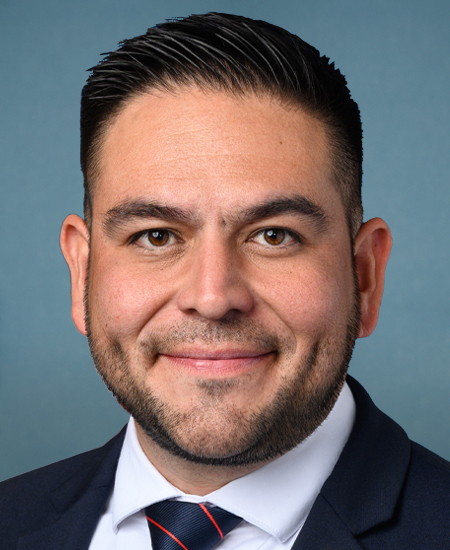
Rep. Gabe Vasquez
Sponsored bills
Maddy summaryThis bill establishes special base pay rates for wildland firefighters employed by the Forest Service or Department of the Interior, increasing their base pay by specific percentages (from 1.5% to 42%) based on their grade. It creates "incident response premium pay" at 450% of hourly rate for firefighters deployed to respond to qualifying wildfire incidents, with a yearly maximum of $9,000. The bill also provides for paid rest and recuperation leave following wildfire incident response. These provisions replace temporary pay increases that were previously authorized under other legislation and directly affect wildland firefighters who perform duties related to wildland fires.
Amplifying Processing of Livestock in the United States Act or the A–PLUS Act This bill directs the Department of Agriculture (USDA) to revise its regulations to allow certain packers to hold an ownership interest in, finance, or participate in the management or operation of a market agency selling livestock on a commission basis. The bill applies to packers that have a cumulative slaughter capacity of (1) less than 2,000 animals per day or 700,000 animals per year with respect to cattle or sheep, and (2) less than 10,000 animals per day or 3 million animals per year with respect to hogs. In addition, USDA must revise its regulations to include a disclosure requirement for a market agency that has an ownership interest in, finances, or participates in the management or operation of a packer. Specifically, the market agency must disclose the existence of such ownership interest, financial relationship, or participation.
Save America's Forgotten Equines Act of 2025 or the SAFE Act of 2025 This bill permanently prohibits the slaughter of equines (e.g., horses and mules) for human consumption. (Current law prohibits the slaughter of dogs and cats for human consumption. This bill extends the prohibition to equines.) Specifically, this bill prohibits a person from knowingly (1) slaughtering an equine for human consumption; or (2) shipping, transporting, possessing, purchasing, selling, or donating an equine to be slaughtered for human consumption or equine parts for human consumption. The bill subjects a violator to a fine. The bill applies to conduct in or affecting interstate or foreign commerce or within the special maritime and territorial jurisdiction of the United States. However, it does not apply to an activity carried out by an Indian for a religious ceremony. As background, in recent years, the appropriations acts have prohibited the Department of Agriculture (USDA) from using federal funds to inspect horses before they are slaughtered for human consumption. Therefore, there are currently no USDA-inspected horse slaughter facilities in the United States.
Delivering for Rural Seniors Act of 2025 This bill directs the Food and Nutrition Service (FNS) to award competitive grants to state agencies under a home delivery pilot program for participants in the Commodity Supplemental Food Program (CSFP). As background, the CSFP works to improve the health of low-income persons at least 60 years of age by supplementing their diets with nutritious Department of Agriculture foods. Under the pilot program, a state agency must distribute grant funds to an eligible entity (i.e., a local agency or subdistributing agency) to operate projects that facilitate home delivery of commodities to CSFP participants. Grant funds may be used for costs associated with transportation and distribution of commodities to CSFP participants, staffing required to operate home delivery services, and home delivery outreach to CSFP participants or potential participants. A state agency must prioritize eligible entities that serve CSFP participants who reside in rural areas. A state agency must also submit an annual report to FNS about the project, including best practices regarding the use of home delivery to improve the effectiveness of the CSFP.
Maddy summaryHR 2467, America's Red Rock Wilderness Act, would designate approximately 1.3 million acres of public land across Utah as wilderness areas, protecting them from development and managing them for conservation. The bill specifically designates 77 wilderness areas in the Great Basin and Colorado Plateau regions, including lands within existing national monuments like Grand Staircase-Escalante and Bears Ears. It includes provisions for water rights protection, allows continued livestock grazing under certain conditions, and withdraws the designated lands from mining and mineral leasing. The bill also ensures Tribal rights are protected and requires the Secretary of the Interior to administer these areas according to wilderness management standards.
Maddy summaryHR 2398, the Rural Veterinary Workforce Act, amends federal tax law to exempt certain student loan repayment or forgiveness assistance from income tax for veterinarians working in rural areas. It specifically expands existing tax exclusions to include programs under the National Agricultural Research, Extension, and Teaching Policy Act (7 U.S.C. 3151a) and similar state-level programs designed to increase rural veterinary access. This change directly affects veterinarians participating in qualifying loan repayment or forgiveness programs in states prioritizing rural veterinary services. The policy change modifies IRS tax treatment to reduce the financial burden on veterinarians serving underserved rural communities.
Maddy summaryThis bill renames the Department of Veterans Affairs community-based outpatient clinic in Las Cruces, New Mexico, as the "Las Cruces Bataan Memorial Clinic." It directly affects the clinic and all federal documents referencing it by updating the official name. The key provision requires all future references in laws, regulations, maps, records, or other government materials to use the new name. The bill does not change clinic services, funding, or operations - only the facility's designation. It honors the historical significance of the Bataan Memorial.
TAP Promotion Act This bill requires that pre-separation counseling under the Transition Assistance Program include a presentation that promotes the benefits available to veterans from the Department of Veterans Affairs (VA). The bill also requires the VA to annually report on the presentation to (1) identify veterans service organizations that participate, (2) provide the number of members of the Armed Forces who attend, and (3) provide any recommendations for changes to the presentation.
Maddy summaryThis bill expands transportation assistance for rural veterans by updating a Department of Veterans Affairs grant program. It allows grants to be awarded to county veterans service organizations and tribal organizations, in addition to existing recipients, and increases the maximum grant amount to $80,000 for organizations needing to purchase ADA-compliant vehicles. The bill defines "rural" using the USDA's Rural-Urban Commuting Areas (RUCA) system and removes fixed annual funding limits, allowing for flexible budgeting. It directly affects rural veterans who need transportation to healthcare facilities and the organizations that provide this service.