

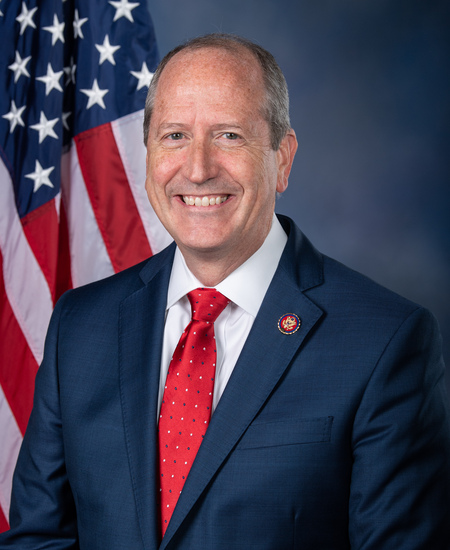
This resolution expresses the sense of the House of Representatives that former President Trump did not engage in insurrection or rebellion against, nor give aid or comfort to the enemies of, the United States.
Rep. Dan Bishop
Sponsored bills
Maddy summaryHJRES 107 is a congressional resolution seeking to block a Federal Communications Commission (FCC) rule published on January 22, 2024 (89 Fed. Reg. 4128). The resolution aims to disapprove the FCC's rule implementing digital discrimination protections under the Infrastructure Investment and Jobs Act, which would have required internet providers to prevent discriminatory practices. If passed, this resolution would nullify the FCC rule, preventing it from taking effect under the Congressional Review Act (Chapter 8 of Title 5, U.S. Code). The bill directly affects the FCC's regulatory authority over digital discrimination enforcement in broadband services.
Maddy summaryThis bill repeals a law (18 U.S.C. § 1715) that previously prohibited mailing firearms without a license. It directly affects the U.S. Postal Service, firearm sellers, and individuals mailing firearms by preventing the Postal Service from creating rules that would block firearm mailings or require disclosure of sensitive records like sales receipts or firearm serial numbers. Key provisions include removing the existing ban on mailing firearms and prohibiting the Postal Service from imposing new restrictions on firearm mailings or demanding customer transaction data. The bill ensures that firearm mailings can proceed without these specific federal restrictions, while applying to ongoing legal cases under the repealed law.
Maddy summaryHRES 974 is a non-binding House resolution supporting the designation of January 21-27, 2024, as "National School Choice Week." It encourages parents to learn about K-12 education options - including public schools, charter schools, private schools, and homeschooling - and promotes public awareness of educational choice. The resolution does not create new laws or policies but formally expresses the House's backing for this annual observance. It directly affects parents and students by highlighting available education pathways and urging communities to host events celebrating school choice. The resolution was introduced by multiple House members and referred to the Education Committee.
Maddy summaryThe Death Tax Repeal Act would eliminate the federal estate tax and generation-skipping transfer tax for estates of people who die on or after the bill's enactment date, and for generation-skipping transfers made after that date. It would also establish a new $10 million lifetime gift tax exemption (adjusted annually for inflation) and replace the existing gift tax rate schedule with a revised structure. These changes would primarily affect high-net-worth individuals and their heirs, as the estate tax and gift tax typically apply to large estates or gifts exceeding the new exemption threshold. The bill's provisions would take effect on the date of enactment, with transitional rules for the year the bill is signed into law.
Maddy summaryThis bill clarifies that tax-exempt status for charities (under IRS Section 501(c)(3)) does not count as "federal financial assistance" for other federal programs. It directly affects tax-exempt organizations, such as charities and religious groups, by preventing their tax exemption from automatically qualifying them for other federal benefits or programs. The key provision amends the U.S. Code to define "federal financial assistance" as excluding tax exemptions, ensuring these organizations aren't mistakenly included in programs meant for recipients of direct federal funds. This change applies prospectively and does not alter how tax exemptions were treated before the bill's enactment.
Maddy summaryHR 788, the Stop Settlement Slush Funds Act of 2023, prohibits federal agencies from entering settlement agreements that direct payments to third parties (other than the U.S. government) unless the payment directly reimburses actual harm caused by the defendant or covers services related to the case. It requires agencies to report annually on such settlements to Congress and mandates annual audits by agency Inspectors General to ensure compliance. The law applies to all federal agencies entering settlements after its enactment and includes a 7-year sunset provision. This directly affects how federal agencies handle settlements in civil cases, limiting their ability to divert settlement funds to external entities without clear, direct justification.
Maddy summaryThis bill permanently cancels unused funds from the Department of Commerce's Nonrecurring Expenses Fund, which were set aside under the 2023 Fiscal Responsibility Act. It specifies that this cancellation won't count toward federal budget caps or allocation rules under existing budget laws. The bill directly affects how leftover government funds are handled within the Commerce Department's budget, eliminating a specific account for nonrecurring expenses.
This bill allows creditors to consider an applicant’s immigration status for certain purposes when assessing an application for an extension of credit. In particular, considering an applicant’s U.S. immigration status for the purpose of determining the creditor's rights and remedies applicable to the particular extension of credit does not constitute discrimination.
Maddy summaryHR 6734 prohibits the use of federal funds to finalize, implement, or enforce the Bureau of Alcohol, Tobacco, Firearms, and Explosives' (ATF) proposed rule (2022R-17) defining "engaged in the business as a dealer in firearms." This bill directly affects the ATF by blocking funding for this specific regulatory rule, which was proposed in August 2023. The legislation does not create new requirements but prevents federal resources from being used to advance this particular ATF regulation.