

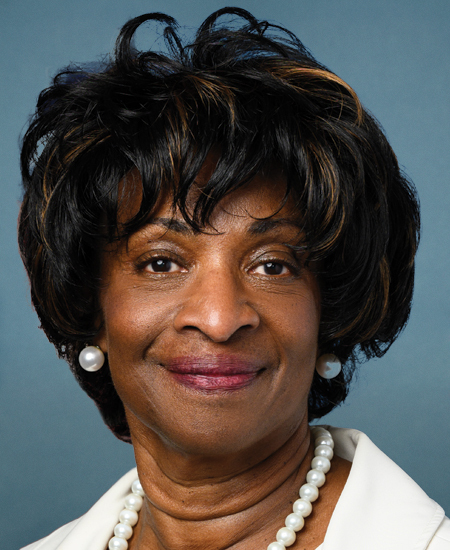
Photo of Valerie P. Foushee
D United States House · District 4 · North Carolina On the 2026 ballot

Rep. Valerie P. Foushee

Compare
Total votes
1,879
all sessions
Attendance
97%
54 missed
Near the chamber average
With party
98%
of cast votes
Near the chamber average
Bipartisan score
1%
crosses aisle rarely
Near the chamber average
Sponsored
896
bills & resolutions
Higher than 84% of chamber peers
Committees
6
assignments
896 bills and resolutions

Sponsored bills

Total
896
Primary
47
Co-sponsor
849
This page
896
matching current filters
Primary HRES 998
In committee · United States House · Lead sponsor
Expressing support for the designation of February 4, 2024, as "Transit Equity Day".

This resolution honors the life and legacy of Rosa Parks by nationally recognizing Transit Equity Day. The resolution also encourages the use of public transportation and the continued work to make public transit accessible for all.

In committee Feb 6, 2024 0 co-sponsors
Co-sponsor HR 7210
In committee · United States House · Co-sponsor
Help America Run Act

Maddy summaryHR 7210, the Help America Run Act, allows campaign funds to cover essential personal expenses like child care, elder care, and health insurance premiums for candidates running for office. This amendment to the Federal Election Campaign Act (Section 313) treats these payments as authorized campaign expenses if necessary for campaign activities, while limiting total payments to the same cap as candidate salary. The bill directly affects working parents, caregivers, and lower-income candidates who might otherwise be unable to run due to unaffordable basic living costs. It aims to remove financial barriers that currently prevent many everyday Americans from seeking office, particularly impacting working mothers and caregivers. The policy change does not alter overall campaign finance limits but expands permissible uses of campaign funds for critical personal needs.

In committee Feb 1, 2024 1 co-sponsor
Co-sponsor HR 7132
In committee · United States House · Co-sponsor
Housing Supply and Affordability Act

Maddy summaryHR 7132 creates a federal grant program to help state and local governments, tribes, and Native Hawaiian organizations develop and implement housing plans. Grants fund both planning (creating strategies) and implementation (putting strategies into action) to increase housing supply and affordability while avoiding displacement of current residents. At least 10% of funds must support rural communities, and recipients must report annually on progress and submit final evaluations after three years. The program requires comprehensive plans addressing housing needs, land use reforms, and community engagement to expand housing options.

In committee Jan 30, 2024 1 co-sponsor
Co-sponsor HR 7095
In committee · United States House · Co-sponsor
Redistricting Transparency and Accountability Act of 2024

Maddy summaryHR 7095 requires states conducting congressional redistricting to establish public internet portals with real-time access to maps, demographic data, and proposed plans. It mandates multiple regional public hearings with virtual options, 72-hour posting of all public comments, and detailed analysis of proposed plans - including population breakdowns, voting history, partisan fairness, and Voting Rights Act compliance. States must also provide accessible materials in languages required under the Voting Rights Act and maintain all redistricting data online for 10 years. The law applies to redistricting after the 2030 census, with limited retroactive application for states still revising 2020 census plans.

In committee Jan 30, 2024 1 co-sponsor
Co-sponsor HR 6747
In committee · United States House · Co-sponsor
Clean Electricity and Transmission Acceleration Act of 2023

Maddy summary# Summary of the Clean Electricity and Transmission Acceleration Act of 2023 This comprehensive legislation establishes significant reforms across environmental policy, energy infrastructure, and community engagement frameworks. Key provisions include: 1. **Environmental Justice Framework**: - Creates an Office of Environmental Justice and External Civil Rights at EPA - Establishes a White House Environmental Justice Interagency Council - Prohibits disparate impact discrimination under Title VI of the Civil Rights Act - Requires community impact reports for Federal actions affecting environmental justice communities 2. **NEPA Reforms**: - Mandates 90-day public comment periods for environmental justice communities - Requires translation of documents into languages spoken by 5%+ of affected communities - Requires assessment of cumulative impacts, including historical pollution - Requires climate change impact assessments using social cost of carbon - Establishes searchable digital archives of NEPA documents 3. **Community Engagement Requirements**: - Creates "Senior Community Engagement Officers" and "Tribal Community Engagement Officers" at all federal agencies - Requires community benefits agreements for major projects - Establishes grants for capacity building in environmental justice communities - Creates an E-NEPA permitting portal for public access to documents 4. **Energy Policy Provisions**: - Includes reforms for FERC (Federal Energy Regulatory Commission) environmental justice liaison - Establishes requirements for intervenor funding at FERC - Contains provisions for transmission planning and infrastructure 5. **Tribal Consultation**: - Strengthens tribal consultation requirements for projects affecting tribal lands - Requires government-to-government relationships with tribal nations The legislation represents a significant shift toward integrating environmental justice considerations throughout the federal permitting and review process, with specific requirements for meaningful community engagement, transparency, and consideration of cumulative impacts on vulnerable populations. It also establishes new funding mechanisms and administrative structures to support these environmental justice goals.

In committee Jan 25, 2024 1 co-sponsor
Co-sponsor HR 7056
In committee · United States House · Co-sponsor
Access to Family Building Act

Maddy summaryHR 7056, the Access to Family Building Act, establishes federal rights for individuals to access assisted reproductive technology (ART) like IVF without unreasonable restrictions, directly affecting patients seeking fertility treatments and health care providers offering ART services. The bill prohibits states from imposing limitations on ART that are more burdensome than those for comparable medical procedures, fail to advance safety, or unduly restrict access, while allowing health and safety regulations that are necessary and least restrictive. It creates federal enforcement mechanisms, including lawsuits by the Attorney General or affected individuals to challenge violating state laws, and preempts conflicting state regulations. The bill explicitly preserves state authority over health/safety regulations and does not alter existing state insurance coverage laws for ART.

In committee Jan 19, 2024 1 co-sponsor
Co-sponsor HR 7039
In committee · United States House · Co-sponsor
Stronger Communities through Better Transit Act

Maddy summaryThe Stronger Communities through Better Transit Act establishes a new federal grant program to improve public transportation service. It provides funding to urban areas, states, and Indian tribes to cover up to 50% of public transit operating costs (up to 80% in persistent poverty areas and 100% for Indian tribes), with requirements to report on service frequency, access to jobs, and conduct community surveys. The program mandates that a majority of funds must benefit underserved communities and areas of persistent poverty, defined as census tracts with high poverty rates or minority populations. Recipients must maintain their transit funding levels and report on improvements in access to essential services. The bill authorizes $20 billion annually for fiscal years 2024-2027.

In committee Jan 18, 2024 1 co-sponsor
Co-sponsor HRES 962
In committee · United States House · Co-sponsor
Honoring Reverend Dr. Martin Luther King, Jr., by Celebrating Diversity, Promoting Tolerance, and Condemning Hate.

Maddy summaryHRES 962 is a ceremonial resolution honoring Reverend Dr. Martin Luther King, Jr.'s legacy, specifically celebrating his 95th birthday on January 15, 2024. It symbolically affirms his teachings by condemning hate, discrimination, and prejudice against Black Americans, Indigenous people, Jewish, Asian-American/Pacific Islander, Muslim, Hispanic/Latino communities, and LGBTQ+ individuals. The resolution does not create new laws or affect any policies - it solely expresses the House's support for Dr. King's values of diversity, tolerance, and equality through non-binding statements. As a symbolic gesture, it has no legal effect or direct impact on any group or individual.

In committee Jan 12, 2024 1 co-sponsor
Co-sponsor HR 6929
In committee · United States House · Co-sponsor
Affordable Connectivity Program Extension Act of 2024

Maddy summaryThe Affordable Connectivity Program Extension Act of 2024 allocates $7 billion in funding for the Affordable Connectivity Program (ACP) during fiscal year 2024. The ACP provides subsidies to low-income households to help cover the cost of internet service and connected devices like laptops or tablets. This funding ensures the program can continue supporting eligible households throughout the year, with the money remaining available until fully spent. The bill extends existing program funding without changing eligibility criteria or service requirements.

In committee Jan 10, 2024 1 co-sponsor
Co-sponsor HR 1734
Signed into law · United States House · Co-sponsor
TRANQ Research Act of 2023

Maddy summaryThe TRANQ Research Act of 2023 requires the National Institute of Standards and Technology (NIST) to coordinate research on illicit drugs containing xylazine, novel synthetic opioids, and other concerning substances. The bill mandates NIST to develop faster detection methods, create data tools for identifying these substances, and consult with agencies like the DEA, CDC, and National Institute on Drug Abuse to establish safe handling practices. NIST must also form partnerships with universities, federal labs, and the private sector to improve detection capabilities. Within one year, NIST must report to Congress on its implementation, and the Comptroller General must conduct a study on federal capabilities to respond to new psychoactive substances, reporting within two years.

Signed into law Dec 19, 2023 1 co-sponsor
Showing 661 to 670 of 896 bills
Previous 1 … 66 67 68 … 90 Next