Fairness for Federal Contractors Act of 2021 This bill prohibits executive agencies from requiring contractors to receive a COVID-19 vaccination. The bill also requires the Government Accountability Office to study the degree to which Executive Order 14042 (Ensuring Adequate COVID Safety Protocols for Federal Contractors) caused disruptions to federal contracts, supply chains, and transportation systems.
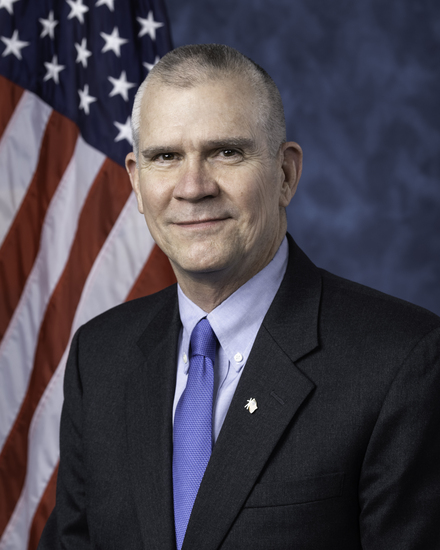
Rep. Matthew M. Rosendale, Sr.
Sponsored bills
This joint resolution nullifies a Department of Labor emergency temporary standard for preventing the transmission of COVID-19 in employment settings. Under the standard issued on November 5, 2021, employers with 100 or more employees must require their onsite employees to either be fully vaccinated against COVID-19 or undergo weekly COVID-19 testing.
This concurrent resolution declares that Congress should not impose any new performance fee, tax, royalty, or other charge relating to the public performance of sound recordings on a local radio station for broadcasting sound recordings over the air, or on any business for such public performance of sound recordings.
Lawless Cities Accountability Act of 2021 This bill prohibits federal funding for a jurisdiction that is a lawless jurisdiction. The term lawless jurisdiction means a state or political subdivision of a state that does one of the following: forbids law enforcement from intervening to restore order during widespread violence or destruction, withdraws law enforcement protection from an area or structure that law enforcement officers are lawfully entitled to access, disempowers or defunds law enforcement agencies, or refuses to accept law enforcement assistance from the federal government amid widespread violence or destruction.
This bill prohibits the use of federal funds to require a member of the Armed Forces to receive a COVID-19 vaccination. The bill also prohibits adverse action (e.g., punishment) being taken against a member of the Armed Forces because the member refuses to receive a COVID-19 vaccination.
Championing our Parents Act of 2021 This bill prohibits the use of federal funds to facilitate certain law enforcement partnerships to address threats against school personnel.
Simon Crosier Act This bill requires hospitals and other health care providers, as a condition of Medicare and Medicaid participation, to have certain written policies and procedures in place that limit the implementation of do-not-resuscitate (DNR) orders for unemancipated minors in accordance with specified criteria. Among other provisions, such policies and procedures must (1) require the informed consent of at least one parent and a reasonable attempt to contact the other parent before instituting a DNR order, (2) allow either parent to refuse to consent to a DNR order, and (3) allow a parent to transfer a minor to another facility after being informed of an intent to institute a DNR order.
Safeguarding Children's Privacy in Schools Act This bill revises the standards for parental consent with respect to the online collection, use, and disclosure of the personal information of a child. First, it revises the definition of verifiable parental consent to require websites and online services to obtain consent by a parent before collecting a child's personal information. Currently, websites and online services must make a reasonable effort to ensure that a parent authorizes the collection, use, and disclosure of such personal information before collecting it. The bill also prohibits elementary and secondary school employees from acting as the agent of a child enrolled in such school for the purpose of providing verifiable parental consent.
Accountability Through Electronic Verification Act This bill expands the E-Verify program by requiring all employers to use it and permanently reauthorizes the program. Currently, E-Verify use is voluntary for most employers, although some states mandate its use. All employers shall use E-Verify to confirm the identity and employment eligibility of all recruited, referred, or hired individuals, including current employees who were never verified under the program. Failure to use E-Verify shall create a rebuttable presumption that the employer is violating immigration law. U.S. Citizenship and Immigration Services shall generate weekly reports about individuals who have received a final nonconfirmation of employment eligibility. The Department of Homeland Security (DHS) shall use the report to enforce immigration laws. DHS shall establish a program to help certain small businesses verify employee eligibility. DHS shall also update E-Verify's design to help prevent and detect fraud and identity theft. The bill increases civil and criminal penalties for hiring unauthorized aliens. DHS shall debar repeat offenders and those criminally convicted from holding federal contracts, grants, or cooperative agreements. The Social Security Administration, Internal Revenue Service, Department of the Treasury, and DHS shall jointly establish a program to share information to help identify unauthorized aliens. The bill establishes the Employer Compliance Inspection Center within Homeland Security Investigations of U.S. Immigration and Customs Enforcement. The center's duties include processing I-9 employment eligibility verification forms and ensuring compliance with employment eligibility laws. DHS shall report to Congress on ways to simplify procedures relating to I-9 forms and on whether the I-9 process should be eliminated.

Coronavirus Regulatory Repeal Act of 202 1 This bill repeals or modifies any agency rule that is temporarily waived or modified during the COVID-19 (i.e., coronavirus disease 2019) public health emergency, subject to a review process. The bill specifies procedures for Congress and the heads of agencies to analyze, review, and recommend whether the waiver or modification of a rule should continue and such waiver or modification expires only if a law is enacted in accordance with a recommendation that the rule be reinstated when the emergency period ends.