

Maddy summaryThis bill requires the Department of Defense to pay prime contractors 5% of the value of subcontracts awarded to qualifying small businesses in Guam, American Samoa, and the Northern Mariana Islands. To qualify, a business must be at least 51% owned by U.S. citizens, have its main office in one of these territories, and employ at least 50% of its staff there. Prime contractors must apply for the payment after entering such subcontracts, and annual reports will track participation, economic impact, and recommendations for improvement. The policy applies to new contracts starting from the bill's enactment date.
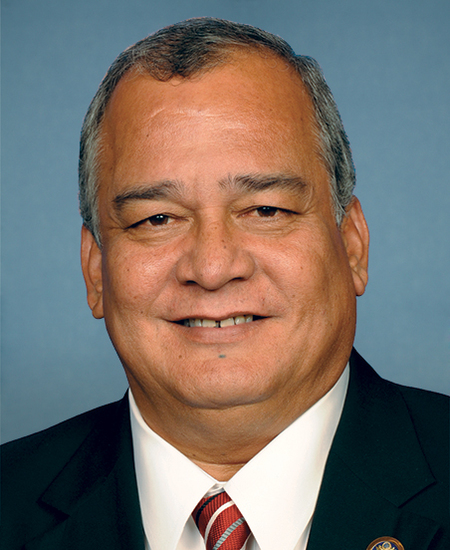
Rep. Gregorio Kilili Camacho Sablan
Sponsored bills
Maddy summaryThis bill amends a provision in U.S. law (49 U.S. Code § 41731) to expand eligibility for essential air service (EAS) subsidies. It adds Guam and the Northern Mariana Islands to the list of territories already covered under the exception, alongside Alaska and Hawaii. The change directly affects air carriers providing essential air service to these territories, ensuring they qualify for the same EAS program benefits as Alaska and Hawaii. This is a technical adjustment to the eligibility criteria, not a new policy.
Maddy summaryHR 9318 amends the Older Americans Act to increase federal funding for senior community service programs in four U.S. territories: Guam, American Samoa, the U.S. Virgin Islands, and the Northern Mariana Islands. The bill raises the minimum funding percentage from 0.75% to 1.0% of total funds, reduces the cap on certain program allocations from 30% to 25%, and increases another allocation percentage from 10% to 25%. These changes specifically affect how funds are distributed to the territories for senior services under the Older Americans Act. The amendments apply only to funds appropriated after the bill's enactment, not to funds already allocated before it became law.
Maddy summaryHR 9196, the Pregnancy Empowerment Act of 2024, prohibits states from delaying or denying divorce petitions solely because a person is pregnant. This directly affects pregnant individuals - particularly women of color and those experiencing intimate partner violence - who face barriers to finalizing divorces during pregnancy, trapping them in abusive relationships. The bill mandates that states cannot consider pregnancy status when processing divorce filings, addressing findings that such delays increase risks of violence and reproductive coercion. It aims to remove legal obstacles that prevent pregnant people from accessing divorce, a critical step for safety and autonomy.
Maddy summaryThe LET'S Protect Workers Act increases civil penalties for employers who violate labor and workplace safety laws. It significantly raises fines for child labor violations (up to $700,000 for serious injuries/deaths), wage and hour violations (up to $50,000 per violation for repeated/willful violations), and workplace safety violations (up to $800,000). The bill also increases penalties for farmworker protections (to $30,000), mine safety violations, and unfair labor practices (up to $100,000). New provisions require employers to pay penalties, with withdrawal orders for mines that fail to pay fines. These changes apply to violations occurring on or after January 1, 2025, with some provisions taking effect immediately.
Maddy summaryH.J. Res. 193 proposes a constitutional amendment to eliminate legal immunity for federal officials, including the President, from criminal prosecution for actions taken while performing official duties. It also prohibits the President from granting a pardon to themselves. The amendment would apply to all federal officers (such as the President, Vice President, and members of Congress) except for Congress members acting in their legislative role as defined in the Constitution. If ratified by 38 states, this change would become part of the U.S. Constitution, requiring no further congressional action.
Maddy summaryHR 9127, the Equitable Access to 340B Act, expands eligibility for the federal 340B drug discount program. It adds territorial disproportionate share hospitals (DSH) in the Northern Mariana Islands, Guam, American Samoa, and the U.S. Virgin Islands to the list of covered entities under the program. These hospitals must meet Medicaid DSH requirements to qualify. The bill directly affects healthcare providers in U.S. territories, enabling them to purchase medications at discounted prices under the 340B program.
Maddy summaryHRES 1335 is a non-binding resolution designating July 21, 2024, as "Guam Liberation Day" to commemorate the U.S. military's liberation of Guam from Japanese occupation on July 21, 1944. It directly affects Guam's community by honoring the island's historical resilience, the CHamoru people's suffering during the 1941-1944 occupation, and the U.S. military's role in the Pacific campaign. The resolution's key mechanism is a formal House endorsement of this commemorative date, urging the President to issue a proclamation encouraging public observance. This is a symbolic gesture with no legal or financial impact, focusing solely on historical recognition.
Maddy summaryHR 8899, the Ko’ko’ BIRDS Stamp Act, directs the U.S. Postal Service to issue a special semipostal stamp (where the extra cost over postage supports a cause) for four years. All revenue from the stamp's sales must go directly to Guam’s Division of Aquatic and Wildlife Resources to fund native bird conservation, rehabilitation, breeding programs, and brown tree snake eradication efforts. The funds are protected from being offset against future postal service appropriations, ensuring dedicated support for these wildlife programs. This bill specifically affects Guam’s wildlife conservation initiatives by creating a new funding stream through stamp sales.
Maddy summaryThis bill expands Post-9/11 GI Bill benefits to National Guard members who perform specific full-time duty. It amends eligibility rules to include service on "full-time National Guard duty" (as defined in Title 32) and "active duty" (as defined in Title 32), which previously did not count toward full benefits. The change applies retroactively to service since September 11, 2001, and takes effect one year after enactment. This directly affects National Guard members serving in these specific full-time roles, granting them parity with other veterans for educational benefits.