

Commission To Study the Potential Creation of a National Museum of Asian Pacific American History and Culture Act This bill establishes a Commission to Study the Potential Creation of a National Museum of Asian Pacific American History and Culture. The commission must (1) report recommendations for a plan of action for the establishment and maintenance of a National Museum of Asian Pacific American History and Culture in Washington, DC; (2) develop a fundraising plan to support the establishment, operation, and maintenance of the museum through public contributions; (3) obtain an independent review of this fundraising plan, including an analysis of the resources necessary to fund the construction of the museum and its operations and maintenance in perpetuity without reliance on federal funds; and (4) submit a legislative plan of action to establish and construct the museum. The commission may convene a national conference relating to the museum. The commission shall be solely responsible for acceptance of contributions to it and payment of its expenses. No federal funding may be obligated to carry out this bill.
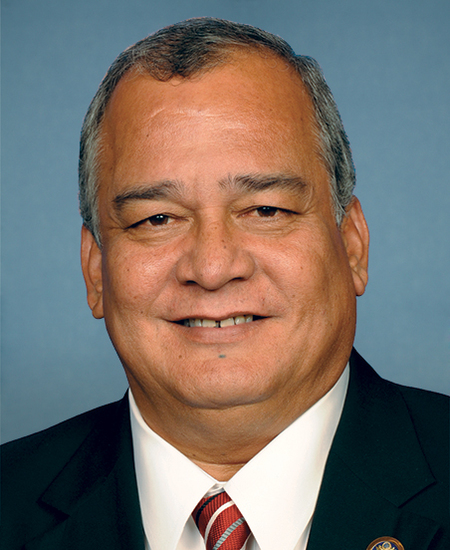
Rep. Gregorio Kilili Camacho Sablan
Sponsored bills
Military Spouse Hiring Act This bill expands the Work Opportunity Tax Credit (WOTC) to include the hiring of a qualified military spouse. (The WOTC permits employers who hire individuals who are members of a targeted group such as qualified veterans, ex-felons, or long-term unemployment recipients to claim a tax credit equal to a portion of the wages paid to those individuals.) A qualified military spouse is any individual who is certified by the designated local agency as being (as of the hiring date) a spouse of a member of the Armed Forces.
Protecting Our Kids Act This bill makes various changes to federal firearms laws, including to establish new criminal offenses and to expand the types of weapons and devices that are subject to regulation. Among the changes, the bill generally prohibits the sale or transfer of certain semiautomatic firearms to individuals who are under 21 years of age; establishes new federal criminal offenses for gun trafficking and related conduct; establishes a federal statutory framework to regulate ghost guns (i.e., guns without serial numbers); establishes a framework to regulate the storage of firearms on residential premises at the federal, state, and tribal levels; subjects bump stocks to regulation under federal firearms laws; generally prohibits the import, sale, manufacture, transfer, and possession of large capacity ammunition feeding devices; and requires the Department of Justice to report on the demographic data of persons who are determined to be ineligible to purchase a firearm based on a background check performed by the national instant criminal background check system.
Federal Extreme Risk Protection Order Act of 2022 This bill authorizes and establishes procedures for federal courts to issue federal extreme risk protection orders. Additionally, the bill establishes grants to support the implementation of extreme risk protection order laws at the state and local levels, extends federal firearms restrictions to individuals who are subject to extreme risk protection orders, and expands related data collection. Extreme risk protection order laws, or red flag laws, generally allow certain individuals (e.g., law enforcement officers or family members) to petition a court for a temporary order that prohibits an at-risk individual from purchasing and possessing firearms. Among its provisions, the bill authorizes a family or household member, or a law enforcement officer, to petition for a federal extreme risk protection order with respect to an individual who poses a risk to themselves or others; directs the Department of Justice to establish a grant program to help states, local governments, Indian tribes, and other entities implement extreme risk protection order laws; extends federal restrictions on the receipt, possession, shipment, and transportation of firearms and ammunition to individuals who are subject to extreme risk protection orders; and requires the Federal Bureau of Investigation to compile records from federal, tribal, and state courts and other agencies that identify individuals who are subject to extreme risk protection orders.
Improving Access to Workers' Compensation for Injured Federal Workers Act of 2022 This bill expands the role of nurse practitioners and physician assistants in providing services to injured federal workers under the federal workers' compensation program. Specifically, under the program, nurse practitioners and physician assistants acting within the scope of their practice may (1) prescribe or recommend treatment for injured federal workers; (2) certify the nature of an injury and probable extent of disability; (3) provide prescribed treatment for injured federal workers; and (4) participate, with a physician designated by the Department of Labor, in a mandatory workers' compensation examination of an injured worker. In general, only physicians may fulfill these roles under current law.
Relief for Restaurants and other Hard Hit Small Businesses Act of 2022 This bill addresses support for restaurants, arts and entertainment venues, and small businesses impacted by the COVID-19 pandemic. The bill provides an additional $42 billion in FY2021 for the Restaurant Revitalization Fund and gives priority to previous applicants who have not received a grant. The Small Business Administration (SBA) must provide to applicants an explanation for denied applications, establish a reconsideration process for denied applications, and institute an audit and oversight plan with respect to grant recipients. Additionally, the bill establishes the Hard Hit Industries Award Program for small businesses that suffered a pandemic-related revenue loss of 40% or more. Aggregate grant amounts are capped at $1 million. Funds may be used for expenses including mortgage, rent, and utility payments and payroll. SBA must prioritize entities that have experienced significant pandemic-related revenue loss, with first priority going to those that experienced a loss of at least 80%, and second priority going to those that experienced a loss of at least 60%. Finally, the bill extends to March 11, 2023 (or a later date as determined by the SBA), the time frame during which Shuttered Venue Operators Grant recipients may use grant funds to cover their expenses.
Violence Against Women Reauthorization Act of 2021 This bill modifies and reauthorizes through FY2026 programs and activities under the Violence Against Women Act that seek to prevent and respond to domestic violence, sexual assault, dating violence, and stalking. The bill also authorizes new programs, makes changes to federal firearms laws, and establishes new protections to promote housing stability and economic security for victims of domestic violence, sexual assault, dating violence, and stalking.
Access to Baby Formula Act of 2022 This bill authorizes the Department of Agriculture (USDA) to take certain actions to address emergencies, disasters, and supply chain disruptions (particularly the shortage of infant formula in the United States) affecting participants of the Special Supplemental Nutrition Program for Women, Infants, and Children (WIC). The bill directs USDA to require each infant formula cost containment contract to include remedies in the event of an infant formula recall, including how an infant formula manufacturer would protect against disruption to WIC participants in the state. USDA must, within 30 days, ensure there is a memorandum of understanding with the Department of Health and Human Services that includes procedures for coordination and information sharing regarding any supply chain disruption, including a supplemental food recall. The bill also authorizes USDA to waive or modify any WIC qualified administrative requirement during emergencies, disasters, and supply chain disruptions. Specifically, USDA may waive or modify such a requirement for one or more state agencies if (1) the requirement cannot be met by state agencies during the emergency, disaster, or disruption; and (2) the modification or waiver is necessary to provide assistance to WIC participants and does not substantially weaken the nutritional quality of supplemental foods. For example, USDA may waive the maximum monthly allowance for infant formula. The bill establishes notification requirements for USDA and state agencies related to supply chain disruptions.
Consumer Fuel Price Gouging Prevention Act This bill prohibits any person from selling, during a proclaimed energy emergency, a consumer fuel at a price that (1) is unconscionably excessive, and (2) indicates that the seller is exploiting the emergency to increase prices unreasonably. The President may issue a proclamation of such an emergency that specifies the consumer fuel and geographic area covered and how long the proclamation applies. The bill provides for enforcement of these provisions by the Federal Trade Commission and state attorneys general. Civil penalties collected by the commission through such enforcement must be used to provide assistance under the Low Income Home Energy Assistance Program. Additionally, the commission must investigate whether the price of gasoline is being manipulated through reducing refinery capacity or other manipulative practices. The commission also must establish a Transportation Fuel Monitoring and Enforcement Unit to collect, monitor, and analyze crude oil and transportation fuel market data. The bill further includes specified transportation fuels within the prohibitions against (1) manipulative market practices, and (2) reporting false price information. It also increases the penalty for violations of those prohibitions. Finally, the Energy Information Administration must survey energy companies to facilitate transparent and competitive crude oil and transportation fuel markets.
Targeting Resources to Communities in Need Act of 2022 This bill addresses funding for areas of persistent poverty. Specifically, the bill requires the Bureau of the Census to publish a list of all areas of persistent poverty and annually update the list; the Office of Management and Budget (OMB) to implement guidance to increase the share of federal investments targeted to areas of persistent poverty and other areas with high and persistent poverty, and to report annually to Congress; and the Government Accountability Office to report on the measures implemented by the OMB under this bill, including an assessment regarding the impact of the measures on increasing federal investments spent in the affected areas.