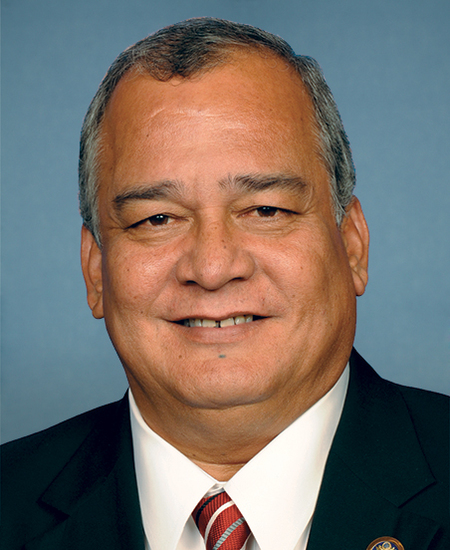
Photo of Gregorio Kilili Camacho Sablan
D United States House · District At-Large · Northern Mariana Islands

Rep. Gregorio Kilili Camacho Sablan

Compare
Total votes
552
all sessions
Attendance
35%
793 missed
Among the lowest in the chamber
With party
98%
of cast votes
Higher than 87% of chamber peers
Bipartisan score
2%
crosses aisle rarely
Near the chamber average
Sponsored
490
bills & resolutions
Near the chamber average
Committees
0
assignments
490 bills and resolutions

Sponsored bills

Total
490
Primary
36
Co-sponsor
454
This page
490
matching current filters
Co-sponsor HR 8770
In committee · United States House · Co-sponsor
Expanding the VOTE Act

Expanding the Voluntary Opportunities for Translations in Elections Act or the Expanding the VOTE Act This bill expands access to voting materials for individuals with limited proficiency in the English language, including by establishing incentive grants for states and political subdivisions to provide translated voting materials. Additionally, the bill directs the Government Accountability Office to study the impact of (1) reducing the threshold requirement under Section 203 of the Voting Rights Act of 1965, and (2) expanding the definition of language minorities to include native speakers of additional languages.

In committee Dec 21, 2022 1 co-sponsor
Co-sponsor HR 7310
In committee · United States House · Co-sponsor
Protecting America’s Retirement Security Act of 2022

Protecting America's Retirement Security Act of 2022 This bill makes various changes with respect to the administration of employer-sponsored retirement plans, including establishing additional spousal consent requirements for distributions under such plans and requiring the periodic automatic reenrollment of nonparticipating employees in automatic contribution arrangements that take effect after December 31, 2024. The bill also requires the Department of Education, in consultation with relevant agencies, to establish a personal finance education portal that includes information about savings, investing, borrowing, and managing student loan repayment.

In committee Dec 20, 2022 1 co-sponsor
Co-sponsor HR 263
Signed into law · United States House · Co-sponsor
Big Cat Public Safety Act

Big Cat Public Safety Act This act revises requirements governing the trade of big cats (i.e., species of lion, tiger, leopard, cheetah, jaguar, or cougar or any hybrid of such species) under the Lacey Act to limit the possession, breeding, and exhibition of big cats. The Lacey Act prohibits any person from importing, exporting, buying, selling, transporting, receiving, or acquiring big cats across state lines or the U.S. border. However, some exemptions are provided for certain entities, such as universities and wildlife sanctuaries. (Sec. 3) The act expands the Lacey Act prohibitions to include a prohibition on possessing or breeding big cats. Breeding means facilitating propagation or reproduction (whether intentionally or negligently), or failing to prevent propagation or reproduction. Owners of big cats that were born before this act's enactment may keep their big cats, but the owners must register them with the U.S. Fish and Wildlife Service. The act modifies the list of entities that are exempt from prohibitions to export, buy, sell, transport, receive, acquire, possess, or breed big cats. The modified list includes exemptions for entities or facilities exhibiting animals to the public if they (1) hold a Class C license in good standing under the Animal Welfare Act, and (2) do not allow individuals to come into direct physical contact with big cats. However, direct contact is allowed if the individual is a trained professional, a veterinarian, or directly supporting conservation programs that do not involve commercial activities and meet other specified restrictions. (Sec. 4) A person who knowingly violates the act must be fined not more than $20,000, or imprisoned for no more than five years, or both. The act considers each violation to be a separate offense. The offense must be deemed to have been committed not only in the district where the violation first occurred, but also in any district in which the defendant may have taken or been in possession of the prohibited wildlife species. (Sec. 5) The act extends forfeiture provisions to fish, wildlife, or plants that are bred or possessed; thus, big cats bred or possessed in violation of the act are subject to forfeiture. (Sec. 6) The Department of the Interior must issue regulations to implement this act.


Signed into law Dec 20, 2022 1 co-sponsor
Co-sponsor HR 604
In committee · United States House · Co-sponsor
Rebuild America’s Schools Act of 2022

Rebuild America's Schools Act of 2022 This bill provides support for long-term improvements to public elementary and secondary school facilities. First, the bill sets forth allocations to states and establishes a need-based grant program for local educational agencies (LEAs) to improve school facilities. Further, the bill specifies allowable uses of grant funds, including carrying out major repairs, improving indoor air quality, and making facilities accessible to disabled individuals. Additionally, the bill requires LEAs that receive funds for new construction, modernization, or renovation projects to comply with hazard-resistance building codes and performance criteria under the WaterSense program of the Environmental Protection Agency. Further, the bill requires such LEAs to adopt certain green practices (environmental standards) and requires the use of iron, steel, and manufactured products that are made in the United States (Buy America). The bill restores school infrastructure tax credit bonds. The bill also sets forth reporting requirements, including annual reports on grant program projects and a report by the Government Accountability Office that requires a study of the geographic distribution of projects, the impact of selected projects on student and staff health and safety, and the accessibility of projects to high-poverty schools. The bill also establishes the Office of School Infrastructure and Sustainability within the Department of Education. Next, the bill extends through FY2027 the Impact Aid Construction program. Finally, the bill establishes a grant program to assist LEAs with repairing or replacing concrete foundations affected by pyrrhotite (an iron sulfide material linked to crumbling foundations).

In committee Dec 16, 2022 1 co-sponsor
Co-sponsor HR 8393
Passed · United States House · Co-sponsor
Puerto Rico Status Act

Puerto Rico Status Act This bill provides for a plebiscite to be held on November 5, 2023, to resolve Puerto Rico's political status. Specifically, such plebiscite shall offer eligible voters a choice of independence, sovereignty in free association with the United States, or statehood. The Puerto Rico State Elections Commission shall carry out a nonpartisan voter education campaign through traditional paid media and make available at all voting locations voter education materials related to the plebiscites, and invite national and international election observers to ensure transparency and confidence in the electoral process. All voter educational materials and ballots used to carry out this bill shall be made available in English and Spanish. The bill sets forth transition and implementation provisions for each choice offered in the plebiscite.

Passed Dec 15, 2022 1 co-sponsor
Co-sponsor HR 1948
Passed · United States House · Co-sponsor
VA Employee Fairness Act of 2021

VA Employee Fairness Act of 2021 This bill repeals provisions excluding any matter or question concerning professional conduct or competence; peer review; or the establishment, determination, or adjustment of employee compensation from the applicability of collective bargaining rights for Veterans Health Administration employees.

Passed Dec 15, 2022 1 co-sponsor
Co-sponsor HR 7946
Passed · United States House · Co-sponsor
Veteran Service Recognition Act of 2022

Veteran Service Recognition Act of 2022 This bill addresses immigration-related issues pertaining to noncitizen (or non-U.S. national) military veterans, including by authorizing the Department of Homeland Security (DHS) to provide lawful permanent resident status to a veteran subject to removal. If a noncitizen veteran appears to be eligible for lawful permanent resident status under this bill, that veteran must receive a reasonable opportunity to apply for such status and may not be removed until there is a final administrative decision on the veteran's eligibility. For the purposes of providing such status under this bill, DHS may waive any applicable grounds of inadmissibility, except for certain crime- or security-related grounds. The bill also extends certain deadlines relating to obtaining citizenship after serving in the Armed Forces. DHS must create a system for identifying noncitizens who are or may be veterans. Before initiating removal proceedings against a noncitizen, DHS must attempt to determine whether the noncitizen is a veteran. DHS must ensure that veteran status is considered in immigration proceedings. The bill also requires U.S. Citizenship and Immigration Services (USCIS) and the Department of Defense to take certain actions to facilitate opportunities for military recruits and veterans to obtain U.S. citizenship, such as by training Judge Advocate General Corps members to act as liaisons between the Armed Forces and USCIS on servicemember citizenship applications. The bill also establishes the Military Family Immigration Advisory Committee to provide recommendations on cases involving the removal of a servicemember, veteran, or certain family members of a servicemember or veteran. Such an individual may not be removed until the committee has provided a recommendation to DHS about the individual's case, unless the individual is inadmissible due to a conviction for an aggravated felony. The bill also waives certain grounds of inadmissibility (e.g., being unlawfully present in the United States) for certain noncitizens applying for lawful permanent resident status as an immediate relative of a U.S. citizen who has served at least two years in the Armed Forces.

Passed Dec 7, 2022 1 co-sponsor
Co-sponsor HR 6181
In committee · United States House · Co-sponsor
Samish Indian Nation Land Reaffirmation Act

Maddy summaryThis bill ratifies the Bureau of Indian Affairs' 2018 decision to place approximately 6.7 acres of land into federal trust for the Samish Indian Nation. It confirms this trust status for the specific land described in the 2018 decision and applies to all current or future legal challenges regarding this land or similar actions. The bill explicitly states it does not prevent the Samish Nation from seeking additional land to be placed into trust in the future. It directly affects the Samish Indian Nation's ownership rights to this specific parcel and their legal standing on related land claims.

In committee Dec 7, 2022 1 co-sponsor
Co-sponsor HR 1884
In committee · United States House · Co-sponsor
Save Oak Flat Act

Save Oak Flat Act This bill repeals the requirement for the Department of Agriculture to convey the 2,422 acres of Forest System land located in Tonto National Forest in Pinal County, Arizona, known as Oak Flat, to Resolution Copper Mining, LLC, in exchange for various parcels of land owned by Resolution Copper. Oak Flat is withdrawn from (1) entry, appropriation, or disposal under the public land laws; (2) location, entry, and patent under the mining laws; and (3) disposition under all laws pertaining to mineral and geothermal leasing or mineral materials.

In committee Dec 7, 2022 1 co-sponsor
Co-sponsor HR 3630
Passed · United States House · Co-sponsor
Lymphedema Treatment Act

Lymphedema Treatment Act This bill provides for Medicare coverage of lymphedema compression treatment items. Specifically, the bill provides for coverage of standard and custom fitted gradient compression garments and other approved items that are prescribed by a physician or other specified health care professional to treat lymphedema.

Passed Nov 17, 2022 1 co-sponsor
Showing 251 to 260 of 490 bills
Previous 1 … 25 26 27 … 49 Next