

Maddy summaryThe Connect the Grid Act modifies federal energy regulations to improve grid connectivity, primarily affecting ERCOT (Texas' grid) and neighboring transmission organizations like SPP and MISO. It repeals exemptions for ERCOT under the Federal Power Act and establishes minimum power transfer requirements between ERCOT and other grids (e.g., 4.3-12.6 gigawatts to SPP). The bill requires joint planning by grid operators to build or upgrade transmission facilities by 2035, prioritizing grid-enhancing technologies, existing infrastructure corridors, environmental justice communities, and renewable energy access. Projects must follow environmental reviews under NEPA and the Endangered Species Act, with mandatory community outreach to tribal, Indigenous, and low-income groups.
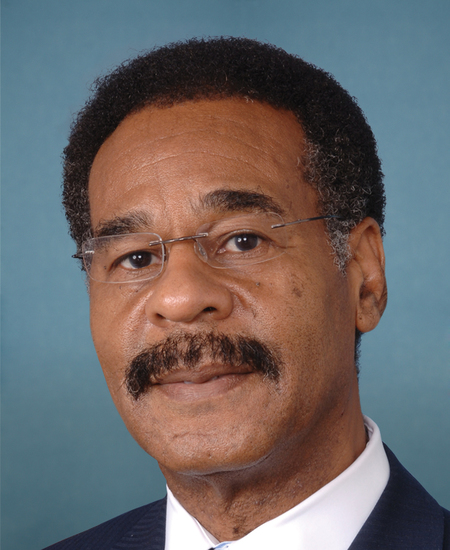
Rep. Emanuel Cleaver
Sponsored bills
Maddy summaryHR 7378, the Frederick Douglass Congressional Gold Medal Act, authorizes Congress to posthumously award a gold medal to honor Frederick Douglass's legacy as a pivotal abolitionist, writer, and advocate for civil rights. The medal, designed by the Treasury Secretary, will be presented to the National Museum of African American History and Culture for display, with bronze duplicates available for sale to cover costs. This ceremonial bill does not create new laws or affect current policies - it solely commemorates Douglass's historical contributions to ending slavery and advancing equality.
Maddy summaryHRES 1013 is a symbolic resolution designating February 2024 as "National Teen Dating Violence Awareness and Prevention Month." It expresses congressional support for this designation to promote community awareness and prevention efforts around teen dating violence, which affects youth across the U.S. The resolution does not create new laws or funding but encourages schools, families, and communities to observe the month with educational activities. It references statistics on teen dating violence (like 28.1% of teens experiencing digital dating abuse) to highlight the issue's significance.
Maddy summaryThis bill restricts how credit reporting companies share homebuyers' credit reports during mortgage applications. It prevents companies from sending these reports to third parties (like marketers) just because a lender requested them for a mortgage. Only specific entities can receive the reports: the mortgage lender who originated the loan, the company servicing the loan, or the bank holding the homebuyer's account. This directly protects homebuyers' privacy by limiting unauthorized sharing of their financial data.
Maddy summaryHR 7272, the Shining a Spotlight on Safer Communities Act, requires the Attorney General to submit annual reports to Congress starting in 2024, detailing how the Bipartisan Safer Communities Act's provisions (specifically sections 932 and 933 of title 18) are being implemented. These reports must include data on investigations, prosecutions, demographic information of defendants, and seized firearms or assets related to gun trafficking and straw purchasing. The bill mandates these reports for fiscal years 2024 through 2027, with a funding limit of $2 million annually for this reporting. It is a procedural bill focused solely on transparency and accountability for existing gun safety measures, not creating new policies.
Ensuring Diverse Leadership Act of 2024 This bill requires that, when appointing a president, a Federal Reserve Bank must interview at least one individual reflective of gender diversity and one reflective of racial or ethnic diversity. The bill amends numerous banking-, finance-, and trade-related acts to make references to officials (including those to the Chairman of the Board of Governors of the Federal Reserve System) gender-neutral.
Maddy summaryThis symbolic resolution (HRES 989) urges the U.S. House of Representatives to recognize January as "Muslim-American Heritage Month" to honor the contributions of Muslim Americans. It highlights their historical and contemporary roles in U.S. society across fields like business, science, sports, and public service. The resolution calls for public observance through ceremonies and programs but has no legal effect or policy changes. It does not allocate funding, alter laws, or directly affect any specific group beyond raising awareness of Muslim-American heritage.
Maddy summaryHR 7127, the FAIR Act, establishes pay adjustments for federal employees in 2025. It increases base pay by 4% for most federal workers under statutory pay systems and for "prevailing rate" employees (like those in specific geographic areas), while raising locality pay rates by 3.4%. The bill directly affects all federal employees receiving pay under these systems, as it modifies their 2025 salary calculations. These changes are based on statutory formulas under Title 5 of the U.S. Code, with no new policy mechanisms beyond the specified percentage increases. The adjustments apply to pay rates in effect as of the end of fiscal year 2024.
Maddy summaryThe Complete Streets Act of 2024 requires states to establish programs that help local governments, transit agencies, and other eligible entities design and build transportation infrastructure accommodating all users, including pedestrians, cyclists, and public transit riders. States must provide technical assistance and grants for complete streets projects, with 5% of certain transportation funds allocated to these programs. The bill establishes design standards requiring features like protected bike lanes, accessible sidewalks, and appropriate lighting for all transportation projects, applying to new projects on Federal-aid highways within metropolitan areas. It mandates that states develop complete streets policies and prioritization plans to improve safety and accessibility, particularly in underserved communities, with compliance required by 2026 or 2029 for different project types.
Maddy summaryThe HOME Investment Partnerships Reauthorization and Improvement Act of 2024 reauthorizes and updates the HOME Investment Partnerships Program, which provides federal funds to states and local governments to develop affordable housing. The bill increases annual funding from $5 billion in 2024 to $6.08 billion in 2028, modifies eligibility requirements for participating jurisdictions, and eliminates a deadline for committing funds. It reforms homeownership resale restrictions, establishes a home loan guarantee program with $2 billion in initial funding (increasing with inflation), and enhances protections for tenants in small-scale affordable housing (defined as housing with no more than 4 rental units). These changes aim to make the program more flexible and effective in creating and preserving affordable housing options for low- and moderate-income households.