

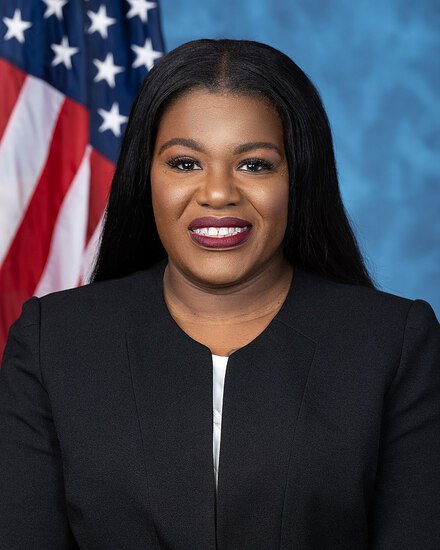
Photo of Cori Bush
D United States House · District 1 · Missouri

Rep. Cori Bush

Compare
Total votes
2,168
all sessions
Attendance
89%
243 missed
Lower than 98% of chamber peers
With party
92%
of cast votes
Lower than 78% of chamber peers
Bipartisan score
4%
crosses aisle rarely
Near the chamber average
Sponsored
794
bills & resolutions
Near the chamber average
Committees
0
assignments
794 bills and resolutions

Sponsored bills

Total
794
Primary
38
Co-sponsor
756
This page
794
matching current filters
Co-sponsor HR 5348
In committee · United States House · Co-sponsor
ESP Family Leave Act

ESP Family Leave Act This bill allows education support professionals to meet the hours of service requirements for family and medical leave if they have worked a number of hours equal to not less than 60% of the total monthly hours expected for their job descriptions and duties, as assigned for the previous school year. Education support professionals are employees within a public school or public institution of higher education which may include specified staff, such as paraeducators, administrative support staff, custodians, skilled trade workers, and nursing support staff. The Department of Labor may provide a method for calculating such leave for these professionals.

In committee Sep 23, 2021 1 co-sponsor
Co-sponsor HR 5342
In committee · United States House · Co-sponsor
Tyler Clementi Higher Education Anti-Harassment Act of 2021

Tyler Clementi Higher Education Anti-Harassment Act of 2021 This bill addresses harassment at institutions of higher education (IHEs). Specifically, the bill requires each IHE to include in its annual security report a statement of policy regarding harassment on the basis of a student's actual or perceived race, color, national origin, sex (including sexual orientation, gender identity, pregnancy, childbirth, a medical condition related to pregnancy or childbirth, and a sex stereotype), disability, or religion. In addition, the Department of Education may award grants to IHEs to initiate, expand, or improve programs to (1) prevent the harassment of students; (2) provide counseling or redress services to students who have been harassed or accused of subjecting other students to harassment; or (3) educate and train students, faculty, or staff to prevent harassment or address harassment if it occurs.

In committee Sep 22, 2021 1 co-sponsor
Primary HR 5307
In committee · United States House · Lead sponsor
Keeping Renters Safe Act of 2021

Keeping Renters Safe Act of 2021 This bill expressly authorizes the Department of Health and Human Services (HHS) to place a moratorium on residential evictions to prevent the spread of communicable diseases. The bill also requires HHS to implement a moratorium nationwide to reduce the spread of COVID-19. This moratorium must remain in effect for at least 60 days following the termination of the COVID-19 public health emergency. Current law authorizes HHS to take measures to prevent the spread of communicable diseases. As part of the COVID-19 response, HHS delegated this authority to the Centers for Disease Control and Prevention (CDC), which then issued (and extended) several orders banning residential evictions. Whether these orders exceed the CDC's statutory and constitutional authority has been the subject of multiple legal challenges; the Supreme Court blocked enforcement of the most recent order on August 26, 2021.

In committee Sep 22, 2021 0 co-sponsors
Co-sponsor HR 5308
In committee · United States House · Co-sponsor
Nutrition Education Act

Nutrition Education Act This bill requires a local educational agency that participates in a school lunch or breakfast program to require each student to receive 50 hours of nutrition education per school year. Such instruction must be consistent with applicable school meal program requirements as well as meet certain other standards with respect to content and delivery.

In committee Sep 21, 2021 1 co-sponsor
Co-sponsor HR 5285
In committee · United States House · Co-sponsor
Extend Unemployment Assistance Act of 2021

Extend Unemployment Assistance Act of 2021 This bill extends pandemic unemployment compensation provisions set to expire on September 6, 2021, until February 1, 2022. Extended provisions include benefits to covered individuals who are not eligible for regular unemployment compensation or traditional extended benefits, the $300 weekly benefit increase, waiting week benefits, and federal reimbursement of short-time compensation. The bill also increases the maximum duration of compensation from 79 weeks to 100 weeks.

In committee Sep 17, 2021 1 co-sponsor
Primary HR 5269
In committee · United States House · Lead sponsor
ERAP Improvement Act of 2021

Emergency Rental Assistance Program Improvement Act of 2021 or the ERAP Improvement Act of 2021 This bill modifies the Department of Treasury's Emergency Rental Assistance program to increase the portion of funding that state and local government grant recipients may use for administrative costs. The bill also encourages grant recipients to utilize these administrative funds to provide application assistance in coordination with public entities such as libraries, elementary schools, courts, and public housing. The program continues to provide grants to state and local governments to assist eligible households in paying rent, utility costs, and other housing costs incurred due to the COVID-19 pandemic.

In committee Sep 17, 2021 0 co-sponsors
Co-sponsor HR 5253
In committee · United States House · Co-sponsor
Fossil Free Finance Act

Fossil Free Finance Act This bill requires large bank holding companies to develop and implement emission reduction plans. Such a plan must include strategies for a company to equitably reduce and eventually eliminate financed greenhouse gas emissions by January 1, 2050, and to discontinue specified fossil fuel projects and financing. The bill also prohibits the use of carbon offsets in such a plan, sets forth technological requirements for reductions, and requires the prioritization of specified social impacts. Plans must be submitted to the Board of Governors of the Federal Reserve System for approval every two years.

In committee Sep 14, 2021 1 co-sponsor
Co-sponsor HR 4
Passed · United States House · Co-sponsor
John R. Lewis Voting Rights Advancement Act of 2021

John R. Lewis Voting Rights Advancement Act of 2021 This bill establishes new criteria for determining which states and political subdivisions must obtain preclearance before changes to voting practices may take effect. Preclearance is the process of receiving preapproval from the Department of Justice (DOJ) or the U.S. District Court for the District of Columbia before making legal changes that would affect voting rights. A state and all of its political subdivisions shall be subject to preclearance of voting practice changes for a 10-year period if 15 or more voting rights violations occurred in the state during the previous 25 years; 10 or more violations occurred during the previous 25 years, at least 1 of which was committed by the state itself; or 3 or more violations occurred during the previous 25 years and the state administers the elections. A political subdivision as a separate unit shall also be subject to preclearance for a 10-year period if three or more voting rights violations occurred there during the previous 25 years. States and political subdivisions that meet certain thresholds regarding minority groups must preclear covered practices before implementation, such as changes to methods of election and redistricting. Further, states and political subdivisions must notify the public of changes to voting practices. Next, the bill authorizes DOJ to require states or political subdivisions to provide certain documents or answers to questions for enforcing voting rights. The bill also outlines factors courts must consider when hearing challenges to voting practices, such as the extent of any history of official voting discrimination in the state or political subdivision.

Passed Sep 14, 2021 1 co-sponsor
Co-sponsor HR 4811
In committee · United States House · Co-sponsor
Medicare Negotiation and Competitive Licensing Act of 2021

Medicare Negotiation and Competitive Licensing Act of 2021 This bill establishes several requirements relating to the prices of prescription drugs. Specifically, the bill requires the Centers for Medicare & Medicaid Services (CMS) to negotiate with pharmaceutical companies regarding prices for drugs covered under Medicare. (Current law prohibits the CMS from doing so.) If the CMS is unable to negotiate the price of a drug, such drug is subject to competitive licensing in order to further its sale under health insurance programs, notwithstanding existing government-granted exclusivities. The negotiated prices also apply to other federal health care programs, private health insurance, and the uninsured; pharmacies that charge more than the negotiated price for uninsured individuals are subject to civil penalties. Manufacturers must also comply with specified reporting requirements relating to prices and licensing, subject to civil penalties. The bill also institutes an excise tax on drugs for which the price spikes beyond a certain limit, subject to specified exemptions, as well as on drugs for which the price exceeds the negotiated price.

In committee Sep 8, 2021 1 co-sponsor
Co-sponsor HRES 624
In committee · United States House · Co-sponsor
Affirming the right of all renters to a safe, affordable, and decent home.

This resolution expresses support for robustly funding programs to increase access to affordable housing and address homelessness, including in any infrastructure package housing investments to serve families with the lowest incomes, and expanding renters' rights.

In committee Sep 7, 2021 1 co-sponsor
Showing 591 to 600 of 794 bills
Previous 1 … 59 60 61 … 80 Next