

Public Service Expenditure Cap Modification Act This bill waives for FY2023 a cap on the amount that recipients of Community Development Block Grant funds may spend on public service activities (e.g., those concerned with employment, crime prevention, childcare, and health). Current law prohibits recipients from expending more than 15% of funds on such activities. The bill also directs the Department of Housing and Urban Development to allow recipients to provide emergency grant payments on behalf of eligible families for up to six months. Currently, these payments, which provide assistance with housing, utilities, or other subsistence support, are limited to three months.
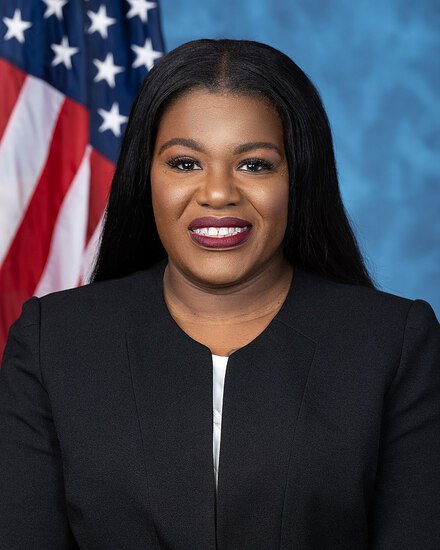
Rep. Cori Bush
Sponsored bills
Justice for All Act of 2022 This bill prohibits discrimination based on sex, sexual orientation, gender identity, or race-related characteristics in schools, businesses, federally funded programs, and other settings. It also provides statutory authority for and expands the types of civil actions that may be brought for violations. For example, the bill expands provisions under the Civil Rights Act of 1964 so as to (1) prohibit federally funded programs from discriminating based on sex or religion; and (2) prohibit public accommodations, including stores and transit services, from discriminating based on sex. The bill defines sex to include sex stereotypes, pregnancy, childbirth, sexual orientation, gender identity, and sex characteristics. It also expands the definition of race to include traits that have been historically associated with race (e.g., natural hair textures). The expanded definitions apply to the Civil Rights Act of 1964, the Fair Housing Act (discrimination in public and private housing), and Title IX of the Education Amendments of 1972 (discrimination based on sex in federally funded educational programs). Further, the bill provides statutory authority for disparate impact or intentional discrimination claims under the aforementioned acts, as well as the Age Discrimination Act of 1975 (discrimination based on age by federally funded programs) and the Rehabilitation Act of 1973 (discrimination based on disability by federally funded programs). The bill also includes other provisions that address (1) profiling by law enforcement officers, (2) employer liability with respect to civil rights violations, (3) predispute arbitration agreements in civil rights cases, and (4) governmental immunity in suits involving constitutional violations.
Ralph David Abernathy, Sr. National Historic Site Act This bill establishes the Ralph David Abernathy, Sr. National Historic Site in Georgia as a unit of the National Park System. The site shall preserve, protect, and interpret the area where the Reverend Dr. Abernathy served as pastor during the height of the modern civil rights movement and his role as an internationally recognized civil rights leader.
Reward Work Act This bill prohibits issuers from purchasing their own securities on a national exchange. The bill also requires one-third of an issuer's board of directors to be elected by employees in order for the issuer to be allowed to register securities.
This bill designates the facility of the United States Postal Service located at 3900 Crown Road Southwest in Atlanta, Georgia, as the John R. Lewis Post Office Building.
Expanding Representation at HHS Act of 2022 This bill requires certain agencies and offices within the Department of Health and Human Services to address diversity in their procurement activities and workforce. The bill specifically covers offices and agencies that are authorized to award grants or other financial assistance, such as the Centers for Medicare & Medicaid Services and the Centers for Disease Control and Prevention. Each covered entity must establish an Office of Minority and Women Inclusion that is responsible for managing diversity within the entity and with respect to the entity's activities. This new office is not, however, responsible for enforcing civil rights statutes, regulations, or executive orders. In addition, an entity subject to the bill's requirements must modify its evaluation, award, and termination of grants and contracts to ensure, to the maximum extent feasible, the inclusion of minorities; women; and minority-led and women-led grantees, contractors, subgrantees, and subcontractors. Each entity must also undertake actions to increase diversity in its workforce, including by recruiting at institutions of higher education where the majority of the students are members of minority populations.
Reproductive Health Care Accessibility Act This bill establishes various grants and related programs that address sexual and reproductive health care for individuals with disabilities. Specifically, the Health Resources and Services Administration must support training for health care providers who offer sexual and reproductive health care to individuals with disabilities, and educating individuals with disabilities about sexual and reproductive health care. The Administration for Community Living must establish a national center to provide recommendations, technical assistance, and other resources related to the provision of sexual and reproductive health care for individuals with disabilities. The bill also authorizes support for medical schools, nursing schools, and other educational institutions that offer obstetrics and gynecology training programs to expand the number of individuals with disabilities entering the reproductive health care workforce. Additionally, the Department of Health and Human Services must study the effectiveness and other aspects of reproductive health care services and programs for individuals with disabilities.
IDs for an Inclusive Democracy Act This bill directs the Social Security Administration (SSA) to produce and make available at no cost to certain individuals in the United States an identification (ID) for the purpose of allowing such individuals to satisfy ID requirements. Such ID must include a photograph and specified information, as well as security features. It shall be valid for a 10-year period. To receive an ID, an individual must be at least 14 years of age. The SSA must develop and implement a campaign to educate the public with respect to the ID, including how an individual can receive and use it. The U.S. Postal Service (USPS) must develop and implement a process that enables individuals to apply for the ID through the USPS, including a process for a first-time ID and renewal, modeled after the process for passport applications. The bill establishes a Task Force on Federal Identification Cards for the purpose of determining the requirements to produce and make available the ID. The task force shall (1) issue a report on the requirements, including a requirement that the SSA and the USPS establish procedures to prevent the unauthorized disclosure of any information obtained with respect to individuals who seek assistance in obtaining the ID; and (2) develop and publish recommendations for voluntary best practices for nonprofit organizations and entities that provide services to vulnerable populations with respect to how such organizations and entities can assist individuals to obtain the ID.
Maximizing Outcomes through Better Investments in Lifesaving Equipment for (MOBILE) Health Care Act This bill allows a health center that currently receives funding through a Health Resources & Services Administration Health Center Program grant to use a New Access Point grant to set up a mobile unit regardless of whether the health center also establishes a permanent health care delivery site. New Access Point grants help health centers establish new delivery sites to provide comprehensive primary care to medically underserved populations. Under current law, health centers may only use the grants to set up a mobile unit if they also establish a permanent site.
Break the Cycle of Violence Act This bill establishes federal grant programs and related entities to support violence intervention initiatives. Specifically, the bill directs the Department of Health and Human Services (HHS) to award grants for coordinated community violence intervention initiatives in communities disproportionately impacted by homicides and community violence. HHS must also establish several related entities, including an Office of Community Violence Intervention to administer programs and activities related to violence intervention; the Community Violence Intervention Advisory Committee to advise and assist the office and HHS; and the National Community Violence Response Center to provide training and technical assistance, coordinate research, and develop data collection policies. Additionally, the bill directs the Department of Labor to award grants for job training and workforce programs in communities disproportionately affected by gun violence to connect youth ages 16 to 24 to in-demand occupations.