

Housing is Infrastructure Act of 2021 This bill generally addresses housing affordability and infrastructure. The bill authorizes the Department of Housing and Urban Development (HUD) to provide grants, programs, and other support related to public housing, affordable housing preservation and construction, and mortgage access. The bill also establishes and funds the National Investment Authority (NIA) which must design, finance, and implement a strategy of long-term national economic growth and development. The NIA must select projects that coordinate investment of public and private capital in equitable, inclusive, and sustainable growth of the economy. Furthermore, the bill establishes the National Infrastructure Bank (NIB) to implement the strategy by engaging in credit market activities that support public and private investment in critical public infrastructure projects. The bill gives the NIA bond issuing authority and authorizes the Board of Governors of the Federal Reserve System to purchase these bonds. The Federal Reserve must lend funds on a short-term basis upon the request of the NIB and other subsidiaries. Additionally, the Department of the Treasury must provide for a line of credit not to exceed 100% of the NIA's total assets. Finally, the bill (1) authorizes HUD to provide support for fair housing organizations, and (2) requires consultation with a fair housing enforcement organization as part of an application for certain housing grants or funds.
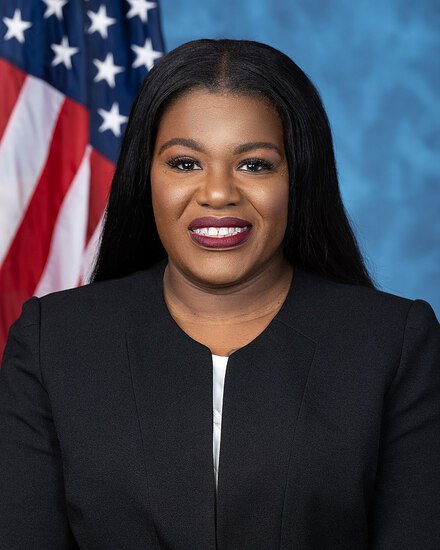
Rep. Cori Bush
Sponsored bills
Inclusive Elections Act of 2021 This bill requires courts, when hearing challenges to election laws, to consider whether the law has a disparate impact on members of a protected class of citizens. Specifically, the bill requires courts to consider whether (1) the challenged standard, practice, or procedure imposes a disparate burden on members of a protected class of citizens; and (2) the disparate burden is related to social and historical conditions that produce discrimination against members of the protected class.
The People's Response Act This bill establishes multiple grant programs and requirements to promote qualified approaches to community safety. These are programs or services that are disconnected from carceral institutions (e.g., law enforcement, child welfare services, and immigration enforcement). Specifically, the bill establishes the Division of Community Safety within the Department of Health and Human Services (HHS) to administer the grants and carry out related activities. These include grants for community-based organizations to support qualified approaches to community safety, such as unarmed first responder agencies and 9-1-1 diversion programs; neighborhood-level interventions, including safe passage to school and violence interruption programs; behavioral health treatment, nutrition support, and other public health programs; housing security programs; and programs for youth and families, survivors of violence, and individuals exiting incarceration or criminal supervision. Additionally, the division must administer grants pertaining to qualified approaches for community safety for state and local governments and hiring and training first responders. The bill also establishes an advisory board to oversee the division's activities. Membership on the board must reflect the racial, ethnic, and other demographic diversities of the United States. The board must also include members who have personal experience with the criminal justice system. Furthermore, HHS must set up (1) a federal health response unit to respond to any public health emergency, assist with qualified approaches to community safety, and provide resources for safe and inclusive schools; and (2) an interagency task force to promote qualified approaches to community safety across federal programs.
Drug Policy Reform Act of 2021 or the DPR Act of 2021 This bill transfers federal regulatory authority over controlled substances, eliminates federal penalties for some drug-related offenses, and removes some collateral consequences for certain criminal convictions. A collateral consequence is a penalty (e.g., a restriction on access to a program or service) imposed on an individual in addition to the penalty associated with the sentence. Specifically, the bill transfers regulatory authority over controlled substances from the Department of Justice to the Department of Health and Human Services (HHS). Additionally, the bill directs HHS to establish a commission to determine a benchmark amount of a controlled substance for personal use supply. The bill eliminates federal criminal and civil penalties for simple possession of a controlled substance in an amount equal to or less than the benchmark. Finally, the bill removes the collateral consequences of certain convictions. For example, the bill removes some restrictions on eligibility for federal assistance and benefits for individuals who are convicted of certain drug-related offenses, reinstates the right to vote in federal elections for persons convicted of criminal offenses, and repeals the requirement for states to revoke or suspend driver's licenses of individuals who are convicted of drug offenses as a condition of receiving a full allocation of certain federal grant funds.
Counseling Not Criminalization in Schools Act This bill prohibits the use of federal funds for law enforcement officers in schools. It also establishes a grant program to replace law enforcement officers in schools with personnel and services that support mental health and trauma-informed services. Specifically, the bill prohibits the use of federal funds to hire, maintain, or train law enforcement officers in elementary or secondary schools. Further, it prohibits the use of public safety and community policing grants for law enforcement officers in schools. Additionally, the bill directs the Department of Education to award grants to local educational agencies to (1) replace law enforcement officers in elementary and secondary schools with personnel and services that support mental health and trauma-informed services, and (2) reform school safety and disciplinary policies to reflect evidence-based practices that do not rely on the criminal justice system. A recipient must use grants funds to hire or train specified staff. The bill prohibits the use of grant funds for (1) establishing or enforcing zero-tolerance school discipline policies, (2) purchasing or installing surveillance equipment (e.g., metal detectors), or (3) arming teachers or other school personnel.
Housing is a Human Right Act of 2021 This bill establishes and expands programs to assist homeless and housing-unstable individuals and establishes new real property-related taxes to fund specified Department of Housing and Urban Development (HUD) programs. HUD must establish the Community Development Block Grant Plus Program for state and local governments to assist homeless and housing-unstable individuals as well as cost-burdened households. These funds may be used only for certain activities that assist these populations, including the construction of new affordable housing. The bill also establishes other grant programs to assist these individuals, such as by facilitating access to voting and libraries. Governmental entities may not receive assistance under the bill unless they have, or are working to implement, policies that (1) do not criminally punish homeless individuals for sleeping outside or on public property, and (2) comply with constitutional protections for these individuals' property. In addition, the bill establishes taxes on (1) the sale or exchange of real property of at least $10 million, (2) the sale or exchange of real property involving an anonymous entity, and (3) rent received by landlords that own large amounts of dwelling units. The revenue from these taxes must be credited to various HUD programs in specified percentages. The Government Accountability Office must study (1) the allocation formula for Emergency Food and Shelter grants, (2) recipient compliance with various grant program guidelines, and (3) barriers related to access to essential documents that homeless and housing-unstable individuals face.
Neighbors Not Enemies Act of 2021 This bill repeals provisions authorizing the President to apprehend and remove from the United States the citizens of a particular nation, if the United States has declared war against that nation or that nation has threatened an invasion against the United States.
Menstrual Equity For All Act of 2021 This bill expands access to free sanitary napkins and tampons (i.e., menstrual products) in certain locations and for particular groups. It also requires Medicaid to cover menstrual products, as well as liners, cups, and similar items used by individuals with respect to menstruation. Specifically, the bill imposes requirements to make free menstrual products available in federal and state correctional facilities (including facilities that house aliens detained by the Department of Homeland Security) and restrooms in federal buildings that are open to the public. It also establishes a demonstration grant program to support the provision of free menstrual products on campuses of institutions of higher education and permits elementary and secondary schools to use certain grants to provide menstrual products to students. Furthermore, the bill requires employers with at least 100 employees to provide free menstrual products for employees. It also permits the use of certain grants for emergency food and shelter to provide menstrual products to homeless individuals.
Abortion Care Awareness Act of 2022 This bill requires the Department of Health and Human Services to carry out a campaign to educate the public about how to access abortion and related health services. The campaign must address, among other matters, the legality of interstate travel to obtain abortions and related services and accurate information about medication abortions.
Original National Domestic Violence Awareness Month Resolution of 2022 This resolution supports the goals and ideals of National Domestic Violence Awareness Month. Further, it expresses the sense of the House of Representatives that Congress should continue to raise awareness of and support programs to end domestic violence.