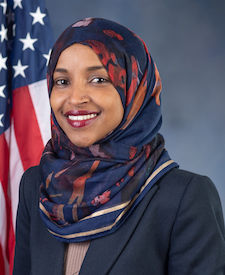
Photo of Ilhan Omar
D United States House · District 5 · Minnesota On the 2026 ballot

Rep. Ilhan Omar

Compare
Total votes
2,837
all sessions
Attendance
98%
43 missed
Near the chamber average
With party
94%
of cast votes
Lower than 77% of chamber peers
Bipartisan score
3%
crosses aisle rarely
Higher than 76% of chamber peers
Sponsored
1,672
bills & resolutions
Higher than 80% of chamber peers
Committees
4
assignments
1,672 bills and resolutions

Sponsored bills

Total
1,672
Primary
79
Co-sponsor
1,593
This page
1,672
matching current filters
Co-sponsor HR 8501
In committee · United States House · Co-sponsor
To prohibit the issuance of licenses for the exportation of certain defense articles to the United Arab Emirates, and for other purposes.

Maddy summaryHR 8501 prohibits the U.S. government from issuing licenses to export certain defense articles to the United Arab Emirates (UAE) or its agencies. This ban takes effect immediately upon the bill's enactment and continues until the President certifies to Congress that the UAE has stopped providing material support to Sudan's Rapid Support Forces (RSF). The restriction applies specifically to military equipment listed in Categories I-VIII, XIV, XVI-XVIII of the U.S. Munitions List (e.g., weapons, vehicles, and related technology). The bill directly affects U.S. defense exporters and the UAE government, requiring congressional oversight before exports can resume.

In committee May 22, 2024 1 co-sponsor
Co-sponsor HR 8311
In committee · United States House · Co-sponsor
Medical Debt Cancellation Act

Maddy summaryThis bill creates a federal grant program to cancel eligible medical debt owed to hospitals by patients. Hospitals can apply for competitive grants to eliminate debt for low-income patients, prioritizing safety-net hospitals serving emergency care patients with debt under 15 months old. It also establishes new rules requiring clear billing statements, banning interest on overdue medical bills, and restricting credit reporting of medical debt. The program aims to reduce financial barriers for patients while expanding to other providers within two years. Patients with specific medical debt types - like emergency care costs from uninsured or low-income individuals - would directly benefit from these changes.

In committee May 17, 2024 1 co-sponsor
Co-sponsor HR 8323
In committee · United States House · Co-sponsor
Comprehensive Addiction Resources Emergency Act of 2024

Maddy summary# Summary of Legislative Text This is a comprehensive legislative proposal focused on addressing substance use disorder through public health approaches, with significant funding and program requirements. Key elements include: 1. **Major Funding Programs:** - **Subtitle A (Local Grants):** $3.0 billion annually (2024-2033) for local entities to provide prevention, treatment, and recovery services - **Subtitle B (State/Regional Grants):** $4.6 billion annually (2024-2033) for state-level programs - **Subtitle C (Other Grants):** $1.0 billion annually (2024-2033) for specific entities and underserved populations - **Subtitle D (Innovation/Training):** $1.5 billion annually (2024-2033) for training, research, and capacity building 2. **Key Program Requirements:** - Mandates for evidence-based treatment services across multiple levels of care - Requirements for cultural competency, particularly for Native American communities - Specific focus on harm reduction, prevention, and recovery support - Provisions for naloxone distribution and overdose reversal programs 3. **Regulatory Changes:** - New certification requirements for covered manufacturers, distributors, and dispensers of Schedule II controlled substances - Penalties for failure to submit certifications or submitting false certifications - Creation of a "Comprehensive Addiction Resources Fund" for penalty revenues 4. **Focus Areas:** - Prevention services (including trauma-informed approaches) - Early intervention services - Recovery support services - Harm reduction programs - Workforce development for treatment providers - Special attention to underserved populations (rural communities, racial minorities, formerly incarcerated individuals) 5. **Funding Priorities:** - 10% of funds for Native American communities - Specific requirements for cultural competency and language access - Mandated data collection and reporting systems This legislation represents a significant shift toward public health approaches to substance use disorder, emphasizing prevention, treatment, and recovery support rather than punitive measures, with substantial funding commitments over a decade.


In committee May 17, 2024 1 co-sponsor
Co-sponsor HR 8301
In committee · United States House · Co-sponsor
United States Call Center Worker and Consumer Protection Act of 2024

Maddy summaryThis bill requires call center employers (with 50+ full-time staff) to notify the Labor Secretary 120 days before moving operations overseas or contracting such work, adding them to a public list for 5 years. Employers on this list become ineligible for federal grants or loans during that period, and federal contracts must prioritize companies not relocating work overseas. It also mandates that all businesses handling customer service communications disclose agent locations at call start (with limited exceptions), allow transfers to U.S.-based agents upon request, and annually certify compliance to the FTC. These provisions directly affect large call center employers and all businesses providing customer service via phone, email, or chat in the U.S.

In committee May 17, 2024 1 co-sponsor
Co-sponsor HR 8426
In committee · United States House · Co-sponsor
Public Service Freedom to Negotiate Act of 2024

Maddy summaryThe Public Service Freedom to Negotiate Act of 2024 establishes federal minimum standards for collective bargaining rights for public employees and supervisory employees. The Federal Labor Relations Authority will determine if each state's laws "substantially provide" for these rights, and if not, federal standards will apply to that state. These standards include the right to self-organization, collective bargaining, recognition of labor organizations, and procedures for resolving disputes. The bill preserves existing collective bargaining agreements and excludes certain employee categories like emergency services workers from some provisions.

In committee May 16, 2024 1 co-sponsor
Co-sponsor HRES 1231
In committee · United States House · Co-sponsor
Recognizing the Nakba and Palestinian refugees' rights.

Maddy summaryThis symbolic resolution (HRES 1231) recognizes the Nakba - the 1948 displacement of Palestinians - as a historical event and ongoing process, affirming U.S. support for Palestinian refugee rights under UN Resolution 194 and the Universal Declaration of Human Rights. It urges the U.S. government to commemorate the Nakba, reject denial of Palestinian rights, support UNRWA services for refugees, and promote public education about the refugee crisis. As a non-binding resolution, it does not change U.S. policy but expresses congressional sentiment. The resolution directly affects how the U.S. government may frame discussions on Palestinian rights and refugee issues.

In committee May 15, 2024 1 co-sponsor
Co-sponsor HR 8370
In committee · United States House · Co-sponsor
Rights for the TSA Workforce Act of 2024

Maddy summaryThe Rights for the TSA Workforce Act of 2024 would transition Transportation Security Administration (TSA) employees, particularly screening agents, from TSA-specific personnel rules to the standard federal government personnel system under Title 5 of the U.S. Code by December 31, 2024. The bill prohibits changes to current personnel policies for covered employees until the transition date and ensures no reduction in pay or benefits during the conversion process. It preserves certain benefits like law enforcement availability pay for Federal air marshals and maintains collective bargaining rights for screening agents. The bill also requires various reports to Congress on recruitment, implementation, diversity, and workplace safety to be submitted within specified timeframes.

In committee May 14, 2024 1 co-sponsor
Co-sponsor HR 8336
In committee · United States House · Co-sponsor
To amend title 10, United States Code, to establish a counseling pathway in the Transition Assistance Program for members of the reserve components of the Armed Forces.

Maddy summaryHR 8336 amends the Transition Assistance Program (TAP) to create a dedicated counseling pathway specifically for members of the reserve components of the Armed Forces. The bill adds language to Section 1142(c)(1) of Title 10, requiring military departments to include this reserve-focused pathway within TAP services. This change directly affects reserve service members transitioning from military to civilian life by providing tailored counseling resources. The bill modifies an existing program structure without creating new benefits or funding.

In committee May 10, 2024 1 co-sponsor
Co-sponsor HR 8253
In committee · United States House · Co-sponsor
BUILD GREEN Infrastructure and Jobs Act

Maddy summaryThe BUILD GREEN Infrastructure and Jobs Act establishes a $50 billion annual grant program (2025-2034) to fund electrified transportation infrastructure projects that reduce greenhouse gas emissions and improve transportation access. It prioritizes projects in frontline, vulnerable, or disadvantaged communities (requiring 40% of funds), with 30-40% allocated to rural areas and 60-70% to urban areas. The bill mandates recipients use 5% of grant funds for workforce training, pay a minimum wage of $17 per hour (increasing annually), and use renewable energy sources for project operations. Eligible projects include electric buses, rail systems, port infrastructure with EV charging, and micromobility initiatives that reduce emissions and improve transportation services.

In committee May 8, 2024 1 co-sponsor
Co-sponsor HR 7924
In committee · United States House · Co-sponsor
ACCESS in Mental Health Act

Maddy summaryThis bill creates grants to support mental and behavioral health graduate programs at minority-serving institutions like historically Black colleges, tribal colleges, and other institutions serving communities of color. It requires at least 5% of grant funds to provide scholarships for students from health professional shortage areas. The grants can help institutions establish or improve programs that train professionals to provide culturally responsive and trauma-informed care. The goal is to increase the number of mental health professionals serving in underserved communities and diversify the mental health workforce.

In committee May 6, 2024 1 co-sponsor
Showing 621 to 630 of 1,672 bills
Previous 1 … 62 63 64 … 168 Next