

Maddy summaryHRES 1279 is a non-binding House resolution expressing support for designating June 2024 as "Black Music Month." It honors Black musicians, creators, and communities whose contributions have shaped American music across genres like blues, jazz, hip-hop, and gospel. The resolution calls on all Americans to recognize the month through actions that elevate Black music's artistry, promote diversity, and spread awareness of its historical impact. It does not create new laws or allocate funding, but serves as a symbolic gesture to celebrate Black music's cultural significance. The resolution was introduced by multiple House members and refers to Black music's role in American history and the civil rights movement.
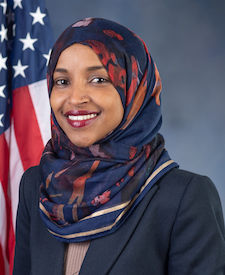
Rep. Ilhan Omar
Sponsored bills
Maddy summaryHRES 1278 is a congressional resolution condemning violence against Garífuna land rights defenders in Honduras and calling for the Honduran government to implement a 2015 Inter-American Court ruling requiring land returns to Garífuna communities. It specifically urges the U.S. State Department to coordinate with Honduras on human rights compliance and requests that multilateral development banks (World Bank and IDB) suspend funding for projects violating Garífuna land rights. The resolution also asks these institutions to review past projects that may have contributed to human rights violations against Garífuna communities and to consult with Garífuna communities before approving new projects. This resolution does not create new laws but serves as a formal statement of congressional position, directly affecting the Garífuna people of Honduras whose cultural survival and land rights are threatened by ongoing displacement and violence.
Maddy summaryThis bill bans rental property owners (with 4+ units) and software services from using algorithms that coordinate pricing or lease terms among landlords, which could enable price-fixing. It specifically prohibits "coordinating functions" like collecting and analyzing rental data to recommend prices or occupancy levels, deeming such use a per se violation of antitrust law. The Federal Trade Commission and state attorneys general can enforce these rules, and victims of violations can sue for triple damages. Pre-dispute arbitration agreements or waivers preventing class actions related to these violations are also invalidated.
Maddy summaryHR 8639, the Warehouse Worker Protection Act, requires employers in covered warehouse facilities (including distribution centers, storage facilities, and delivery services) to provide workers with clear written descriptions of any quotas they're subject to, including how performance is measured and monitored. The bill prohibits quotas that interfere with breaks, safety compliance, or anti-discrimination protections, and mandates that employers provide employee work speed data in human-readable formats. It creates new anti-retaliation protections for workers who exercise these rights or file complaints, and establishes a Fairness and Transparency Office within the Department of Labor to oversee implementation. The act also amends the National Labor Relations Act to explicitly prohibit quotas that discourage workers from exercising their labor rights.
Maddy summaryThe George Floyd Justice in Policing Act of 2024 establishes a National Police Misconduct Registry to track complaints and disciplinary actions against officers, requiring all federal, state, and local law enforcement agencies to report use-of-force incidents with racial, gender, and age data. It bans chokeholds and carotid holds in police encounters, prohibits no-knock warrants in drug cases, and reforms qualified immunity to make it harder for officers to avoid accountability for misconduct. The bill mandates body cameras for federal officers, requires independent investigations of officer-involved shootings, and creates new data collection systems to monitor racial profiling and use-of-force patterns. It also includes provisions for civilian oversight boards, improved officer training on de-escalation and implicit bias, and restrictions on military equipment transfers to local police departments. This law affects all law enforcement agencies receiving federal funding under programs like Byrne and COPS grants.
Maddy summaryHR 8470, the Helping Families Heal Act of 2024, provides federal funding to support mental health services for individuals affected by law enforcement violence. The bill authorizes $50 million annually (2025-2029) to award grants to community organizations and schools for programs that recruit mental health professionals to serve those who witnessed or experienced law enforcement violence, lost family members to it, or are grieving such losses. Key provisions include funding community-based trauma awareness programs, school-based mental health services for students and staff, and establishing an interagency task force to coordinate federal efforts. The bill prioritizes communities with high law enforcement interaction rates, racial bias investigations, or high incarceration rates of people with mental health conditions, while prohibiting funds from going to law enforcement entities.
Maddy summaryThis bill reauthorizes the National Alzheimer's Project Act through 2035 (extending the previous deadline of 2025) and adds new requirements to promote healthy aging and reduce Alzheimer’s risk factors. It mandates the program to provide information on healthy behaviors that may lower cognitive decline risk and expands the advisory group to include representatives from agencies like the Department of Justice, FEMA, and Social Security Administration, plus experts with diverse clinical trial experience. The bill directly affects Alzheimer’s research, care programs, and the federal advisory group overseeing national efforts. Key changes include requiring annual evaluations instead of initial ones and adding a focus on reducing health disparities in Alzheimer’s initiatives.
Maddy summaryThe PAUL Act of 2024 amends the Foreign Agents Registration Act (FARA) to strengthen enforcement by creating a dedicated unit within the Department of Justice, funded with $10 million annually, to investigate and prosecute violations. It increases civil penalties for non-compliance, including up to $200,000 for serious breaches like failing to disclose financial benefits to officials, and requires foreign agents to report any financial transactions (e.g., gifts, favorable treatment) provided to U.S. government officials within the past 60 days. Current registrants must file supplemental disclosures within 90 days of enactment, and collected penalties will fund the new enforcement unit. This directly affects foreign agents representing foreign principals in the U.S., mandating greater transparency about financial interactions with government officials.
Maddy summaryThe PROKID Act establishes an independent Office of the Ombudsperson within the Department of Health and Human Services to monitor facilities where immigrant children are detained. The Ombudsperson will conduct regular site visits, investigate complaints about conditions, and ensure compliance with laws including the Flores settlement agreement. The bill requires detailed data collection on immigrant children in custody, including location, length of stay, and placement details, which must be published monthly on the Office of Refugee Resettlement website. It also creates an expert advisory committee to review facility compliance and make recommendations for improving conditions for immigrant children in government custody.
Maddy summaryHR 8552, the *Protect Democracy From Criminal Corporations Act*, prohibits corporations convicted of certain felonies involving dishonesty (like conspiracy under 18 U.S.C. §371) or those entering agreements requiring $1 million+ payments to make political contributions, independent expenditures, or electioneering communications. It defines "criminal corporations" as those with such convictions or specific settlement agreements, banning their political spending for 10 years after conviction or agreement. The bill amends the Federal Election Campaign Act to enforce this prohibition, directly affecting corporations meeting these criteria. It applies to all federal, state, and local election-related political activity during the 10-year ban period.