

Maddy summaryHR 3303, the Maternal Health for Veterans Act, requires the Department of Veterans Affairs (VA) to annually report on maternity care coordination programs and maternal health outcomes for veterans receiving care through VA facilities or VA-contracted providers. The bill mandates the VA to collect data on maternal outcomes - including disparities affecting high-risk demographic groups - and submit recommendations to Congress by September 2028. It authorizes $15 million annually (2024-2028) for VA maternity care coordination programs, supplementing existing funding without reducing current resources. The law directly affects veterans using VA maternity services, aiming to improve care through data-driven strategies.
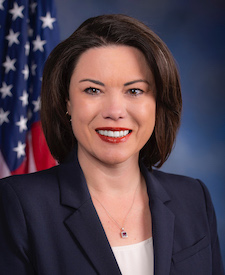
Rep. Angie Craig
Sponsored bills
Maddy summaryHR 1083, the Caring for Survivors Act of 2023, increases financial support for surviving spouses of veterans. It amends Title 38 to raise dependency and indemnity compensation from a fixed $1,154 to 55% of the monthly compensation rate under section 1114(j), effective six months after enactment. The bill also modifies eligibility for survivors of veterans who died before 1993, ensuring they receive the greater of their current benefit or the new calculation. Additionally, it reduces the required continuous service rating period for survivors from 10 years to five years when a veteran was totally disabled at death. These changes directly affect surviving spouses, particularly those with veterans who died prior to 1993.
Maddy summaryHRES 1148 is a resolution passed by the U.S. House of Representatives that condemns the Iranian government for supporting terrorism, regional proxy conflicts, and internal suppression of dissent - including its crackdown on protests following Mahsa Amini's death in 2022. It specifically calls for maintaining sanctions against Iran, supporting the Iranian Resistance's Ten-Point Plan (which advocates for a democratic, secular, nonnuclear Iran), and protecting Iranian political refugees in Albania. The resolution also affirms the Iranian people's right to self-determination under international law and urges the U.S. to recognize their struggle for freedom. As a non-binding resolution, it does not create new laws but formally expresses congressional stance.
Maddy summaryThis bill reauthorizes a federal grant program to improve swimming pool and spa safety, targeting states, Indian Tribes, and qualifying nonprofits (501(c)(3) organizations with pool safety experience). It requires applicants to already have state or tribal laws meeting minimum safety standards for pools built after a certain date. Grant funds must be used for at least 25% on hiring/inspecting drain covers and enforcement, with the remainder for public education on drowning prevention - prioritizing underserved, rural, or minority communities with higher drowning rates. The program is funded at $5 million annually from 2024-2028, with recipients required to submit annual reports on grant use and effectiveness.
Maddy summaryHCONRES 102 is a non-binding symbolic resolution supporting International Transgender Day of Visibility, introduced by multiple House members. It formally encourages the U.S. to observe the day with ceremonies and programs, celebrates transgender community achievements, and recognizes their ongoing fight for equality amid documented discrimination in employment, healthcare, housing, and public spaces. The resolution highlights transgender representation in politics (including 21 state legislators) and historical context, while acknowledging rising anti-transgender legislation. It directly affirms the transgender community's visibility and rights without creating new policies or funding.
Maddy summaryHR 7849, the Disaster Resiliency and Coverage Act of 2024, establishes a federal grant program to help homeowners in high-risk disaster areas make their homes more resilient. The program provides up to $10,000 per household (adjusted annually for inflation) for specific qualifying mitigation activities, such as reinforcing roofs, installing flood barriers, or creating fire-resistant landscaping. Homeowners must have an adjusted gross income under $250,000 ($500,000 for joint filers) and the work must meet FEMA-established standards. States and tribal governments administer the program, with funds intended to incentivize insurance companies to offer or increase coverage in vulnerable areas.
Maddy summaryThe Parity in Engineering Act amends a federal highway law (Section 112(b)(2)(F) of Title 23) by removing Minnesota from a list of states subject to a specific engineering services requirement. It corrects a technical reference by replacing "States of West Virginia or Minnesota" with "State of West Virginia," meaning the provision now applies solely to West Virginia. This change directly affects federal highway engineering contracting processes in West Virginia and Minnesota, with Minnesota no longer covered by this specific rule. The bill makes a narrow procedural adjustment without altering broader policy or impacting other states.
Maddy summaryHR 7825, the Shrinkflation Prevention Act of 2024, would ban manufacturers from reducing product sizes (like smaller cereal boxes or thinner soap bars) without lowering the price proportionally or clearly disclosing the change. It directly affects consumer goods manufacturers by requiring the Federal Trade Commission (FTC) to create regulations prohibiting this practice within 18 months of the bill becoming law. The bill treats shrinkflation as an unfair or deceptive act under existing FTC law, allowing the FTC and state attorneys general to enforce the ban through fines, injunctions, or restitution for affected consumers. This focuses on making product size changes transparent and preventing companies from profiting from misleading downsizing without altering the price.
Maddy summaryHRES 1109 is a symbolic resolution commemorating the 1913 Woman Suffrage Procession in Washington, DC, where suffragists led by Alice Paul and Inez Milholland marched to demand voting rights for women. It honors the participants' courage during a protest that drew 500,000 spectators despite violent opposition, highlighting how this event advanced the national push for the 19th Amendment. The resolution does not create new laws but reaffirms support for voting rights equality, connecting the 1913 march to ongoing efforts to protect democratic access. It specifically acknowledges the intersectional struggles of women of color in the suffrage movement. As a commemorative resolution, it has no binding policy effect.
Maddy summaryHRES 1105 designates March 21, 2024, as "National Women in Agriculture Day" to recognize the contributions of women in the agricultural sector. It specifically highlights women as producers, educators, mentors, and leaders who drive economic impact (accounting for 36% of U.S. agricultural sales in 2022) and support workforce development. The resolution encourages all citizens to acknowledge these women’s roles in food production, agricultural innovation, and mentoring through programs like 4-H and FFA. As a symbolic resolution, it does not create new laws or funding but formally celebrates their ongoing contributions to U.S. agriculture.