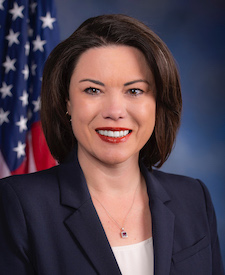
Photo of Angie Craig
D United States House · District 2 · Minnesota

Rep. Angie Craig

Compare
Total votes
2,837
all sessions
Attendance
98%
60 missed
Near the chamber average
With party
93%
of cast votes
Near the chamber average
Bipartisan score
4%
crosses aisle rarely
Near the chamber average
Sponsored
1,831
bills & resolutions
Higher than 95% of chamber peers
Committees
1
assignment
1,831 bills and resolutions

Sponsored bills

Total
1,831
Primary
87
Co-sponsor
1,744
This page
1,831
matching current filters
Co-sponsor HR 1318
Signed into law · United States House · Co-sponsor
Women’s Suffrage National Monument Location Act

Maddy summaryThe Women’s Suffrage National Monument Location Act (HR 1318) authorizes the placement of a monument on the National Mall to honor the women’s suffrage movement and the 19th Amendment. The bill specifies that the monument must be located within a designated area on the National Mall known as the "Reserve," bypassing standard requirements for monument locations under existing law. This legislation sets the physical site for a monument already authorized by previous law (Public Law 116-217), without creating new policy or altering commemorative regulations beyond the location.

Signed into law Jan 4, 2025 1 co-sponsor
Co-sponsor HR 670
Signed into law · United States House · Co-sponsor
Think Differently Database Act

Maddy summaryThe Think Differently Database Act (HR 670) requires the U.S. Department of Health and Human Services (HHS) to create and maintain a public website within three years. The website will provide clear, accessible information about Medicaid eligibility for people with disabilities - including specific state requirements, contact details for state Medicaid offices, and wait times for home-based services. It directly affects individuals with disabilities, their caregivers, and families seeking support through Medicaid programs. The site will standardize resource access across states, using existing Medicaid rules and modeling after the thinkdifferently.net website.

Signed into law Jan 4, 2025 1 co-sponsor
Co-sponsor HR 51
In committee · United States House · Co-sponsor
Washington, D.C. Admission Act

Washington, D.C. Admission Act This bill provides for the establishment of the State of Washington, Douglass Commonwealth, and its admission into the United States. The state is composed of most of the territory of the District of Columbia (DC), excluding a specified area that encompasses the U.S. Capitol, the White House, the U.S. Supreme Court building, federal monuments, and federal office buildings adjacent to the National Mall and the U.S. Capitol. The excluded territory shall be known as the Capital and serve as the seat of the government of the United States, as provided for in Article I of the Constitution. The state may not impose taxes on federal property except as Congress permits. The bill provides for the DC Mayor to issue a proclamation for the first elections to Congress of two Senators and one Representative of the state. The bill eliminates the office of Delegate to the House of Representatives. The bill applies current DC laws to the state. DC judicial proceedings and contractual obligations shall continue under the state’s authority. The bill also provides for specified federal obligations to transfer to the state upon its certification that it has funds and laws in place to assume the obligations. These include maintaining a retirement fund for judges and operating public defender services.  The bill establishes a commission that is generally comprised of members who are appointed by DC and federal government officials to advise on an orderly transition to statehood.

In committee Jan 3, 2025 1 co-sponsor
Co-sponsor HR 158
In committee · United States House · Co-sponsor
CLEAN Elections Act

Maddy summaryHR 158, the CLEAN Elections Act, requires all states to use nonpartisan independent commissions - composed of equal numbers from the two largest political parties and excluding elected officials - to draw both congressional and state legislative district boundaries. This applies starting with the redistricting cycle following the 2020 census for congressional districts and the first post-enactment cycle for state legislative districts. States must certify this process to the federal Election Assistance Commission to continue receiving federal funds for election administration. The bill aims to reduce partisan influence in redistricting by mandating independent, nonpartisan commission oversight.

In committee Jan 3, 2025 1 co-sponsor
Co-sponsor HR 4818
In committee · United States House · Co-sponsor
Treat and Reduce Obesity Act of 2023

Maddy summaryThe Treat and Reduce Obesity Act of 2023 expands Medicare coverage for obesity treatment by allowing a wider range of healthcare providers - including nurse practitioners, dietitians, psychologists, and community-based counseling programs - to deliver intensive behavioral therapy for obesity, provided they coordinate with primary care providers. It also adds Medicare Part D coverage for medications used to treat obesity or for weight loss management in overweight individuals with related health conditions like diabetes or high blood pressure. These changes directly affect Medicare beneficiaries, particularly older adults (65+), who face higher obesity rates and associated costs, including $50 billion annually in Medicare spending for obesity-related care. The bill requires annual reports to Congress on implementation to improve coordination of obesity care across federal health programs.

In committee Dec 27, 2024 1 co-sponsor
Co-sponsor HR 1691
In committee · United States House · Co-sponsor
Ensuring Patient Access to Critical Breakthrough Products Act of 2024

Maddy summaryThis bill creates a 4-year transitional coverage period for Medicare to automatically cover "breakthrough medical devices" - new FDA-prioritized devices approved after March 2021 - as "reasonable and necessary" for treatment. During this period, these devices qualify for additional payments under Medicare's hospital and outpatient payment systems without requiring separate approval. After the 4-year period, Medicare must develop regular coverage based on additional data, with automatic coverage for all approved uses if no action is taken within two years. The bill requires Medicare to assign unique codes for these devices within three months of FDA approval and to update payment systems regularly. It also includes special provisions for "specified breakthrough devices" that lack existing Medicare benefit categories, requiring reports on their impact and cost to Congress.

In committee Dec 24, 2024 1 co-sponsor
Co-sponsor HR 5646
Signed into law · United States House · Co-sponsor
Stop Campus Hazing Act

Maddy summaryThe Stop Campus Hazing Act requires colleges and universities to publicly report hazing incidents involving student organizations. It defines hazing as intentional acts causing physical or psychological harm during initiation or membership in student groups, including activities like forced substance consumption, sleep deprivation, or sexual acts. Institutions must include hazing statistics in annual security reports and publish a "Campus Hazing Transparency Report" on their websites by July 1, 2025, detailing findings about organizations violating hazing policies. The reports must include organization names, violation descriptions, and key dates while excluding personally identifiable student information. This applies to all colleges participating in federal student aid programs.

Signed into law Dec 23, 2024 1 co-sponsor
Co-sponsor HR 1097
Signed into law · United States House · Co-sponsor
Everett Alvarez, Jr. Congressional Gold Medal Act of 2023

Maddy summaryThis bill, HR 1097 (Everett Alvarez, Jr. Congressional Gold Medal Act of 2023), authorizes the award of a Congressional Gold Medal to Everett Alvarez, Jr., in recognition of his service as a U.S. Navy pilot and Vietnam War prisoner of war. It directly honors Alvarez, who was the first U.S. pilot shot down in the Vietnam War, spent over 8.5 years in captivity, and later served in the Peace Corps and Veterans Administration. The bill’s key mechanism is directing the U.S. Mint to strike a gold medal bearing his name and image, with bronze duplicates available for sale to cover costs. It does not create new policies or affect any group beyond the honoree.

Signed into law Dec 23, 2024 1 co-sponsor
Co-sponsor HR 2367
In committee · United States House · Co-sponsor
Truck Parking Safety Improvement Act

Maddy summaryHR 2367, the Truck Parking Safety Improvement Act, creates a federal grant program to address commercial truck parking shortages on highways. It provides competitive grants (totaling $175M-$320M over three years) for projects like building new rest areas, expanding parking at ports or truck stops, or improving safety at existing facilities. The program requires all funded parking to be free, publicly accessible to all truck drivers, and maintained without user fees. This directly affects commercial truck drivers, motor carriers, and highway safety by aiming to improve parking access, reduce traffic congestion, and enhance safety on federal-aid highways.

In committee Dec 19, 2024 1 co-sponsor
Co-sponsor HR 3269
In committee · United States House · Co-sponsor
Law Enforcement Innovate to De-Escalate Act

Maddy summaryHR 3269, the Law Enforcement Innovate to De-Escalate Act, exempts specific less-than-lethal projectile devices from federal firearm taxes and National Firearms Act restrictions. The bill defines these devices as those firing projectiles at under 500 feet per second and designed not to cause death or serious injury. This directly affects law enforcement agencies using such devices and manufacturers producing them, by removing tax burdens and registration requirements. The key change is creating a clear legal exemption for these devices under federal law, streamlining their use for de-escalation purposes.

In committee Dec 18, 2024 1 co-sponsor
Showing 711 to 720 of 1,831 bills
Previous 1 … 71 72 73 … 184 Next