

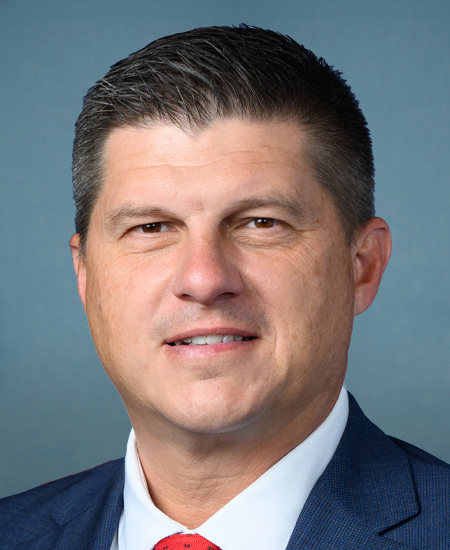
Photo of Brad Finstad
R United States House · District 1 · Minnesota On the 2026 ballot

Rep. Brad Finstad

Compare
Total votes
2,001
all sessions
Attendance
99%
17 missed
Higher than 78% of chamber peers
With party
96%
of cast votes
Higher than 83% of chamber peers
Bipartisan score
2%
crosses aisle rarely
Lower than 84% of chamber peers
Sponsored
819
bills & resolutions
Near the chamber average
Committees
11
assignments
819 bills and resolutions

Sponsored bills

Total
819
Primary
67
Co-sponsor
752
This page
819
matching current filters
Co-sponsor HR 2367
In committee · United States House · Co-sponsor
Truck Parking Safety Improvement Act

Maddy summaryHR 2367, the Truck Parking Safety Improvement Act, creates a federal grant program to address commercial truck parking shortages on highways. It provides competitive grants (totaling $175M-$320M over three years) for projects like building new rest areas, expanding parking at ports or truck stops, or improving safety at existing facilities. The program requires all funded parking to be free, publicly accessible to all truck drivers, and maintained without user fees. This directly affects commercial truck drivers, motor carriers, and highway safety by aiming to improve parking access, reduce traffic congestion, and enhance safety on federal-aid highways.

In committee Dec 19, 2024 1 co-sponsor
Co-sponsor HR 3269
In committee · United States House · Co-sponsor
Law Enforcement Innovate to De-Escalate Act

Maddy summaryHR 3269, the Law Enforcement Innovate to De-Escalate Act, exempts specific less-than-lethal projectile devices from federal firearm taxes and National Firearms Act restrictions. The bill defines these devices as those firing projectiles at under 500 feet per second and designed not to cause death or serious injury. This directly affects law enforcement agencies using such devices and manufacturers producing them, by removing tax burdens and registration requirements. The key change is creating a clear legal exemption for these devices under federal law, streamlining their use for de-escalation purposes.

In committee Dec 18, 2024 1 co-sponsor
Co-sponsor HR 8977
In committee · United States House · Co-sponsor
Improving Access to Emergency Medical Services Act of 2024

Maddy summaryThis bill creates a new Medicare payment model for emergency medical services (EMS) that allows coverage when ambulance providers deliver critical care on-site without transporting patients to a hospital. It directly affects Medicare beneficiaries receiving such on-site emergency care and ambulance providers who would previously not be reimbursed for non-transport services. The key provision requires Medicare to pay for these services at rates matching what would have been paid for transport, based on state protocols and emergency call responses, for a 5-year trial period. A report due 4 years after implementation will evaluate impacts on patient outcomes, system efficiency, and regional access.

In committee Dec 17, 2024 1 co-sponsor
Co-sponsor HR 8801
In committee · United States House · Co-sponsor
MOMS Act

Maddy summaryThe MOMS Act establishes a federal resource website called pregnancy.gov that will help pregnant and postpartum women find local services through a ZIP code-based search system. It creates grant programs to support nonprofit organizations providing services like medical care, housing assistance, and parenting support to pregnant women, while prohibiting organizations that provide or support abortion from receiving these funds. The bill also amends child support laws to allow enforcement of child support obligations for unborn children, beginning from the month of conception with the mother's consent. These provisions aim to improve access to prenatal and postnatal resources while maintaining a focus on supporting women and their families.

In committee Dec 17, 2024 1 co-sponsor
Co-sponsor HR 8702
In committee · United States House · Co-sponsor
Improving Seniors’ Timely Access to Care Act of 2024

Maddy summaryThis bill requires Medicare Advantage plans to implement electronic prior authorization systems by 2027 and publish detailed data on their approval and denial rates for medical services by 2026. It directly affects Medicare Advantage plans (private insurers offering Medicare coverage) and their enrollees (seniors 65+), mandating transparency about prior authorization decisions, processing times, and appeal outcomes. Key provisions include requiring plans to report annual statistics on request approvals/denials, average processing times, and use of technology, with this data published publicly by the Centers for Medicare & Medicaid Services. The bill also sets timelines for plan responses to prior authorization requests and mandates reports to Congress on implementation and impacts.

In committee Dec 17, 2024 1 co-sponsor
Co-sponsor HR 8398
In committee · United States House · Co-sponsor
Miscellaneous Tariff Bill Reform Act

Maddy summary# Summary of Tariff Suspensions and Reductions Document This document is a section of U.S. tariff legislation that adds new duty suspensions and reductions to the Harmonized Tariff Schedule of the United States. It contains 120 new tariff items (numbered 9902.19.01 through 9902.20.24) that provide temporary duty-free or reduced-duty status for various goods. Key features of the document: 1. **Content**: The list includes chemical compounds, food ingredients, and specialty materials (such as shelled pine nuts, licorice extract, refined carrageenan, various chemicals like neodymium metal, tungsten concentrate, and numerous organic compounds). 2. **Tariff Treatment**: Most entries are listed as "Free" (meaning duty-free), with a few having small duty rates (e.g., 0.7%, 1.8%, 2.3%, 2.9%, 4.3%). 3. **Effective Period**: All listed suspensions and reductions are effective "On or before 12/31/2025." 4. **Purpose**: These tariff suspensions are intended to support specific industries, reduce costs for manufacturers, or provide temporary relief for certain imported goods. 5. **Technical Details**: Each entry includes the chemical name, CAS number, Harmonized Tariff Schedule code, duty rate, and a brief description of the product. This document represents a legislative amendment to the Harmonized Tariff Schedule, specifically adding new subchapter II of chapter 99 to provide temporary duty relief for these specific items.

In committee Dec 17, 2024 1 co-sponsor
Co-sponsor HR 8331
In committee · United States House · Co-sponsor
Essential Caregivers Act of 2024

Maddy summaryThe Essential Caregivers Act of 2024 requires nursing homes and similar facilities to allow residents to designate essential caregivers who provide emotional support or assistance with daily activities. During emergencies when regular visitation is restricted, facilities must permit at least one essential caregiver access to residents daily and cannot deny access without following specific procedures. Facilities may deny access for a maximum of 7 days during emergencies (or 14 days with state approval), and must provide a written explanation and appeal process if access is denied. The bill establishes a 48-hour appeal process for residents and caregivers to challenge denials, with facilities required to prove violations during appeals. This law applies to Medicare skilled nursing facilities, Medicaid nursing facilities, intermediate care facilities, and certain inpatient rehabilitation facilities.

In committee Dec 17, 2024 1 co-sponsor
Co-sponsor HR 7636
In committee · United States House · Co-sponsor
Responsible Use of Seafloor Resources Act of 2024

Maddy summaryThe Responsible Use of Seafloor Resources Act of 2024 directs the President to coordinate federal agencies in supporting U.S. development of seafloor nodule collection and domestic processing for critical minerals used in defense and clean energy. It mandates annual reports analyzing the environmental, social, and economic impacts of seafloor minerals compared to land-based mining, including job creation and ecosystem effects. The reports will assess how U.S. sourcing aligns with security goals and international standards, while tracking benefits like supply chain diversification and reduced reliance on foreign sources.

In committee Dec 17, 2024 1 co-sponsor
Co-sponsor HR 7476
In committee · United States House · Co-sponsor
Countering Communist China Act

Maddy summary# Summary of Proposed Legislation This document outlines a comprehensive U.S. legislative proposal with several key components: 1. **Research Restrictions**: - Requires certification from Federal research grant recipients that they are not Chinese citizens or participants in Chinese talent programs - Prohibits employment of Chinese nationals in federally funded research - Requires institutions receiving Federal assistance to agree not to knowingly employ individuals participating in Chinese talent programs 2. **Foreign Gifts and Contracts Disclosure**: - Mandates disclosure of foreign gifts/contracts over $50,000 to universities - Requires public reporting of restricted/conditional gifts/contracts - Creates a searchable public database of foreign gifts to universities - Requires institutions to maintain policies regarding foreign gifts to faculty and staff 3. **Investment Restrictions**: - Restricts tax-exempt organizations from holding investments in "disqualified Chinese companies" (defined as corporations incorporated in China or with significant Chinese government ownership) - Requires annual reporting on such investments - Allows limited waivers with public disclosure 4. **Taiwan Policy**: - Prohibits U.S. government from recognizing PRC claims to sovereignty over Taiwan without Taiwan's consent - Requires U.S. government to treat Taiwan's democratically elected government as the legitimate representative of the people of Taiwan - Requires a strategy to protect U.S. businesses from Chinese coercion efforts 5. **Additional Provisions**: - Requires participants in Chinese talent programs to register as agents of the Chinese government - Amends economic espionage laws to include education and research - Mandates disclosure of certain funds received by visa holders The legislation represents a significant effort to limit Chinese influence in U.S. academic institutions, research, and business sectors while establishing a more robust policy framework regarding Taiwan.

In committee Dec 17, 2024 1 co-sponsor
Co-sponsor HR 7254
In committee · United States House · Co-sponsor
Hearing Device Coverage Clarification Act

Maddy summaryThis bill clarifies that Medicare must cover fully implanted active middle ear hearing devices as prosthetics, not as hearing aids. It requires the Centers for Medicare & Medicaid Services (CMS) to update its rules within 60 days of the bill's enactment to remove these devices from Medicare's hearing aid coverage exclusion. This directly affects Medicare beneficiaries who rely on these specific implanted devices for hearing. The change means these devices will now be covered under Medicare's prosthetic benefits, not excluded under hearing aid rules, without altering existing coverage for other hearing aids.

In committee Dec 17, 2024 1 co-sponsor
Showing 371 to 380 of 819 bills
Previous 1 … 37 38 39 … 82 Next