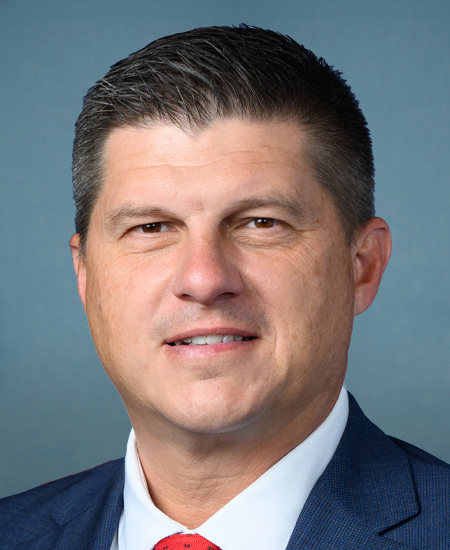
Photo of Brad Finstad
R United States House · District 1 · Minnesota On the 2026 ballot

Rep. Brad Finstad

Compare
Total votes
2,001
all sessions
Attendance
99%
17 missed
Higher than 78% of chamber peers
With party
96%
of cast votes
Higher than 83% of chamber peers
Bipartisan score
2%
crosses aisle rarely
Lower than 84% of chamber peers
Sponsored
815
bills & resolutions
Near the chamber average
Committees
11
assignments
815 bills and resolutions

Sponsored bills

Total
815
Primary
67
Co-sponsor
748
This page
815
matching current filters
Co-sponsor HR 2968
In committee · United States House · Co-sponsor
Business over Ballots Act

Maddy summaryHR 2968 prohibits the Small Business Administration (SBA) from using its programs or funds to assist with voter registration. It requires all SBA contracts to include terms banning recipients from using assistance for voter registration and prevents state or local governments receiving SBA funds from doing so. The bill directly affects SBA operations and its grant recipients, including state agencies, by restricting how federal funds can be utilized. It does not create new programs but limits the SBA’s existing authority to avoid involvement in voter registration activities.

In committee Apr 30, 2025 1 co-sponsor
Co-sponsor HR 3033
In committee · United States House · Co-sponsor
Protecting the Mailing of Firearms Act

Maddy summaryHR 3033, the "Protecting the Mailing of Firearms Act," repeals a federal law (18 U.S.C. §1715) that previously prohibited mailing firearms and related items. This bill directly affects firearm sellers, buyers, and the U.S. Postal Service by removing the ban on mailing firearms, ammunition, and components. It also prohibits the Postmaster General from creating rules that would block firearm mailings or require disclosure of sales receipts, transaction records, or firearm serial numbers. The law takes effect immediately for pending cases and prevents new restrictions on firearm shipping through the postal system.

In committee Apr 28, 2025 1 co-sponsor
Co-sponsor HRES 337
In committee · United States House · Co-sponsor
Recognizing linemen, the profession of linemen, the contributions of these brave men and women who protect public safety, and expressing support for the designation of April 18, 2025, as "National Lineman Appreciation Day".

Maddy summaryHRES 337 is a symbolic House resolution honoring linemen for their critical role in maintaining power infrastructure and responding to emergencies. It recognizes them as first responders who work in dangerous conditions 24/7 to keep electricity flowing, supporting schools and businesses during storms. The resolution formally supports designating April 18, 2025, as "National Lineman Appreciation Day" to publicly acknowledge their contributions. As a non-binding resolution, it has no direct policy impact or effect on affected individuals.

In committee Apr 17, 2025 1 co-sponsor
Co-sponsor HR 2964
In committee · United States House · Co-sponsor
Fight Fentanyl Act

Maddy summaryThe Fight Fentanyl Act increases annual funding for fentanyl-related law enforcement efforts to $333 million from 2025 through 2030. It requires the Office of National Drug Control Policy to report annually on how HIDTA (High Intensity Drug Trafficking Area) funds target fentanyl trafficking, including seizure data and threat assessments. The bill also mandates the Attorney General to prioritize fentanyl prosecutions by temporarily reassigning U.S. attorneys to these cases. These provisions directly affect federal, state, local, and tribal law enforcement agencies working on fentanyl interdiction and prosecution.

In committee Apr 17, 2025 1 co-sponsor
Co-sponsor HR 2926
In committee · United States House · Co-sponsor
National Energy Dominance Council Act of 2025

Maddy summaryThe National Energy Dominance Council Act of 2025 establishes a new council within the Executive Office of the President, chaired by the Secretary of the Interior and including 20+ cabinet secretaries and White House officials. The council’s primary role is to advise the President on strategies to increase U.S. energy production, reduce unnecessary regulations, and streamline permitting for energy infrastructure. Key provisions require the council to develop a "National Energy Dominance Strategy" within 100 days, focusing on cutting bureaucratic delays, boosting private-sector investment, and fast-tracking projects like natural gas pipelines and Small Modular Nuclear Reactors. The council must also consult with state, local, tribal governments and private sector stakeholders to address energy affordability and reliability for homes, vehicles, and industries.

In committee Apr 17, 2025 1 co-sponsor
Co-sponsor HR 2911
In committee · United States House · Co-sponsor
Accounting STEM Pursuit Act of 2025

Maddy summaryThis bill amends the Elementary and Secondary Education Act to explicitly include accounting education as part of a well-rounded K-12 curriculum. It requires schools to develop and strengthen programs teaching accounting, including increasing access to high-quality accounting courses for students from groups historically underrepresented in accounting careers. The key provision inserts specific language into existing law, directing schools to promote accounting career awareness and expand course availability through grade 12. This directly affects K-12 students, particularly those from underrepresented backgrounds, by making accounting education a recognized component of career-focused learning.

In committee Apr 14, 2025 1 co-sponsor
Co-sponsor HR 2854
In committee · United States House · Co-sponsor
Neighborhood Homes Investment Act

Maddy summaryThe Neighborhood Homes Investment Act creates a new tax credit for developers who build or rehabilitate affordable homes in distressed communities. The credit is calculated as the lesser of (1) the difference between development costs and sale price, (2) 40% of development costs, or (3) 32% of the national median home price. It applies only to homes sold to qualified homeowners with income up to 140% of area median income in designated "qualified census tracts" (areas with high poverty rates, low median home values, and low median family income). Developers must meet quality standards and repay the credit if the home is sold within 5 years of the affordable sale. This credit aims to address the "value gap" that prevents housing development in distressed communities by incentivizing affordable home construction and rehabilitation.

In committee Apr 10, 2025 1 co-sponsor
Co-sponsor HR 2819
In committee · United States House · Co-sponsor
DRIVE Act

Maddy summaryHR 2819, the DRIVE Act, prohibits the Federal Motor Carrier Safety Administration from requiring speed limiting devices on trucks weighing over 26,000 pounds operating in interstate commerce. This directly affects commercial truck drivers and carriers that operate large vehicles across state lines. The bill blocks the agency from implementing any rule mandating speed limiters that would cap these trucks' maximum speed. It prevents a potential new federal requirement for trucking companies without altering existing safety standards.

In committee Apr 10, 2025 1 co-sponsor
Co-sponsor HR 22
Passed · United States House · Co-sponsor
SAVE Act

Safeguard American Voter Eligibility Act or the SAVE Act This bill requires individuals to provide documentary proof of U.S. citizenship when registering to vote in federal elections. Specifically, the bill prohibits states from accepting and processing an application to register to vote in a federal election unless the applicant presents documentary proof of U.S. citizenship. The bill specifies what documents are considered acceptable proof of U.S. citizenship, such as identification that complies with the REAL ID Act of 2005 that indicates U.S. citizenship. Further, the bill (1) prohibits states from registering an individual to vote in a federal election unless, at the time the individual applies to register to vote, the individual provides documentary proof of U.S. citizenship; and (2) requires states to establish an alternative process under which an applicant may submit other evidence to demonstrate U.S. citizenship. Each state must take affirmative steps on an ongoing basis to ensure that only U.S. citizens are registered to vote, which shall include establishing a program to identify individuals who are not U.S. citizens using information supplied by certain sources. Additionally, states must remove noncitizens from their official lists of eligible voters. The bill allows for a private right of action against an election official who registers an applicant to vote in a federal election who fails to present documentary proof of U.S. citizenship. The bill establishes criminal penalties for certain offenses, including registering an applicant to vote in a federal election who fails to present documentary proof of U.S. citizenship.


Passed Apr 10, 2025 1 co-sponsor
Co-sponsor HR 2756
In committee · United States House · Co-sponsor
National Biotechnology Initiative Act of 2025

Maddy summaryThe National Biotechnology Initiative Act of 2025 establishes a coordinated federal strategy for biotechnology across 14 participating departments and agencies, including Agriculture, Defense, and Health and Human Services. It creates a National Biotechnology Coordination Office and an Interagency Committee to oversee activities related to research, regulatory streamlining, workforce development, and international partnerships. The bill authorizes $22 million in fiscal year 2026, increasing to $35 million by 2027, and requires annual reports and a national strategy every five years. Key provisions include developing a centralized website for biotechnology information, standardizing regulatory pathways for biotechnology products, and improving workforce development programs. This legislation aims to reduce duplication, improve coordination across government departments, and enhance U.S. competitiveness in biotechnology.

In committee Apr 9, 2025 1 co-sponsor
Showing 211 to 220 of 815 bills
Previous 1 … 21 22 23 … 82 Next