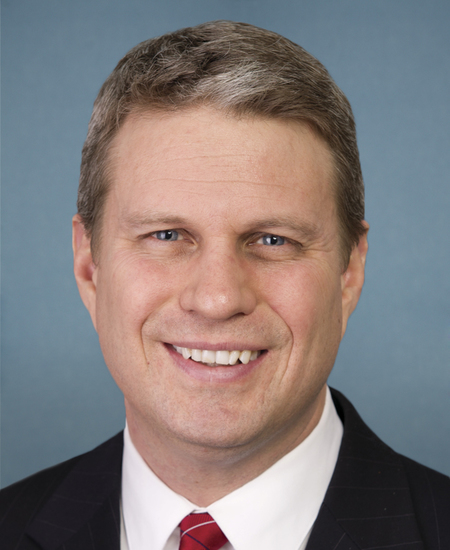
Photo of Bill Huizenga
R United States House · District 4 · Michigan On the 2026 ballot

Rep. Bill Huizenga

Compare
Total votes
2,837
all sessions
Attendance
99%
40 missed
Near the chamber average
With party
96%
of cast votes
Near the chamber average
Bipartisan score
2%
crosses aisle rarely
Near the chamber average
Sponsored
725
bills & resolutions
Near the chamber average
Committees
6
assignments
725 bills and resolutions

Sponsored bills

Total
725
Primary
80
Co-sponsor
645
This page
725
matching current filters
Co-sponsor HR 3132
In committee · United States House · Co-sponsor
CHOICE for Veterans Act of 2025

Maddy summaryThis bill creates a new system for recognizing and regulating individuals who help veterans file benefit claims. It requires the VA to provide veterans with information about free assistance options and maintain a public list of accredited representatives. The bill sets a maximum fee limit of $12,500 or 5 times the monthly benefit increase for representatives, and establishes penalties for unaccredited representatives who charge improper fees. The law aims to protect veterans from unscrupulous representatives while ensuring they have access to quality assistance with their benefit claims.

In committee May 6, 2025 1 co-sponsor
Co-sponsor HR 2392
In committee · United States House · Co-sponsor
STABLE Act of 2025

Maddy summaryThe STABLE Act of 2025 establishes a regulatory framework for stablecoins, which are digital assets designed to maintain a stable value relative to a national currency. It restricts stablecoin issuance to "permitted payment stablecoin issuers," including bank subsidiaries, federally-approved nonbank entities, and state-qualified issuers. These issuers must maintain 1:1 reserves backed by specific assets (like U.S. currency, Treasury securities, or demand deposits), publish monthly reserve reports, and cannot pay interest to stablecoin holders. The Act also includes transparency requirements, restrictions on leadership (prohibiting those with certain felony convictions), and preempts conflicting state laws for federally-approved issuers.

In committee May 6, 2025 1 co-sponsor
Co-sponsor HR 976
In committee · United States House · Co-sponsor
1071 Repeal to Protect Small Business Lending Act

Maddy summaryHR 976, the "1071 Repeal to Protect Small Business Lending Act," would repeal data collection and reporting requirements for small business loans under Section 704B of the Equal Credit Opportunity Act. This specifically removes the mandate for financial institutions - especially community banks and credit unions - to track and submit loan data by business characteristics like race or gender. The bill aims to reduce compliance costs for lenders, which its findings argue limit small business access to credit. The repeal would eliminate these reporting obligations and remove references to the requirement from related federal laws.

In committee May 6, 2025 1 co-sponsor
Co-sponsor HR 478
In committee · United States House · Co-sponsor
Promoting New Bank Formation Act

Maddy summaryThis bill provides a 3-year transition period for newly insured banks to meet federal capital requirements, easing compliance for institutions that recently became federally insured. It allows these banks to request temporary deviations from approved business plans, with regulators required to respond within 30 days (or the request is automatically approved). Small rural banks with less than $10 billion in assets located in rural areas receive a lower 8% leverage ratio requirement during this transition. Additionally, the bill expands lending authority for certain banks to include agricultural loans and requires a federal study on increasing new bank formations in underserved areas.

In committee May 6, 2025 1 co-sponsor
Primary HR 3191
In committee · United States House · Lead sponsor
Made in America Motors Act

Maddy summaryThis bill creates a new tax deduction for individuals who pay interest on loans for qualifying American-made vehicles. It allows a deduction of up to $2,500 per tax year for interest paid on vehicles manufactured primarily in the U.S. with final assembly completed within the country, weighing under 14,000 pounds, and having at least four wheels. The deduction applies regardless of whether the taxpayer itemizes other deductions and is available for vehicles purchased on or after January 1, 2025. It becomes effective for tax years beginning after December 31, 2025.

In committee May 5, 2025 0 co-sponsors
Co-sponsor HR 3151
In committee · United States House · Co-sponsor
SHIPS for America Act of 2025

Maddy summary# Summary of the SHIPS for America Act This comprehensive legislation focuses on strengthening the U.S. maritime industry, shipbuilding capacity, and maritime workforce to enhance national security and economic competitiveness. ## Key Areas of Focus 1. **Shipbuilding & Maritime Infrastructure** - Establishes a United States Center for Maritime Innovation to accelerate adoption of commercial technologies - Creates a National Shipbuilding Research Program - Requires an annual survey of anticipated commercial vessel construction - Includes provisions for streamlined environmental reviews of maritime infrastructure 2. **Workforce Development** - Establishes the United States Merchant Marine Career Retention Program to maintain mariner qualifications - Creates Centers of Excellence for Domestic Maritime Workforce Training and Education - Implements military-to-maritime transition programs - Establishes a Maritime Career and Technical Education Advisory Committee 3. **Education & Training** - Expands educational assistance for merchant mariners - Creates eligibility for Naval Postgraduate School for merchant mariners - Establishes maritime education programs from K-12 through higher education - Provides for international exchanges for mariners and naval architects 4. **National Security & Strategic Readiness** - Requires reports on National Defense Reserve Fleet utilization - Includes measures to de-risk the maritime sector from Chinese influence - Enhances shipbuilding capacity for national security needs - Establishes programs to ensure sufficient mariner workforce for national defense 5. **Funding Mechanisms** - Authorizes appropriations from the Maritime Security Trust Fund - Includes funding for workforce programs, education, and shipbuilding initiatives - Establishes specific funding levels for various programs over multiple fiscal years The legislation aims to create a sustainable domestic maritime industrial base that supports both commercial shipping and national defense requirements, with a particular emphasis on developing and retaining a skilled U.S. maritime workforce.

In committee May 1, 2025 1 co-sponsor
Co-sponsor HRES 337
In committee · United States House · Co-sponsor
Recognizing linemen, the profession of linemen, the contributions of these brave men and women who protect public safety, and expressing support for the designation of April 18, 2025, as "National Lineman Appreciation Day".

Maddy summaryHRES 337 is a symbolic House resolution honoring linemen for their critical role in maintaining power infrastructure and responding to emergencies. It recognizes them as first responders who work in dangerous conditions 24/7 to keep electricity flowing, supporting schools and businesses during storms. The resolution formally supports designating April 18, 2025, as "National Lineman Appreciation Day" to publicly acknowledge their contributions. As a non-binding resolution, it has no direct policy impact or effect on affected individuals.

In committee Apr 17, 2025 1 co-sponsor
Primary HR 2850
In committee · United States House · Lead sponsor
Youth Sports Facilities Act of 2025

Maddy summaryHR 2850, the Youth Sports Facilities Act of 2025, amends the Public Works and Economic Development Act of 1965 to expand eligibility for federal grants to include youth sports facilities. It specifically requires these facilities to address sedentary lifestyles and obesity, prioritize low-income rural youth in underserved communities, and serve children lacking access to physical education spaces or living in areas with high opioid use or violence. The bill mandates that grant-funded projects must benefit highly rural communities with limited tax revenue and support economic development through youth sports infrastructure. It directly affects communities and children in rural, underserved, or high-risk areas by directing federal funding toward building or improving local sports facilities. The key mechanism is modifying existing grant criteria to prioritize these specific community needs through new eligibility requirements.

In committee Apr 10, 2025 0 co-sponsors
Co-sponsor HR 22
Passed · United States House · Co-sponsor
SAVE Act

Safeguard American Voter Eligibility Act or the SAVE Act This bill requires individuals to provide documentary proof of U.S. citizenship when registering to vote in federal elections. Specifically, the bill prohibits states from accepting and processing an application to register to vote in a federal election unless the applicant presents documentary proof of U.S. citizenship. The bill specifies what documents are considered acceptable proof of U.S. citizenship, such as identification that complies with the REAL ID Act of 2005 that indicates U.S. citizenship. Further, the bill (1) prohibits states from registering an individual to vote in a federal election unless, at the time the individual applies to register to vote, the individual provides documentary proof of U.S. citizenship; and (2) requires states to establish an alternative process under which an applicant may submit other evidence to demonstrate U.S. citizenship. Each state must take affirmative steps on an ongoing basis to ensure that only U.S. citizens are registered to vote, which shall include establishing a program to identify individuals who are not U.S. citizens using information supplied by certain sources. Additionally, states must remove noncitizens from their official lists of eligible voters. The bill allows for a private right of action against an election official who registers an applicant to vote in a federal election who fails to present documentary proof of U.S. citizenship. The bill establishes criminal penalties for certain offenses, including registering an applicant to vote in a federal election who fails to present documentary proof of U.S. citizenship.


Passed Apr 10, 2025 1 co-sponsor
Co-sponsor HR 2731
In committee · United States House · Co-sponsor
Great Lakes Mapping Act of 2025

Maddy summaryThe Great Lakes Mapping Act of 2025 requires the National Oceanic and Atmospheric Administration (NOAA) to create high-resolution maps of all Great Lakes lakebeds by December 31, 2030. This includes collecting detailed depth measurements, cataloging existing data, and managing metadata, with NOAA coordinating with Great Lakes states, regional councils, and existing initiatives. The bill mandates that partial maps be shared publicly during the project and the full map with supporting data must be released within 180 days of completion. It authorizes $50 million annually (2025-2029) for this effort, with funds available through 2030. The law directly affects NOAA and its partners, enabling improved resource management and navigation through publicly accessible lakebed data.

In committee Apr 8, 2025 1 co-sponsor
Showing 181 to 190 of 725 bills
Previous 1 … 18 19 20 … 73 Next