Countering China Economic Coercion Act This bill establishes an interagency task force to respond to the Chinese government's acts of economic coercion. The task force must oversee the development and implementation of an integrated U.S. government strategy to respond to such acts of economic coercion. The strategy must include an evaluation of the costs such acts have on U.S. businesses and economic performance. The task force must also report to Congress on the strategy as well as a comprehensive review on the economic tools that the Chinese government uses (or can use) to coerce other governments, non-Chinese companies, and multilateral institutions and organizations.
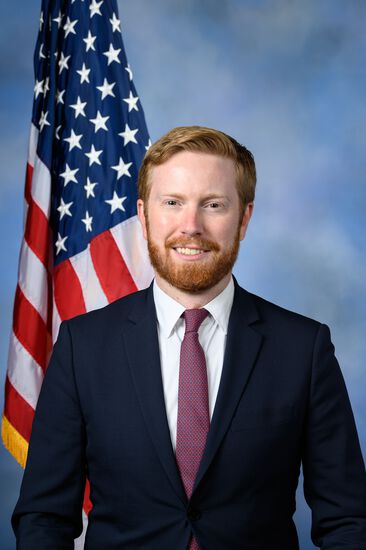
Rep. Peter Meijer
Sponsored bills
Prohibiting IRS Financial Surveillance Act This bill prohibits the Department of the Treasury from requiring a financial institution to report the transfers into and out of a financial account. This prohibition does not apply to laws or regulations in effect on October 1, 2021.
Urban Waters Federal Partnership Act of 2021 This bill provides statutory authority for the Urban Waters Federal Partnership Program. Under the program, the Environmental Protection Agency and other specified agencies must reconnect urban communities, particularly urban communities that are overburdened or economically distressed, with their waterways by improving coordination among federal agencies.
This resolution requests the President and directs the Department of State to transmit to the House of Representatives, not later than 14 days after the adoption of this resolution, copies of both classified and unclassified documents that refer or relate to certain information on the withdrawal of the United States from Afghanistan, including reactions, concerns, or objections expressed by certain allies and partners; any agreement reached with the Taliban related to the evacuation of specified individuals; and numbers of specified individuals in contact with the State Department to request evacuation assistance from Afghanistan, from July 30, 2021, to the present.
National Security Reforms and Accountability Act This bill limits presidential authorities related to, and increases congressional oversight of, introducing U.S. armed forces into hostilities, arms transactions, and national emergencies. The bill makes various changes to the War Powers Resolution, which provides procedures for Congress and the President to participate in decisions to send U.S. forces into hostilities. These changes include requiring specific statutory authorization for, and revising congressional procedures to approve or disapprove of, the introduction of U.S. forces into hostilities. The bill also prohibits the use of federal funds for any activity of U.S. forces that lacks the required authorization. The President must also seek congressional approval before entering, renewing, or extending an arms sale or related transaction if the transaction exceeds specified dollar thresholds. This does not apply to transactions with NATO and its member countries, Australia, Japan, South Korea, Israel, New Zealand, or Taiwan. The bill also prohibits transfers of defense articles and services to countries that commit genocide or otherwise violate international humanitarian law. The bill restricts presidential authorities related to national emergencies, including by limiting the period of a declared emergency to 30 days unless Congress authorizes an extension. The bill also establishes procedures for approving or disapproving an extension, requires the President to provide more detailed reports to Congress about national emergencies, and sets out specific provisions for terminating an emergency.

This bill requires the Department of Veterans Affairs to provide training and technical assistance to grant recipients and recipients of per diem payments regarding the planning, development, and provision of services for homeless veterans for which the grants or payments are made. Additionally, the bill removes the cap on the amount available under the Supportive Services for Veterans Families program for training and technical assistance.
Israel Relations Normalization Act of 2021 This bill requires the Department of State to take certain actions promoting the normalization of relations between Israel, Arab states, and other relevant countries and regions. Specifically, the State Department must develop a strategy on expanding and strengthening the Abraham Accords (the term used to refer collectively to agreements between Israel and the United Arab Emirates and between Israel and Bahrain marking the public normalization of relations between the two Arab countries and Israel). The strategy must include a description of how the U.S. government will encourage further normalization of relations with Israel. In addition, the State Department must report on options for U.S. international efforts to promote the strengthening of ties between Israel, Arab states, and other relevant countries and regions. The State Department must also report on the status of the normalization of relations with Israel, including information on (1) laws that punish individuals for people-to-people relations with Israelis (i.e., anti-normalization laws), and (2) evidence of steps taken by Arab governments toward permitting or encouraging normalized relations between their citizens or residents and Israeli citizens.
Eliminating a Quantifiably Unjust Application of the Law Act of 2021 or the EQUAL Act of 2021 This bill eliminates the federal sentencing disparity between drug offenses involving crack cocaine and powder cocaine. Currently, different threshold quantities of crack cocaine and powder cocaine (e.g., 28 grams of crack cocaine and 500 grams of powder cocaine) trigger the same statutory criminal penalties. This bill eliminates the lower quantity thresholds for crack cocaine offenses. Under the bill, the same threshold quantities of crack cocaine and powder cocaine trigger the same statutory criminal penalties. The change applies to future cases and cases pending on the date of enactment. With respect to past cases, the bill authorizes a sentencing court to impose a reduced sentence on a defendant who was convicted or sentenced for a specified crack cocaine offense before this bill's enactment. A defendant does not have to be present at the sentence reduction hearing. Finally, the bill prohibits the reduction of a sentence that was previously reduced.
This resolution supports the designation of National Clean Energy Week.
Teaching Engaged Citizenship Act of 2021 This bill provides resources to expand civic education. Specifically, the bill requires the Department of Education (ED) to establish the Civic Education and Service Learning Grant Program to award grants to eligible entities (e.g., state educational agencies) for promoting and expanding civic education in public elementary and secondary schools. Next, the bill creates the Office of Civic Education within ED to promote civic education throughout the United States. The office must establish the Center for Civic Excellence to analyze programs created with the use of grant funds and develop best practices for implementing civic education. Further, the bill establishes the role of Assistant Secretary for Civic Education, whose responsibilities shall include managing the grant program established by the bill. It also establishes an advisory committee to advise the assistant secretary on civic education policy. The bill requires the National Assessment of Educational Progress in civics and history to be administered every two years to certain grade levels. Further, civics and history assessment data must be published in the aggregate for the United States and separately for each state. Additionally, the bill establishes an annual Excellence in Civics Award to highlight excellence in the development and teaching of civic education and service learning. The Library of Congress, the Institute of Museum and Library Services, and the National Archives and Records Administration must work jointly to develop and publicly distribute educational materials and teaching resources related to civic education and effective citizenship.