

Maddy summaryHRES 341 is a symbolic House resolution expressing support for Earth Day, not a substantive bill. It urges the President to issue an Earth Day proclamation, encourages Americans to address environmental challenges (like climate change and litter), and calls for rejoining the Paris Agreement - though these are non-binding recommendations with no legal force. The resolution references historical environmental legislation (like the Clean Air Act) but does not create new policies, allocate funds, or change regulations. It directly affects no specific group, as it solely serves to affirm environmental values through symbolic recognition. (Note: The document header incorrectly lists "Federal Water Pollution Control Act" as the bill text, but this is a formatting error; the actual resolution is about Earth Day.)
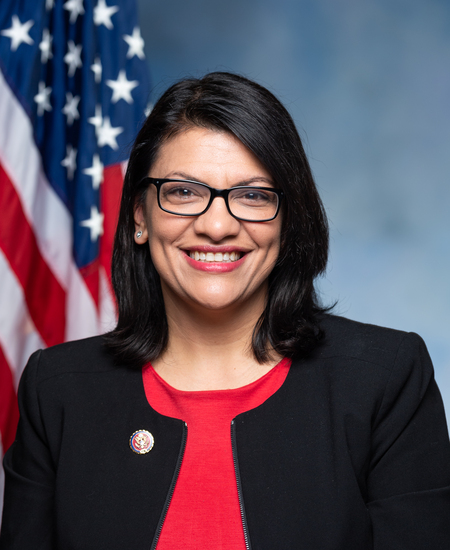
Rep. Rashida Tlaib
Sponsored bills
Maddy summaryHRES 340 is a ceremonial resolution recognizing April 2025 as "Community College Month" to celebrate the role of over 1,000 U.S. community colleges. It highlights these institutions' work in providing affordable higher education, workforce training, and economic support - serving 10.2 million students annually and contributing significantly to national economic growth (e.g., generating $898 billion in alumni income in 2020). The resolution emphasizes community colleges' accessibility (average $3,990 tuition for in-district students, 10-mile average student commute) and their role in workforce development across sectors like healthcare and manufacturing. As a non-binding recognition, it does not create new laws or funding.
Maddy summaryThe Hunger-Free Future Act of 2025 amends the SNAP program to require that any update to the thrifty food plan must not increase food insecurity. It mandates that adjustments to the diet cost must continue following existing rules while explicitly ensuring updates do not worsen food insecurity, defined as households lacking adequate food due to insufficient money or resources. This directly affects SNAP beneficiaries by setting a new standard for how the program's cost calculations are reviewed. The bill changes the procedural requirement for SNAP re-evaluations without altering benefit amounts or eligibility rules.
Hot Foods Act of 2025 This bill expands the Supplemental Nutrition Assistance Program (SNAP) to permit the use of SNAP benefits to purchase hot foods or hot food products ready for immediate consumption.
Maddy summaryHR 2357, the Food Secure Strikers Act of 2025, removes a restriction that previously barred workers on strike from receiving Supplemental Nutrition Assistance Program (SNAP) benefits. The bill amends the Food and Nutrition Act of 2008 to eliminate language making workers ineligible for SNAP "as a result of being on strike," ensuring striking workers are not automatically denied food assistance during labor disputes. This change directly affects workers participating in strikes who would otherwise lose access to SNAP benefits. The key mechanism updates the eligibility rules to prevent SNAP ineligibility solely due to strike participation.
Maddy summaryThe STRONG Support for Children Act of 2025 establishes a federal grant program to help communities prevent and mitigate childhood trauma through data analysis and trauma-informed care coordination. It authorizes up to $47.5 million in funding to support up to 5 eligible entities (like state or local health departments) to identify geographic areas with high rates of adverse childhood experiences and connect children and families with services including mental health support, housing assistance, substance use treatment, and economic resources. The bill requires grantees to use culturally specific, gender-responsive approaches and prohibits using data for individual case decisions or requiring participation in services. The program will be evaluated over 7 years to assess its impact on reducing childhood trauma and improving outcomes like housing stability, school readiness, and reduced foster system involvement.
Maddy summaryThis bill, HR 2936 (the ABC-ED Act), aims to reduce emergency department crowding by requiring real-time tracking of hospital bed capacity and related metrics like patient wait times. It allows federal grants to modernize public health data systems that monitor emergency department boarding rates, bed availability, and ambulance offload times, with results displayed on a public dashboard (while protecting privacy). The bill also adds two new Medicare Innovation Center pilot programs: one focused on improving care for older adults (through staffing, infrastructure, and senior care coordination) and another for psychiatric crisis care (including dedicated units and faster facility transfers). Finally, it mandates a one-year study by the Government Accountability Office to evaluate best practices for these data systems and their impact on emergency department efficiency.
Maddy summaryHR 2948, the Safer Neighborhoods Gun Buyback Act of 2025, authorizes $360 million annually from 2025-2027 to fund gun buyback programs across the country. The bill creates a grant program for states, local governments, tribal governments, and eligible gun dealers to collect firearms from individuals using "smart prepaid cards" that cannot be used to purchase guns. Participants would pay 125% of a gun's market value (with possible increases for modified weapons) and must destroy all collected firearms and ammunition within 30 days. The program requires criminal background checks on all collected weapons and prohibits reselling any guns obtained through the initiative, with a new federal criminal provision making it illegal to use these cards for firearm transactions.
Maddy summaryThe All-Americans Tax Relief Act of 2025 would significantly expand tax benefits for low-to-moderate income individuals and families. Key provisions include making the Child Tax Credit fully refundable (allowing payments even if taxpayers owe no income tax), expanding the Earned Income Tax Credit with higher maximum amounts, and creating new deductions for medical expenses, daycare, commuting, tutoring, and credit card interest. The bill would also establish a rent deduction for primary residences and exclude certain discharged debt from taxable income. These changes would apply to tax years beginning after December 31, 2026, and would primarily benefit working families with children and lower-income taxpayers.
Maddy summaryHR 2947, the Deafblind DATA Act, requires the U.S. Census Bureau to publish an annual data table starting in 2026 showing individuals who reported both hearing and vision loss in the American Community Survey. The table will include demographic details (sex, race, age) and economic factors (employment, education, income, poverty status) for people in each state, without revealing personal identifiers. This bill directly addresses the lack of centralized data on the deafblind population (estimated at 10,000 children and 40,000 adults by the National Center on Deafblindness), which currently prevents accurate service planning. The Census Bureau must also report to Congress within 180 days on feasibility of expanding such data collection. The Act does not change existing services but aims to improve understanding of this population's needs through better data.