

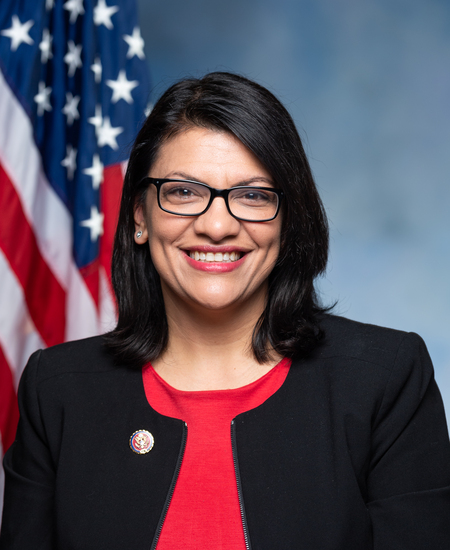
Photo of Rashida Tlaib
D United States House · District 12 · Michigan On the 2026 ballot

Rep. Rashida Tlaib

Compare
Total votes
2,837
all sessions
Attendance
98%
52 missed
Near the chamber average
With party
93%
of cast votes
Lower than 86% of chamber peers
Bipartisan score
4%
crosses aisle rarely
Higher than 85% of chamber peers
Sponsored
2,899
bills & resolutions
Higher than 99% of chamber peers
Committees
4
assignments
2,899 bills and resolutions

Sponsored bills

Total
2,899
Primary
101
Co-sponsor
2,798
This page
2,899
matching current filters
Co-sponsor HR 4844
In committee · United States House · Co-sponsor
Improving Training for School Food Service Workers Act

Maddy summaryThis bill amends the Child Nutrition Act to require school food service training programs to be scheduled during regular paid work hours whenever possible. If training must occur outside work hours, schools must compensate staff for attending, explain the necessity, and not penalize staff for missing it. Training must also be offered in-person with hands-on components when appropriate. The law directly affects school food service workers and their employers, mandating specific scheduling and compensation practices for required training.

In committee Jul 25, 2023 1 co-sponsor
Co-sponsor HR 4852
In committee · United States House · Co-sponsor
IDs for an Inclusive Democracy Act

Maddy summaryHR 4852, the "IDs for an Inclusive Democracy Act," requires the Social Security Administration to create and issue free federal identification cards within three years. These cards would be accepted like state driver's licenses for most purposes, including voting and accessing services, and must include a gender option for "X" (unspecified/other identity) alongside male and female. The bill mandates the U.S. Postal Service to handle applications through existing passport-like processes, with free photography and mail-in options, and establishes a Task Force to develop security features and accessibility guidelines. It also sets special validity rules: cards for minors expire at age 18, while those for seniors 65+ remain valid indefinitely after their 10-year term.

In committee Jul 25, 2023 1 co-sponsor
Co-sponsor HR 4893
In committee · United States House · Co-sponsor
Scientific Integrity Act

Maddy summaryHR 4893, the Scientific Integrity Act, requires federal agencies that fund, conduct, or oversee scientific research to adopt policies preventing political interference in science. The bill mandates these agencies to prohibit suppression or distortion of research findings, establish Scientific Integrity Officers to enforce policies, and implement training and reporting systems. It directly affects scientists and engineers employed by or contracted with covered agencies (like the EPA or NIH), ensuring their work remains free from political pressure. Key mechanisms include annual public reporting on misconduct complaints, whistleblower protections, and requiring scientific conclusions to be based on evidence, not ideology.

In committee Jul 25, 2023 1 co-sponsor
Co-sponsor HR 4870
In committee · United States House · Co-sponsor
Wall Street Tax Act of 2023

Maddy summaryHR 4870, the Wall Street Tax Act of 2023, imposes a 0.1% tax on most securities transactions occurring on U.S. exchanges or involving U.S. persons. It directly affects financial institutions, brokers, and investors participating in covered transactions like stock, bond, and derivative trades. The tax applies to the fair market value of transactions (excluding initial security issuances and short-term debt under 100 days), with payment responsibility falling on U.S. exchanges, brokers, or U.S. parties depending on the transaction type. Exceptions include certain real property contracts, insurance products, and derivatives used in normal business operations. The tax takes effect for transactions after December 31, 2023.

In committee Jul 25, 2023 1 co-sponsor
Co-sponsor HR 4889
In committee · United States House · Co-sponsor
Raise the Wage Act of 2023

Maddy summaryHR 4889, the Raise the Wage Act of 2023, would gradually increase the federal minimum wage for most workers to $15.50 per hour by 2027, with specific annual targets: $9.50 starting in 2023, rising to $11.00 after one year, $12.50 after two years, and $15.50 after four years. It would also phase out the separate lower minimum wage for tipped employees (starting at $6.00/hour) by aligning their pay with the regular minimum wage by 2028, while requiring employers to let workers keep all tips. The bill includes similar phased increases for workers under 20 and transitions toward fairer wages for workers with disabilities under special certificates, which would sunset after 2028. Future annual increases after 2028 would tie the minimum wage to the median hourly wage of all workers.

In committee Jul 25, 2023 1 co-sponsor
Co-sponsor HR 4888
In committee · United States House · Co-sponsor
Polluter Portfolio Disclosure Act

Maddy summaryThis bill requires large U.S. insurance companies (those collecting $100 million+ in annual premiums) to annually disclose all investments and insurance policies tied to fossil fuel industries - including coal, oil, gas extraction, and related infrastructure. Companies must report specific details like maximum financial exposure and policy amounts for each fossil fuel-related investment and policy. Federal agencies will use this data to monitor financial risks to consumers and the broader economy, and the public will access a searchable annual database of all disclosed information. The law directly affects major insurers regulated by the Federal Insurance Office, mandating transparency around their fossil fuel ties.

In committee Jul 25, 2023 1 co-sponsor
Co-sponsor HR 4157
In committee · United States House · Co-sponsor
Not Just a Number Act

Maddy summaryHR 4157, the "Not Just a Number Act," requires the Department of Veterans Affairs (VA) to produce annual reports on veteran suicide rates and their connection to VA healthcare and benefits. The reports must break down suicide rates by age, gender, and race, and examine how engagement with VA services (like Vet Centers, healthcare enrollment, benefits claims, and housing loans) correlates with suicide trends. The bill also mandates a VA toolkit for state/local coroners to improve veteran suicide death reporting, and a study on creating a dedicated VA suicide prevention office. These measures aim to standardize data collection and identify effective prevention strategies, directly affecting VA operations, congressional oversight, and veteran care systems.

In committee Jul 25, 2023 1 co-sponsor
Co-sponsor HR 4785
In committee · United States House · Co-sponsor
Fracturing Responsibility and Awareness of Chemicals Act of 2023

Maddy summaryHR 4785, the Fracturing Responsibility and Awareness of Chemicals Act of 2023, requires oil and gas companies conducting hydraulic fracturing operations to disclose detailed chemical information to state agencies or the EPA. Specifically, companies must provide a pre-operation list of chemicals (including CAS numbers and volumes) and a post-operation report of chemicals actually used, which states must then make publicly available online. The bill also mandates immediate disclosure of proprietary chemical formulas to medical personnel during emergencies, without requiring prior written consent. It explicitly excludes natural gas storage from the definition of hydraulic fracturing. This bill directly affects oil and gas operators and state environmental agencies managing disclosure requirements.

In committee Jul 21, 2023 1 co-sponsor
Co-sponsor HR 4774
In committee · United States House · Co-sponsor
Empowering Resilient Communities Act

Maddy summaryThis bill amends the Robert T. Stafford Disaster Relief Act to define "high need communities" as small areas (under 10,000 people) with high disaster risk, not already covered by existing programs. It requires FEMA to issue guidance on extreme temperature events within one year and mandates that state and local hazard mitigation plans include resilience goals, address disparities in underserved communities, and integrate nature-based solutions. The bill also allows communities meeting advanced building codes to use disaster funds for resilience projects and directs FEMA to provide technical assistance for implementing these plans. These changes primarily affect small, high-risk communities and state/local governments managing disaster recovery funds.

In committee Jul 21, 2023 1 co-sponsor
Co-sponsor HR 4782
In committee · United States House · Co-sponsor
CLOSE Act

Maddy summaryThis bill, the CLOSE Act (HR 4782), removes a loophole that allowed oil and gas facilities to aggregate emissions from multiple sources when calculating pollution levels under federal law. It requires the EPA to add hydrogen sulfide - a pollutant linked to health harm - directly to the list of hazardous air pollutants within 180 days of the bill becoming law. The EPA must then, within a year, define specific categories of oil and gas wells and other sources that emit hydrogen sulfide. This change directly affects oil and gas operators by subjecting hydrogen sulfide emissions from their facilities to stricter federal pollution controls.

In committee Jul 21, 2023 1 co-sponsor
Showing 1,701 to 1,710 of 2,899 bills