

Compact of Free Association Host Communities Support Act This bill authorizes various financial waivers for certain U.S. jurisdictions (i.e., states, territories, or possessions) that host citizens of the Marshall Islands, Micronesia, or Palau as residents. (Under current law, citizens of these countries, known as the Freely Associated States, have the right to reside and work in the United States as nonimmigrants or habitual residents.) Specifically, this bill authorizes a federal agency to, for the purposes of a federal grant, waive any matching funds requirements for a jurisdiction that hosts citizens of the Freely Associated States as residents. Furthermore, the President may reduce, release, or waive amounts that such a hosting jurisdiction owes to a federal agency, at the request of the hosting jurisdiction. As a condition of receiving such a reduction, release, or waiver, a hosting jurisdiction must report to the Department of the Interior an accounting of the jurisdiction's unreimbursed economic impacts associated with receiving citizens of the Freely Associated States from 2004 through 2021.
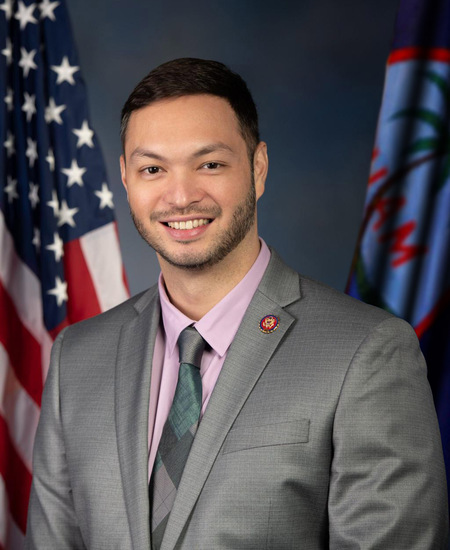
Rep. Michael F. Q. San Nicolas
Sponsored bills
Native Pacific Islanders of America Equity Act This bill establishes a CHamoru Registry program. It also allows eligible Native CHamoru organizations and Native Northern Marianas organizations to qualify for federal contracting opportunities through their participation in certain small business programs that are administered by the Small Business Administration. First, the bill establishes a CHamoru Registry program under the Office of the Governor of Guam. The program must keep a database to serve as a genealogy bank to verify Native CHamoru ancestry requirements. Next, it treats businesses owned by economically disadvantaged Native CHamoru organizations or Native Northern Marianas organizations as socially and economically disadvantaged small businesses for purposes of the Minority Small Business and Capital Ownership Development program, which is commonly known as the 8(a) program. Further, it allows businesses that are owned by Native CHamoru organizations or Native Northern Marianas organizations to participate in the Historically Underutilized Business Zone Empowerment Contracting (HUBZone) program. The 8(a) program and the HUBZone program each limit competition for certain government contracts to participating small businesses.
Part-Time Worker Bill of Rights Act This bill modifies various employment, leave, and pension rules with respect to part-time workers. Specifically, the bill removes the requirement that employees work a minimum number of hours during the preceding 12-month period before becoming eligible for family and medical leave. The bill also sets the maximum length of service on which employers may condition the eligibility of part-time employees for a qualified pension plan (e.g., 401(k) retirement plan). Except as required by an applicable collective bargaining agreement, such service requirement may be no longer than two consecutive 12-month periods of at least 500 hours of service for part-time employees who have reached the age of 21 by the end of such periods. The bill further prohibits employers of more than 15 employees from setting disparate terms of employment or working conditions for part-time employees, including with respect to compensation, notice of work hours, and promotion opportunities, among others. Additionally, the bill requires such employers to offer available, qualified part-time employees additional work hours before hiring new employees for such hours. Among other enforcement methods, employers must maintain three years of records for offers of additional hours and employee responses to such offers. The bill also provides a private right of action for employees to enforce the nondiscrimination requirements of this bill.
Climate Security Intelligence Act of 2022 This bill permanently authorizes the Climate Security Advisory Council (currently authorized until December 31, 2025). The bill also requires the advisory council to report to Congress a plan to permanently establish a Climate Security Intelligence Center within the Office of the Director of National Intelligence. The plan must contain recommendations relating to the proposed center's duties, which shall include (1) serving as the primary intelligence community organization addressing the climate security intelligence needs and priorities of policymakers, (2) analyzing U.S. climate security risks and U.S. influence on climate policies around the world, and (3) conducting strategic forecasting for future climate security risks and opportunities. The plan shall also include a proposed process for transferring recommended functions and duties from the advisory council to the center.
Striking Workers Healthcare Protection Act This bill prohibits an employer from terminating or significantly altering the employer-provided health insurance coverage of an employee engaged in a lawful strike. An employer that violates this prohibition is subject to a maximum civil penalty of $50,000 for each violation.
Banning Surveillance Advertising Act of 2022 This bill restricts online advertising that targets an individual, internet-connected device, or group of individuals or devices based on personal information. Personal information includes information that is reasonably linkable to an individual or connected device such as internet browsing history or the content of communications. The bill generally prohibits (1) online advertisers from using personal information, including personal information that identifies an individual as a member of a specified protected class, to target advertising; and (2) advertising facilitators (i.e., entities that receive compensation for disseminating online advertisements) from using personal information to disseminate targeted advertising or knowingly enabling online advertisers to do so. The bill allows certain exceptions, including for advertisements disseminated based on (1) content with which an individual is engaging, such as search results, if the advertisement is displayed in close proximity to the individual's engagement with the content; or (2) a state, market area, or other geographic location associated with an individual. Furthermore, an advertising facilitator may use information provided by an advertiser or third party if that advertiser or third party also attests in writing that the information complies with the bill's requirements. The bill provides for enforcement of these provisions by the Federal Trade Commission, states, and individuals.
Climate Risk and Emergency Support In Livable Inclusive and Equitable Neighborhoods and Communities Everywhere Act or the Climate RESILIENCE Act This bill makes changes to the Robert T. Stafford Disaster Relief and Emergency Assistance Act to take into account climate change. The bill includes extreme temperature events, such as heat waves or freezes, within the scope of the act and defines resilience for purposes of disaster assistance and mitigation efforts. Federal and state preparedness and mitigation assistance may be used for reducing the impacts of extreme temperatures and improving air quality and mitigating against wildfire smoke.. The bill authorizes implementing predisaster hazard mitigation measures that will be cost-effective and equitable long-term and provide enhanced protection to the community. The Federal Emergency Management Agency (FEMA) must (1) provide technical assistance to underserved and disadvantaged communities for such measures; and (2) provide guidance to implement the latest published editions of relevant consensus-based codes, specifications, and standards that incorporate the latest hazard-resistant designs. The bill includes within the hazard mitigation program requirements the abatement of lead, mold, mildew, radon, asthma, and allergen triggers, or other pollutants and hazardous materials directly caused by a major disaster or emergency. FEMA must report to Congress regarding challenges posed by FEMA requirements for determining the cost-effectiveness of mitigation activities and how such requirements may disproportionately burden underserved or disadvantaged communities.
This resolution expresses support for the goals and ideals of Korean American Day and honors the 119th anniversary of the arrival of the first Korean immigrants to the United States.
Combating Terrorist and Other Illicit Financing Act This bill revises provisions related to the National Strategy for Combating Terrorist and Other Illicit Financing developed by the Department of the Treasury. Currently, the strategy must be published through 2022. The bill requires the strategy to be published in 2024 and 2026. The bill also revises how Treasury evaluates existing efforts as part of the strategy. Additionally, tribal and territorial entities must be (1) eligible for grant programs to combat financial crime, and (2) included in efforts to combat illicit finance.
Maddy summaryThis bill (H.J.Res. 68) is a symbolic, procedural measure that would require the President to issue an annual proclamation designating a day as "Democracy Day." It directs the President to call on state/local governments and citizens to observe the day through programs and activities, with January 6 referenced as a potential date. The bill does not create new government programs or change existing laws - it only establishes a recurring presidential proclamation. It directly affects federal, state, and local governments by encouraging them to participate in annual observances. The bill has no budgetary impact and remains focused on promoting civic engagement through a designated day.