

PrEP Access and Coverage Act This bill requires private health insurance plans to cover prescription drugs that prevent HIV, including related screenings, diagnostic procedures, administrative fees, and clinical follow-ups, without any cost-sharing obligation for the plan holder. Further, insurance plans must not impose any preauthorization requirement for this coverage. These coverage requirements also apply to public health insurance programs, including Medicare, Medicaid, and the Children's Health Insurance Program. Additionally, the bill prohibits denying, limiting, or qualifying coverage or increasing premiums for disability insurance, long-term care insurance, or life insurance policies based on an individual taking medication for HIV prevention. The bill further requires the Department of Health and Human Services to award grants to states, or directly to eligible local organizations, to provide uninsured individuals and underinsured individuals access to prescription drugs and related services that prevent HIV. The Centers for Disease Control and Prevention also must develop a public awareness campaign that focuses efforts in communities with a high need for HIV prevention treatment.
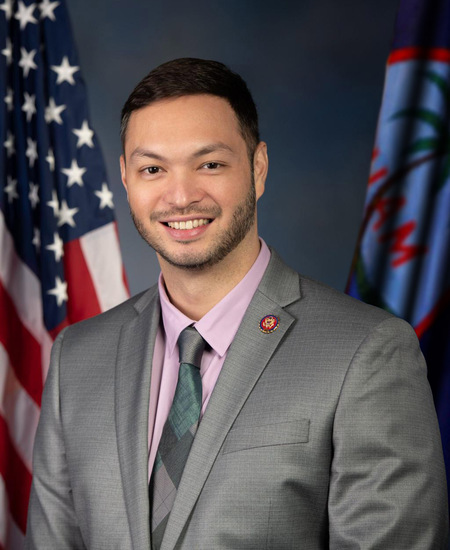
Rep. Michael F. Q. San Nicolas
Sponsored bills
College Student Hunger Act of 20 21 This bill modifies the eligibility requirements for the Supplemental Nutrition Assistance Program (SNAP) to make additional students at institutions of higher education eligible for benefits.
Low-Revenue Recipient Paycheck Protection Program Relief Act of 2021 This bill provides additional forgiveness and flexibilities to certain low-revenue recipients of Paycheck Protection Program loans.
EDUCATORS for America Act This bill provides resources to support the recruitment, retention, and preparation of educators. These resources include, among others, expanding the Teacher Quality Partnership program to include training and professional development opportunities for principals and other school leaders, updating the Augustus F. Hawkins Centers of Excellence program to support underrepresented candidates in educator preparation programs, and revising the Teacher Education Assistance for College and Higher Education (TEACH) grant program to raise the maximum amount for TEACH grants. The bill also directs the Department of Education to carry out a program to provide loan credits to eligible educator borrowers enrolled in income-contingent or income-based repayment plans.
Radiation Exposure Compensation Act Amendments of 2021 This bill expands two programs that compensate individuals who were exposed to radiation during certain nuclear testing or uranium mining and subsequently developed medical conditions, including cancers. First, the bill expands and extends a program that compensates individuals who were exposed to radiation from atmospheric nuclear testing or other sources and subsequently developed specified cancers. Under current law, this program compensates individuals who were present in a designated geographic area during a period of nuclear testing and certain individuals employed in uranium mining. The bill expands the designated areas to include Colorado, Idaho, Montana, New Mexico, and Guam and additional areas in Arizona, Nevada, and Utah; makes more individuals who worked in uranium mining eligible for the program; increases the amount of compensation awarded to and provides medical benefits for eligible claimants; and extends for 19 years following the bill's enactment the fund that supports this program and the statute of limitations for filing claims (currently, the program terminates on July 10, 2022). Second, the bill makes certain individuals employed in uranium mines or mills eligible for a program that compensates workers, including Department of Energy employees and contractors, for illnesses caused by occupational exposure to radiation and hazardous substances during development and testing of the nation's nuclear weapons stockpile. The bill also establishes a grant program in the National Institute of Environmental Health Sciences for institutions of higher education to study the epidemiological impacts of uranium mining and milling among individuals without occupational exposure.
Strength in Diversity Act of 2021 This bill establishes a program through which the Department of Education may award planning and implementation grants to specified educational agencies (e.g., local educational agencies) to improve diversity and reduce or eliminate racial or socioeconomic isolation in publicly funded early childhood education programs, public elementary schools, or public secondary schools.
Online Privacy Act of 2021 This bill establishes certain online privacy rights for personal information (including contents of communications) and certain requirements for data processors, service providers, and third parties. The bill also establishes the Digital Privacy Agency.
This bill requires the Department of Veterans Affairs (VA) to establish the Advisory Committee on United States Outlying Areas and Freely Associated States to provide advice and guidance to the VA on matters relating to veterans residing in American Samoa, Guam, Puerto Rico, the Commonwealth of the Northern Mariana Islands, the U.S. Virgin Islands, the Federated States of Micronesia, the Republic of the Marshall Islands, and the Republic of Palau. Among other duties, the committee must advise the VA on how to improve its programs and services to better serve veterans living in the listed areas.
Holding SPACs Accountable Act of 2021 This bill revises the exclusion from safe harbor protections from liability applicable to forward-looking statements (i.e., statements that predict, project, or use future events as expectations or possibilities) made in connection with certain investments. Specifically, it excludes from the safe harbor a development stage company that has no specific business plan or purpose or has indicated that its business plan is to acquire or merge with an unidentified company, entity, or person (e.g., a special purpose acquisition company).
Sarah Keys Evans Congressional Gold Medal Act This bill provides for the award of a Congressional Gold Medal to Sarah Keys Evans in recognition of her achievements relating to the desegregation of passengers on interstate buses in the 1950s.