

Work Without Worry Act This bill modifies eligibility for Social Security Disability Insurance (SSDI) benefits for individuals who have a disability that began before age 22. Under current law, these individuals may obtain SSDI benefits based on the work record of a retired, disabled, or deceased parent. However, an individual with earnings after age 22 that exceed a specified monetary limit (i.e., constitute substantial gainful activity) permanently loses eligibility for such benefits. This bill allows individuals to retain eligibility for such benefits regardless of the amount of earnings after age 22. Additionally, individuals who apply for SSDI benefits on a parent's record and also independently qualify for Social Security benefits on their own record will receive the larger of the two benefit amounts.
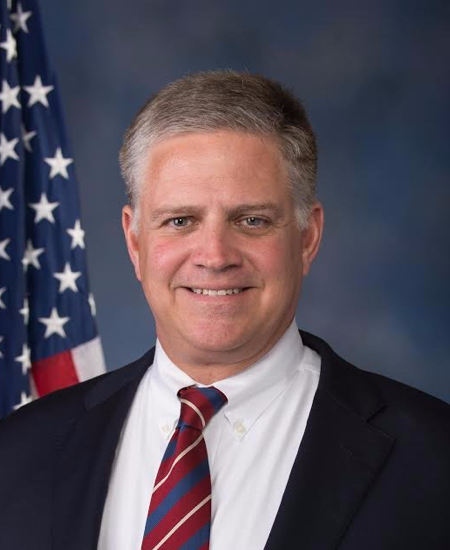
Rep. A. Drew Ferguson IV
Sponsored bills
Defending Domestic Produce Protection Act This bill establishes a process by which a core seasonal industry may petition for countervailing and antidumping duties. A core seasonal industry means the producers (1) of a domestic like product that is a raw agricultural product, (2) whose collective output constitutes a majority of the total production in any state or group of states that accounts for a major portion of the total production during a discrete season or cyclical period of time, and (3) that make substantially all of their sales during that season or time period. The bill also provides that this process shall apply with respect to goods from Canada and Mexico.
Flexible Financing for Rural America Act This bill allows rural utility service providers to submit to the Department of Agriculture (USDA) a request to adjust the interest rate or modify the terms of certain loans. The request shall include a report summarizing how the adjustment or modification will assist the borrower in providing critical utility services to a rural community. Specifically, on receipt of a request, USDA or the Department of the Treasury (in the case of a loan owned by the Federal Financing Bank) must adjust the interest rate on the loan to match certain interest rates for obligations of comparable maturity to the term remaining on the loan (or a higher rate requested by the borrower), and make modifications to the loan terms as necessary to address changes in the financial position of the borrower due to the COVID-19 public health emergency and to promote the financial sustainability of the borrower. In carrying out the adjustments or modifications, USDA or Treasury shall not impose or collect any fee from, or impose any penalty on, a borrower. The bill also provides funding to implement the adjustments and modifications and for the liquidation of residual intragovernmental amounts owed by the Federal Financing Bank in connection with certain loans.
This resolution condemns the rocket attacks by Hamas against Israel beginning the week of May 9, 2021. It also states that the United States must continue to invest in and support Israel's security and sovereignty.
United States Army Rangers Veterans of World War II Congressional Gold Medal Act This bill provides for the award of a single Congressional Gold Medal to the U.S. Army Rangers Veterans of World War II in recognition of their dedicated service during World War II.
Dentist and Optometric Care Access Act of 2021 or the DOC Access Act of 20 21 This bill prohibits private health insurance plans from setting rates for items and services, except for dental cleanings, provided by a doctor of optometry, of dental surgery, or of dental medicine for which the plan does not pay a substantial amount. Additionally, an agreement between a plan and such a doctor for limited scope dental or vision benefits may last longer than two years only with the prior acceptance of the doctor for each term extension. Plans also may not restrict such a doctor's choice of laboratories or suppliers. Such doctors may elect to waive the application of the payment amount and choice of laboratories provisions of this bill. The bill establishes a private right of action for a person adversely affected by a violation of this bill. The bill does not supersede state laws regarding health insurers and dental or vision benefit plans.
Gigabit Opportunity Act This bill authorizes the designation of qualified gigabit opportunity zones in low-income communities and provides tax incentives for investments in such zones. Governors may submit nominations for a limited number of qualified gigabit opportunity zones in low-income communities to the Department of the Treasury for certification and designation and must give particular consideration to areas that are facing obstacles to economic development due to a lack of geographic broadband coverage or speed; are the focus of mutually reinforcing state, local, or private economic development initiatives; are poised for economic growth that requires access to high speed broadband for commercial purposes; and represent the areas of a state where such service would result in the highest return on investment. For eligible taxpayers who sell certain broadband services, the bill allows (1) deferrals, reductions, or exemptions from taxes on capital gains invested in certain property used to provide broadband services in a zone; and (2) immediate expensing of the costs of the property. The bill also allows tax-exempt private activity bonds to be used for certain broadband projects in the zones. Within one year of enactment of this bill, the Federal Communications Commission must publish a Uniform Model Broadband Deployment Act containing laws for the state regulation of the deployment of broadband services. Qualified zones must either adopt the Act or laws comparable to the Act.
Saving Gig Economy Taxpayers Act This bill modifies requirements for third party settlement organizations to eliminate their reporting requirement with respect to the transactions of their participating payees unless they have earned more than $20,000 on more than 200 separate transactions in an applicable tax period. A third party settlement organization is the central organization that has the contractual obligation to make payments to participating payees (generally, a merchant or business) in a third party payment network. This reverses a provision in the American Rescue Plan Act of 2021 that lowered the reporting threshold to $600 with no minimum on the number of transactions.
Contact Lens Prescription Verification Modernization Act This bill revises the requirements for the verification of prescriptions related to the purchase of contact lenses. Specifically, online sellers of prescription contact lenses must provide consumers with a method to transmit a digital copy of their prescriptions to such sellers. Online sellers also must encrypt protected health information they send by email. Additionally, the bill prohibits any seller of prescription contact lenses from using telephone calls with an artificial or prerecorded voice (i.e., robocalls) to verify a consumer's prescription.
This resolution directs the Office of the Attending Physician to update the mask-wearing guidance (consistent with public guidance released by the Centers for Disease Control and Prevention) applicable to the Hall of the House of Representatives and committee meeting spaces for Members and staff who are vaccinated against COVID-19.