Ensuring Second Amendment Freedoms are Executed Timely Act This bill allows a licensed gun dealer, manufacturer, or importer to transfer a firearm to an unlicensed person if a submitted background check remains incomplete after three calendar days (currently, three business days).
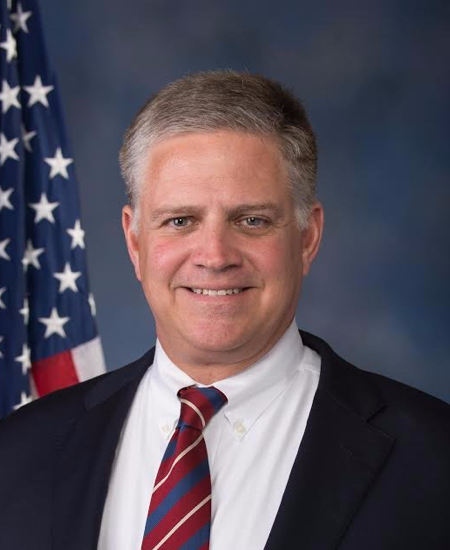
Rep. A. Drew Ferguson IV
Sponsored bills
21st Century NICS Act This bill modifies procedures for conducting firearms-related background checks through the national instant criminal background check system (NICS). Specifically, it permits the NICS to query an additional database—the National Data Exchange—as part of a firearm-related background check.
Combatting COVID Unemployment Fraud Act of 2021 This bill requires additional documentation for individuals seeking pandemic unemployment assistance, requires state unemployment agencies to use designated fraud prevention tools, and otherwise addresses pandemic-related unemployment benefits.
Behavioral Intervention Guidelines Act of 2021 This bill requires the Department of Health and Human Services (HHS) to develop best practices for establishing behavioral intervention teams in educational settings. These teams, comprised of experts, are responsible for identifying individuals who exhibit concerning behaviors and addressing associated behavioral health issues to prevent harm to the individual or others. HHS must also provide technical assistance on implementing these teams to elementary and secondary schools and institutions of higher education.
Suicide Training and Awareness Nationally Delivered for Universal Prevention Act of 20 21 or the STANDUP Act of 2021 This bill requires state, tribal, and local educational agencies that receive grant funding for priority mental-health needs, including through the Project AWARE State Education Agency Grant Program, to establish and implement evidence-based suicide awareness and prevention training policies. In addition, the Substance Abuse and Mental Health Services Administration, in coordination with the Department of Education and Bureau of Indian Education, must provide educational agencies with best practices for these trainings.
Combatting Racist Training in the Military Act of 2021 This bill prohibits the Armed Forces and academic institutions of the Department of Defense from promoting specified anti-American and racist theories (e.g., that any race is inherently superior or inferior to any other race). Specifically, the bill prohibits including anti-American and racist theories or materials in curricula, reading lists, seminars, workshops, trainings, or other educational or professional settings in a manner that could appear as sponsorship, approval, or endorsement; contracting with, hiring, or otherwise engaging speakers, consultants, diversity trainers, and other persons for the purpose of advocating anti-American and racist theories; compelling members of the Armed Forces to affirm or profess belief in anti-American and racist theories; and segregating members of the Armed Forces by race in any setting, including educational and training sessions.

This resolution expresses the sense of the House of Representatives that the United States should continue to lead reform efforts and urge member cooperation at the World Trade Organization in order to address barriers to trade, improve living standards across the world, and enhance accountability and dispute settlement mechanisms.
Airline Pilots Retirement Security Act This bill allows catch up contributions to tax-exempt retirement plans for employees subject to a federally-mandated retirement age, in the three years prior to and including such retirement age (e.g., airline pilots). The amount of such contribution is twice the current allowable amount. The bill also modifies the cost-of-living adjustment to the defined contribution plan limit of a tax-exempt employer retirement plan.
Connect America Now Act or the CAN Act This bill allows an exclusion from gross income, for income tax purposes, of gain from the sale or exchange of the entire interest in a wholly-owned rural incumbent local exchange carrier. A rural incumbent local exchange carrier is a carrier that serves (1) an area where it was required to provide communications services by a specified date to any customer regardless of cost, and (2) an area other than an urbanized area with not fewer than 50,000 people and a core where there are not fewer than 1,000 people per square mile. The bill requires recapture of tax for income from the sale or exchange of stock in a carrier not held for at least one year. The bill allows an investment tax credit for 30% of expenditures to purchase, maintain, or improve property to provide voice telephone service or broadband internet access in rural empowerment zones. The bill increases the volume cap for private activity bonds and allows the use of bond proceeds for infrastructure for broadband internet access service.
Return Excessive Migrants and Asylees to International Neighbors in Mexico Act of 2021 or the REMAIN in Mexico Act of 2021 This bill requires the Department of Homeland Security (DHS) to implement the Migrant Protection Protocols as outlined in the January 25, 2019, memo titled Policy Guidance for Implementation of the Migrant Protection Protocols . (The protocols generally required aliens who are not clearly admissible, including those seeking asylum, arriving by land along the U.S.-Mexico border to be returned to Mexico while their immigration proceedings are pending, rather than remain in the United States. On January 21, 2021, DHS stopped applying the protocols to newly-arrived individuals.)