

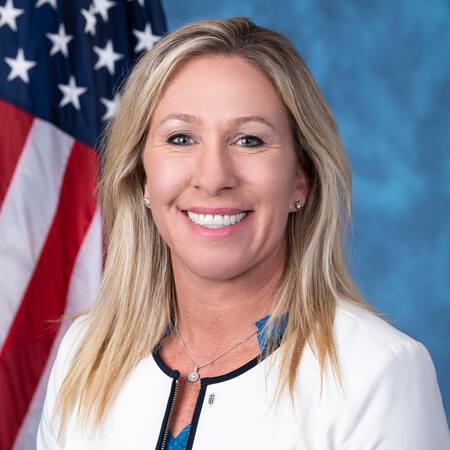
Photo of Marjorie Taylor Greene
R United States House · District 14 · Georgia

Rep. Marjorie Taylor Greene

Compare
Total votes
2,525
all sessions
Attendance
95%
124 missed
Lower than 91% of chamber peers
With party
79%
of cast votes
Lower than 96% of chamber peers
Bipartisan score
11%
some cross-party votes
Higher than 95% of chamber peers
Sponsored
500
bills & resolutions
Lower than 95% of chamber peers
Committees
0
assignments
500 bills and resolutions

Sponsored bills

Total
500
Primary
68
Co-sponsor
432
This page
500
matching current filters
Co-sponsor HR 899
In committee · United States House · Co-sponsor
To terminate the Department of Education.

Maddy summaryHR 899 would end the U.S. Department of Education by December 31, 2026, terminating its federal agency status. This bill directly affects all federal education programs and operations currently managed by the Department, such as student aid and school funding. The key mechanism is a fixed termination date, requiring the transfer of the Department's responsibilities to other federal agencies without specifying new administrative structures. The bill focuses solely on ending the agency's existence, not altering education policy or funding mechanisms.

In committee Jan 31, 2025 1 co-sponsor
Co-sponsor HR 724
In committee · United States House · Co-sponsor
CBO Show Your Work Act

Maddy summaryThis bill requires the Congressional Budget Office (CBO) to publicly publish the models, data, and detailed methodology it uses to estimate the costs and effects of legislation. Specifically, it mandates that the CBO make available all fiscal models, data routines, and the underlying assumptions behind its cost estimates, allowing independent verification. This applies to all CBO analyses of proposed bills, including the specific data and computational details needed for others to replicate the results. The requirement applies to all users of CBO reports - lawmakers, researchers, and the public - except for data legally restricted from disclosure, which would still require a public list of variables and descriptive statistics.

In committee Jan 24, 2025 1 co-sponsor
Co-sponsor HR 735
In committee · United States House · Co-sponsor
United States Reciprocal Trade Act

Maddy summaryHR 735, the United States Reciprocal Trade Act, would give the President authority to impose tariffs on imports from countries that maintain higher tariffs on U.S. goods than the U.S. imposes on their goods, or that apply significant nontariff barriers. The bill requires the President to consider multiple factors before taking action, including tariff classifications, trade impacts, and competitive relationships, and mandates consultation with Congress before imposing new tariffs. It establishes a 3-year timeframe for these tariff actions with a potential 3-year extension, while providing Congress with a process to disapprove tariffs through a joint resolution requiring a two-thirds vote. The law aims to address perceived trade imbalances by promoting reciprocal trade practices between the U.S. and its trading partners.

In committee Jan 24, 2025 1 co-sponsor
Co-sponsor HR 722
In committee · United States House · Co-sponsor
Life at Conception Act

Life at Conception Act This bill declares that the right to life guaranteed by the Constitution is vested in each human being at all stages of life, including the moment of fertilization, cloning, or other moment at which an individual comes into being. Nothing in this bill shall be construed to authorize the prosecution of any woman for the death of her unborn child.

In committee Jan 24, 2025 1 co-sponsor
Co-sponsor HR 21
Passed · United States House · Co-sponsor
Born-Alive Abortion Survivors Protection Act

Maddy summaryHR 21, the Born-Alive Abortion Survivors Protection Act, requires medical staff at abortion facilities to provide the same immediate care and hospital admission to any infant born alive during an abortion as they would for any newborn. It mandates reporting failures to provide this care to law enforcement and imposes penalties of up to 5 years in prison for violations, with harsher penalties for intentional killing. The bill also allows women who undergo abortions to sue for civil damages, including triple the abortion cost, and provides for attorney fees. It defines "abortion" to exclude procedures performed after viability to preserve a live birth. This law directly affects healthcare providers at abortion facilities and creates new federal legal obligations for them.

Passed Jan 24, 2025 1 co-sponsor
Co-sponsor HRES 59
In committee · United States House · Co-sponsor
Expressing the sense of the House of Representatives that the sermon given by the Right Reverend Mariann Edgar Budde at the National Prayer Service on January 21st, 2025, at the National Cathedral was a display of political activism and condemning its distorted message.

Maddy summaryHRES 59 is a symbolic resolution expressing the House of Representatives' disapproval of a sermon delivered by Bishop Mariann Edgar Budde at the National Prayer Service on January 21, 2025, at the National Cathedral. It declares the sermon "a display of political activism" and condemns its "distorted message," though it does not change any laws or policies. The resolution directly addresses the bishop's remarks during a nonpartisan religious event, making no concrete policy changes but reflecting the House's view on the content of that specific sermon. As a procedural resolution, it has no legal effect beyond expressing the House's stance.

In committee Jan 23, 2025 1 co-sponsor
Co-sponsor HR 645
In committee · United States House · Co-sponsor
National Constitutional Carry Act

Maddy summaryHR 645, the National Constitutional Carry Act, would prevent all U.S. states and localities from requiring permits or imposing penalties for carrying firearms in public. It directly affects eligible U.S. citizens (including non-residents) who legally possess firearms under state and federal law, removing current permit requirements for public carry. The bill’s key provision amends federal law to invalidate any state or local law that criminalizes or discourages public firearm carry, except where private property owners clearly prohibit firearms or security screening occurs. This would override existing state permit laws, making permitless carry legal across all states and territories for qualified individuals.

In committee Jan 23, 2025 1 co-sponsor
Co-sponsor HR 703
In committee · United States House · Co-sponsor
Main Street Tax Certainty Act

Maddy summaryHR 703, the Main Street Tax Certainty Act, makes a key tax deduction permanent for small business owners. It removes the temporary sunset provision (subsection (i)) from Section 199A of the tax code, ensuring the qualified business income deduction remains available for eligible small businesses. This change directly affects pass-through business owners (like S-corps, partnerships, and sole proprietorships) who currently qualify for this deduction. The permanent change takes effect for tax years starting after December 31, 2025.

In committee Jan 23, 2025 1 co-sponsor
Co-sponsor HR 569
In committee · United States House · Co-sponsor
Birthright Citizenship Act of 2025

Birthright Citizenship Act of 2025 This bill limits birthright citizenship by redefining what it means to be subject to the jurisdiction of the United States. Currently, a person born in the United States and subject to U.S. jurisdiction is entitled to citizenship. Under the bill, a person is subject to U.S. jurisdiction if he or she is born to a parent who is (1) a U.S. citizen or national, (2) a lawful permanent resident residing in the United States, or (3) a non-U.S. national ( alien under federal law) with a lawful immigration status who is performing active service in the Armed Forces. The bill does not affect the citizenship or nationality status of any person born before the bill's enactment date.

In committee Jan 21, 2025 1 co-sponsor
Co-sponsor HR 473
In committee · United States House · Co-sponsor
SHOW UP Act of 2025

Maddy summaryHR 473, the SHOW UP Act of 2025, requires federal executive agencies to return to pre-pandemic telework policies within 30 days of enactment, limiting work-from-home options to those in place on December 31, 2019. Agencies must then conduct a 6-month study analyzing pandemic-era telework impacts - including effects on mission performance, costs from underused office space, and employee productivity tools - and submit a plan to Congress if they seek to expand telework beyond these baseline levels. The plan requires certification from the Office of Personnel Management confirming it will improve mission performance, reduce real estate costs, lower locality pay expenses, and ensure secure remote work capabilities without increasing agency costs. This bill directly affects all federal executive agencies (excluding the Government Accountability Office) and their employees by restricting telework flexibility and imposing strict requirements for any future expansion.

In committee Jan 16, 2025 1 co-sponsor
Showing 81 to 90 of 500 bills
Previous 1 … 8 9 10 … 50 Next