

Institutional Grants for New Infrastructure, Technology, and Education for HBCU Excellence Act or the IGNITE HBCU Excellence Act This bill establishes a grant program to support long-term improvements of historically Black colleges and universities (HBCUs) and graduate programs at HBCUs. Specifically, the bill requires the Department of Education (ED) to award grants to HBCUs to improve campus facilities. A recipient must use grant funds for certain activities, such as constructing or renovating facilities, carrying out major repairs, and strengthening the safety and security of a campus. Any new construction, modernization, or renovation projects must meet building code and energy and water conservation requirements. Further, HBCUs must seek to procure contracts from certain small businesses, including those owned and controlled by veterans and service-disabled veterans. The bill prohibits the use of grant funds for specified activities, including for the payment of routine and predictable maintenance costs, minor repairs, and utility bills. The Government Accountability Office must study the implementation of the grant program. The bill also requires ED to repay the outstanding balance of principal, interest, fees, and costs and any related reimbursements for certain capital financing loans.
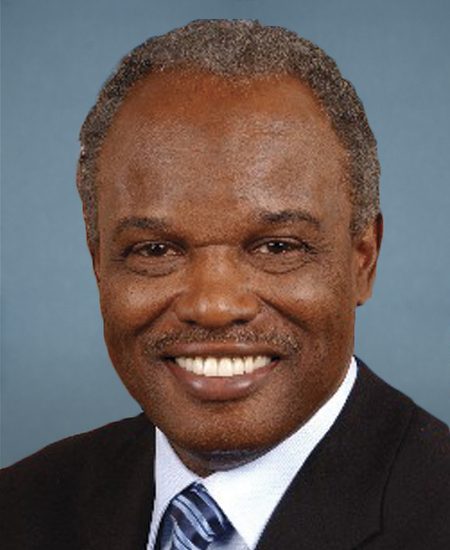
Rep. David Scott
Sponsored bills
Hate Crimes Commission Act of 2021 This bill establishes the United States Commission on Hate Crimes. The commission must investigate and report on whether hate crimes have increased; factors that contributed to an increase in hate crimes, if one is determined to exist; policies or actions by law enforcement agencies to reduce the commission of hate crimes; the impact of underreporting on hate crimes statistics and prevention; and successful community bias prevention responses.
COVID - 19 Hate Crimes Act This bill requires a designated officer or employee of the Department of Justice (DOJ) to facilitate the expedited review of COVID-19 (i.e., coronavirus disease 2019) hate crimes and reports of COVID-19 hate crimes. It defines COVID-19 hate crime as a violent crime that is motivated by two things: (1) the actual or perceived characteristic (e.g., race or ethnicity) of any person, and (2) the actual or perceived relationship to the spread of COVID-19 of any person because of that characteristic. The bill requires DOJ to issue guidance for state and local law enforcement agencies on (1) the establishment of online hate crime reporting processes and the availability of online reporting in multiple languages, and (2) the expansion of culturally competent education campaigns. Additionally, DOJ and the Department of Health and Human Services must issue guidance on best practices for mitigating racially discriminatory language in describing the COVID-19 pandemic.
Journalism Competition and Preservation Act of 2021 This bill creates a four-year safe harbor from antitrust laws for print, broadcast, or digital news companies to collectively negotiate with online content distributors (e.g., social media companies) regarding the terms on which the news companies' content may be distributed by online content distributors.
Non-Opioids Prevent Addiction In the Nation Act or the NOPAIN Act This bill temporarily establishes separate payments for certain non-opioid treatments under the Medicare prospective payment system for hospital outpatient department services and the payment system for ambulatory surgical center services. The bill applies to pain management treatments that are able to replace or reduce opioid consumption, as shown through clinical trials or data.
Pregnant Workers Fairness Act This bill prohibits employment practices that discriminate against making reasonable accommodations for qualified employees affected by pregnancy, childbirth, or related medical conditions. A qualified employee is an employee or applicant who, with or without reasonable accommodation, can perform the essential functions of the position, with specified exceptions. Specifically, the bill declares that it is an unlawful employment practice to fail to make reasonable accommodations to known limitations of such employees unless the accommodation would impose an undue hardship on an entity's business operation; require a qualified employee affected by such condition to accept an accommodation other than any reasonable accommodation arrived at through an interactive process; deny employment opportunities based on the need of the entity to make such reasonable accommodations to a qualified employee; require such employees to take paid or unpaid leave if another reasonable accommodation can be provided; or take adverse action in terms, conditions, or privileges of employment against a qualified employee requesting or using such reasonable accommodations. The bill sets forth enforcement procedures and remedies that cover different types of employees in relation to such unlawful employment practices. The Equal Employment Opportunity Commission must provide examples of reasonable accommodations that shall be provided to affected employees unless the employer can demonstrate that doing so would impose an undue hardship. The bill prohibits state immunity under the Eleventh Amendment to the Constitution from an action for a violation of this bill.
I am Vanessa Guillén Act of 2021 This bill addresses the policies and procedures of the Department of Defense (DOD) for cases or allegations of sex-related offenses.
Postal Service Improvement Act This bill requires mail-in ballots for federal elections to meet certain design and tracking requirements and revises authority to provide parental leave to postal employees. Specifically, each mail-in ballot must be carried or delivered in an envelope that contains a USPS barcode that enables tracking of each individual ballot, satisfies USPS requirements for ballot envelope design and for machinable (i.e., able to be processed using USPS equipment) letters, and includes the official election mail logo. The federal government must reimburse each state (including the District of Columbia and any U.S. territory or possession) for the cost of using the barcode service. The bill also provides paid parental leave to officers and employees of the USPS and the Postal Regulatory Commission.
Safer Neighborhoods Gun Buyback Act of 2021 This bill authorizes the Department of Justice's Bureau of Justice Assistance (BJA) to make grants to states, local governments, or gun dealers to conduct gun buyback programs. The BJA may distribute smart prepaid cards for use by a state, local government, or gun dealer to compensate individuals who dispose of firearms. Additionally, the bill establishes a new criminal offense for using or accepting a smart prepaid card in the acquisition or transfer of a firearm or ammunition. A violator is subject to a fine, up to two years in prison, or both.
Transit to Trails Act of 2021 This bill directs the Department of Transportation (DOT) to establish the Transit to Trails Grant Program to award grants to certain governmental and private entities for projects that increase transportation access and mobility to public lands, inland and coastal waters, parkland, or monuments for critically underserved communities. For example, DOT must (1) prioritize approving certain projects, such as projects that use low-or zero-emission vehicles and those that provide free or discounted rates for low-income riders; (2) develop transportation planning procedures for projects conducted under the program that are consistent with metropolitan and statewide planning processes; and (3) ensure that all new transportation connectors and routes developed under the program are accessible to people with disabilities. The bill requires grant awards to be at least $25,000 and not more than $500,000. Further, the bill requires publicized schedules and routes for transportation systems that are developed after the receipt of a grant under the program.