

This bill requires the Environmental Protection Agency (EPA) to amend its regulations to revise the standards for the emission of ethylene oxide. Specifically, regulations must be revised based on results from the National Center for Environmental Assessment report titled Evaluation of the Inhalation Carcinogenicity of Ethylene Oxide . The bill also requires revisions to apply maximum achievable control technology requirements to chamber exhaust vents. Maximum achievable control technology standards are established for sources of hazardous air pollutants to limit or control emissions. Additionally, the revisions must apply to area sources and major sources of ethylene oxide. The EPA must carry out a residual risk assessment with respect to the revised standards. Finally, the EPA must notify the public of violations under the revised standards, and failure to do so will result in an investigation to assess the health risks and prevent a future failure of notification.
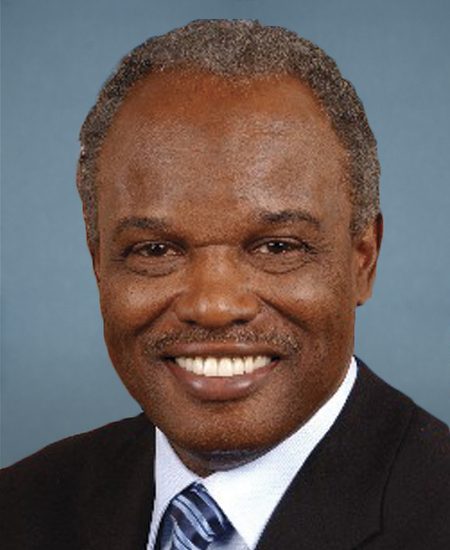
Rep. David Scott
Sponsored bills
Trees for Residential Energy and Economic Savings Act of 2021 or the TREES Act of 2021 This bill directs the Department of Energy (DOE) to establish a grant program for states, local governments, Indian tribes, and other entities to facilitate tree planting projects that reduce residential energy consumption. Under the program, DOE may award grants to facilitate the planting of at least 300,000 trees annually in residential neighborhoods.
John Lewis Every Child Deserves a Family Act This bill prohibits discrimination on the basis of sexual orientation, gender identity, marital status, or religion in the provision of child welfare programs and services by entities receiving federal funding. The Department of Health and Human Services (HHS) must provide technical assistance to help states follow this requirement, including (1) guidance for bringing state laws into compliance, (2) developing training to increase cultural competency related to social identity, and (3) training for judges and attorneys involved in child welfare cases, among other supports. Additionally, HHS must establish the National Resource Center on Safety, Well-Being, Placement Stability, and Permanency for LGBTQ Children and Youth Involved with Child Welfare Services to provide training, technical assistance, and guidance to applicable state and local agencies and service providers. Further, the Religious Freedom Restoration Act may not be the basis for challenging the application or enforcement of this bill. The Government Accountability Office must study and report on states' compliance with the requirements of the bill no later than three years after enactment.
Student Agriculture Protection Act of 2021 This bill modifies the requirements for calculating taxable income to exclude from the gross income of a student agriculturist up to $5,000 of the gain from the sale or exchange of personal property (including livestock, crops, and agricultural mechanics or shop products) produced or raised by the student agriculturist. A student agriculturist is an individual who is under 22 years of age and is enrolled in (1) an FFA (Future Farmers of America) chapter or a program established by the National FFA Organization; (2) a 4H Club or other program established by 4H; or (3) a student agriculture program that is under the direction or guidance of an agricultural educator, advisor, or club leader.
Jobs, On-the-Job 'Earn-While-You-Learn' Training, and Apprenticeships for Young African Americans Act This bill makes changes to the national apprenticeship system aimed at promoting diversity. Specifically, the bill establishes the Diversity and Inclusion Administrator in the Office Apprenticeship within the Office of Employment and Training Administration at the Department of Labor, requires every apprenticeship program that registers or renews an apprenticeship with the Office of Apprenticeship to submit a plan to increase participation by individuals who are African American, and requires the Diversity and Inclusion Administrator to award grants to create or expand diversity in registered apprenticeship programs.
Concentrating on High-value Alzheimer's Needs to Get to an End Act of 2021 or the CHANGE Act of 2021 This bill modifies the requirements under Medicare for diagnosing and treating Alzheimer's disease and other cognitive impairments in older adults. Specifically, the bill expands the cognitive impairment detection benefit during annual wellness visits to require the use of validated detection tools and documentation of the results in the patient's medical record. Further, when a cognitive impairment is detected, the patient must be referred to an appropriate diagnostic service provider and other specified supports. Additionally, the Centers for Medicare & Medicaid Services must implement Medicare policies that increase the identification and response to patients' Alzheimer's disease risk factors and incentivize providers to utilize high-quality cognitive impairment diagnosis practices. The Government Accountability Office also must conduct a study of policies that may accelerate progress in Alzheimer's disease research and enhance the quality of care for individuals diagnosed with Alzheimer's disease.
This resolution condemns the acts of gun violence that led to the tragic loss of eight lives in Georgia on March 16, 2021.
Financial Inclusion in Banking Act of 2021 This bill expands the duties of the Office of Community Affairs within the Consumer Financial Protection Bureau regarding under-banked, un-banked, and underserved consumers. Specifically, the office must (1) report on impeding factors for individuals and families that do not participate in the banking system, and (2) develop strategies to increase such participation. The bill also decreases, beginning September 30, 2031, the cap on the surplus funds of the Federal Reserve banks. (Amounts exceeding this cap are deposited in the general fund of the Treasury.)
This resolution expresses the sense of the House of Representatives that the United States can achieve a more perfect union by condemning the violence and destruction perpetrated against the African American community of Greenwood in Tulsa, Oklahoma. The resolution states that a more perfect union may be achieved through other means as well, including by promoting tolerance and unity, and it recognizes Congress's commitment to acknowledge and learn from the history of racism and racial violence in the United States in order to reverse the legacy of white supremacy and fight for racial justice.
This resolution recognizes the forthcoming centennial of the Tulsa Race Massacre of 1921. The resolution acknowledges the historical significance of this event as one of the largest single instances of state-sanctioned violence against Black people in American history; honors the lives and legacies of the estimated 300 Black individuals who were killed during the massacre and the nearly 9,000 who were left homeless and penniless; condemns efforts to cover up the truth and shield the white community, especially government officials, from accountability; condemns the continued legacy of racism and white supremacy against Black people in the United States, particularly in the form of police brutality; encourages education about the massacre, the history of white supremacy that fueled the massacre, and subsequent attempts to deny or cover up the massacre, in all elementary and secondary education settings and in institutions of higher education; and recognizes the commitment of Congress to acknowledge and learn from the history of racism and racial violence to reverse the legacy of white supremacy and fight for racial justice.