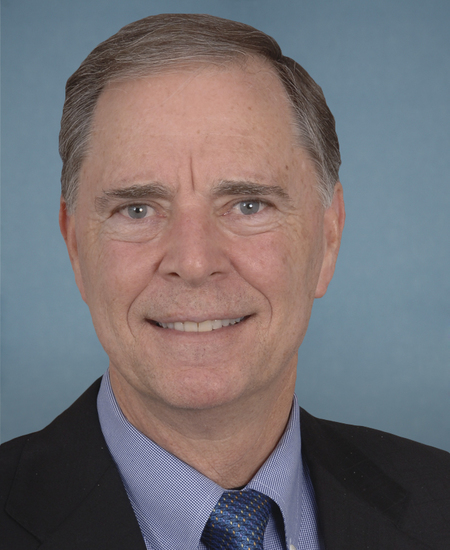
Photo of Bill Posey
R United States House · District 8 · Florida

Rep. Bill Posey

Compare
Total votes
2,168
all sessions
Attendance
96%
88 missed
Near the chamber average
With party
90%
of cast votes
Lower than 82% of chamber peers
Bipartisan score
6%
crosses aisle rarely
Higher than 81% of chamber peers
Sponsored
985
bills & resolutions
Near the chamber average
Committees
0
assignments
985 bills and resolutions

Sponsored bills

Total
985
Primary
69
Co-sponsor
916
This page
985
matching current filters
Co-sponsor HR 10315
In committee · United States House · Co-sponsor
STAND Act

Maddy summaryThe STAND Act would temporarily halt federal funding for non-defense foreign aid (including bilateral, multilateral, and humanitarian assistance) by the State Department and USAID for 60 days after a natural disaster is declared under the Stafford Act. This means no such aid spending could occur during that period, directly affecting how these agencies allocate taxpayer funds in disaster response. The freeze could only be lifted if Congress passes a joint resolution that the President signs into law. The bill focuses on pausing foreign aid to prioritize domestic disaster relief efforts in the immediate aftermath of events.

In committee Dec 5, 2024 1 co-sponsor
Co-sponsor HR 6751
Passed · United States House · Co-sponsor
Roberto Clemente Commemorative Coin Act

Maddy summaryHR 6751 authorizes the U.S. Mint to produce commemorative coins honoring Roberto Clemente, a Hall of Fame baseball player and humanitarian, including 50,000 $5 gold coins, 400,000 $1 silver coins, and 750,000 half-dollar coins. The coins must feature Clemente's image and inscriptions like "Roberto Clemente" and "2027," with all sales including a surcharge ($5-$35 per coin) paid to the Roberto Clemente Foundation. The foundation, which supports youth sports, education, and disaster relief programs, will use these funds for its mission, while the U.S. Treasury must recover all production costs. The coins will be sold exclusively in 2027, with no net cost to the government.

Passed Dec 5, 2024 1 co-sponsor
Co-sponsor HR 758
In committee · United States House · Co-sponsor
Promoting Access to Capital in Underbanked Communities Act of 2023

Maddy summaryHR 758 aims to improve financial access in communities affected by bank branch closures, primarily targeting rural and underserved urban areas. It establishes a 3-year phase-in period for new financial institutions to meet federal capital requirements and reduces the leverage ratio for qualifying rural community banks (under $10 billion in assets) to 8% during this period. The bill also allows banks to request temporary deviations from approved business plans and expands agricultural loan authority for savings associations. Additionally, it mandates a federal study on barriers to new bank formation in underserved areas, with a report due to Congress within one year. The law directly affects community banks, their regulators, and residents in counties identified as "deeply affected" by branch closures.

In committee Dec 3, 2024 1 co-sponsor
Co-sponsor HR 7333
Signed into law · United States House · Co-sponsor
To name the Department of Veterans Affairs medical center in West Palm Beach, Florida, as the "Thomas H. Corey VA Medical Center".

Maddy summaryThis bill designates the Department of Veterans Affairs medical center in West Palm Beach, Florida, as the "Thomas H. Corey VA Medical Center." The change updates all federal references - including laws, regulations, maps, and documents - to reflect the new name. It directly affects the facility's official identity and veteran services documentation. The bill is procedural and does not alter healthcare services or funding.

Signed into law Nov 25, 2024 1 co-sponsor
Co-sponsor HR 807
Signed into law · United States House · Co-sponsor
Working Dog Commemorative Coin Act

Maddy summaryThe Working Dog Commemorative Coin Act (HR 807) directs the U.S. Treasury to mint three types of commemorative coins honoring working dogs' service: $5 gold coins, $1 silver coins, and half-dollar coins with specific weight and composition requirements. Each coin will carry a surcharge ($35 for $5 coins, $10 for $1 coins, $5 for half-dollars) that will be paid directly to America's VetDogs to support their programs providing service dogs for veterans, the disabled, and others. The coins will be issued in 2027 with designs reflecting working dogs' roles in military, detection, therapy, and assistance work. The legislation specifies that all surcharge revenue must fund America's VetDogs' operations without creating new government programs. This is a commemorative measure focused on honoring working dogs' contributions through coin sales, with all surcharge funds going to a specific nonprofit organization.

Signed into law Nov 25, 2024 1 co-sponsor
Co-sponsor HR 3887
In committee · United States House · Co-sponsor
Children’s Hospital GME Support Reauthorization Act of 2023

Maddy summaryThis bill reauthorizes federal funding for graduate medical education (GME) programs at children's hospitals through fiscal year 2028. It prohibits payments to any children's hospital that provided gender-affirming care to minors during the previous fiscal year (with a special rule for 2024 payments covering July-September 2023). The bill defines "gender-affirming care" as specific medical treatments like surgeries or puberty-blocking medications for gender transition, but excludes care for certain medical conditions or gender dysphoria treatment not classified as such. This directly affects hospitals receiving GME funding that serve minors, potentially impacting their federal support if they provided the specified care. The policy change modifies existing funding rules without altering broader healthcare access for minors.

In committee Nov 20, 2024 1 co-sponsor
Co-sponsor HR 6951
In committee · United States House · Co-sponsor
College Cost Reduction Act

Maddy summary# Summary of Proposed Higher Education Act Amendments This document outlines significant proposed amendments to the Higher Education Act of 1965, primarily as part of the "College Cost Reduction Act." The key elements include: ## Accreditation Reform - Major overhaul of accreditation standards, requiring accrediting agencies to demonstrate independence from trade associations - New requirements for accrediting agencies to assess student achievement outcomes, including median value-added earnings relative to median total price charged - Introduction of an "Alternative Quality Assurance Experimental Site Initiative" to test non-accredited institutions - Protections for religious institutions, including a new process for appealing accreditation decisions related to religious mission - Removal of "litmus tests" that would require institutions to support specific political viewpoints ## Student Success Initiatives - Establishment of "Postsecondary Student Success Grants" to increase participation, retention, and completion rates for high-need students - Focus on evidence-based practices, with tiered requirements (tier 1, 2, and 3 reforms) - Mandatory inclusion of high-need student populations (low-income, first-generation, military-connected, etc.) - Requirements for institutions to report on completion rates, retention rates, and student demographics ## Regulatory Changes - Repeal of numerous existing regulations including: * Closed school discharges * Borrower defense to repayment * Pre-dispute arbitration * False certification requirements * Ability-to-benefit rules * Financial responsibility regulations - New restrictions on incentive compensation for recruiters - Changes to third-party servicer definitions and regulations ## Transfer and Credit Policies - New requirement that institutions cannot deny transfer credit based solely on the source of accreditation - Requirements for transparent transfer policies - Changes to reverse transfer policies ## Other Key Provisions - Modifications to the National Advisory Committee on Institutional Quality and Integrity (NACIQI) - New definitions for "total price" and "value-added earnings" - Changes to the process for institutions to change accrediting agencies - New requirements for institutions to report on student outcomes The overall focus of these proposed amendments is to reduce regulatory burden on institutions, promote transparency, improve student outcomes (particularly for high-need students), modernize accreditation processes, and protect religious institutions' rights in accreditation decisions.


In committee Nov 18, 2024 1 co-sponsor
Co-sponsor HRES 1574
In committee · United States House · Co-sponsor
Calling for the removal of Federal Deposit Insurance Corporation Chairman Martin J. Gruenberg from his position, effective immediately.

Maddy summaryHRES 1574 is a non-binding House resolution calling for the immediate removal of Federal Deposit Insurance Corporation (FDIC) Chairman Martin J. Gruenberg. It cites concerns about his leadership, including alleged mistreatment of staff, a "toxic workplace," staffing shortages, and failures in bank supervision that contributed to financial institution failures. The resolution does not change law or remove Gruenberg (as the President appoints FDIC leaders), but formally demands his removal. It was introduced by 25 Republican representatives and referred to the Financial Services Committee.

In committee Nov 15, 2024 1 co-sponsor
Co-sponsor HR 1279
In committee · United States House · Co-sponsor
Sunshine Protection Act of 2023

Maddy summaryThe Sunshine Protection Act of 2023 would end the practice of changing clocks twice a year for daylight saving time (DST) by making DST permanent nationwide, unless a state chooses to remain on standard time. It repeals the requirement to switch clocks back to standard time in the fall, directly affecting all U.S. states and territories that currently observe DST. The bill allows states that previously opted out of DST under the Uniform Time Act (like Arizona and Hawaii) to maintain their current time zone choices without further action. Key provisions include adjusting time zone offset language in existing law and granting states the authority to select either permanent DST or standard time based on their current arrangements. This change would eliminate seasonal time changes for most Americans, though states could still choose to stay on standard time if they prefer.

In committee Nov 14, 2024 1 co-sponsor
Co-sponsor HR 10077
In committee · United States House · Co-sponsor
University Forced Vaccination Student Injury Mitigation Act of 2024

Maddy summaryThis bill requires universities that mandate COVID-19 vaccination for attendance to cover medical costs for students who develop specific vaccine-related conditions (like myocarditis, pericarditis, or thrombosis). Students must submit documentation including vaccination records, a medical diagnosis, and cost records to their institution for reimbursement. If a university fails to comply, the Secretary of Education may cut its federal funding. The bill directly affects colleges receiving federal funds with vaccine attendance requirements and students who experience qualifying health issues after mandated vaccination. It does not change vaccination policies but establishes a process for medical cost coverage.

In committee Oct 29, 2024 1 co-sponsor
Showing 51 to 60 of 985 bills
Previous 1 … 5 6 7 … 99 Next