

Choose Home Care Act of 2021 This bill provides for coverage of home-based extended care services under Medicare. Specifically, the bill provides for coverage of services that are furnished to Medicare beneficiaries in their homes by home health agencies, including nursing care, meals and nutritional support, home medical supplies, nonemergency medical transportation, and care coordination. Coverage includes 30 days of post-hospital care and other periods of extended illness, as determined by the Centers for Medicare & Medicaid Services (CMS). Home health agencies that provide such services may receive additional payments in accordance with a specified methodology. The CMS may make payments for covered services furnished before 2022 during any period in which there is a public health emergency.
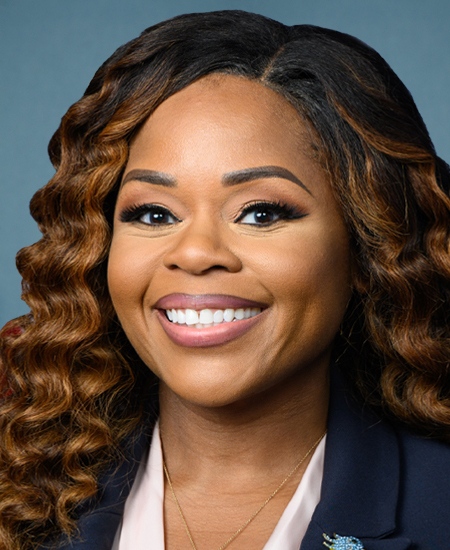
Rep. Sheila Cherfilus-McCormick
Sponsored bills
Reducing Obesity in Youth Act of 2021 This bill requires the Centers for Disease Control and Prevention, in coordination with the Administration for Children and Families, to award grants to nonprofits, institutions of higher education, or consortia of these entities to promote healthy eating and physical activity and address food insecurity among children in early care and education settings.
Diversifying Investigations Via Equitable Research Studies for Everyone Trials Act or the DIVERSE Trials Act This bill requires activities to increase diversity in clinical trials. It also expands reporting by laboratories that test for and diagnose COVID-19 and requires a study on data collection and data sharing during public health emergencies. Specifically, the Food and Drug Administration (FDA) must issue guidance on decentralized clinical trials to promote meaningful demographic and geographic diversity in patient engagement, enrollment, and participation. Decentralized clinical trials include those executed through telemedicine or other digital technologies to allow for the remote collection and assessment of clinical trial data. The FDA may also work with foreign regulators to harmonize international regulations governing decentralized clinical trials and the use of digital health technology. In addition, the Department of Health and Human Services (HHS) may support community education, outreach, and recruitment activities for clinical trials of treatments for conditions that disproportionately impact populations underrepresented in clinical trials. The bill also specifies that drug or device manufacturers may provide, subject to some limits, free digital health technologies and other remuneration to patients in approved clinical trials without violating laws that address fraud and abuse in federal programs. Furthermore, laboratories that test for and diagnose COVID-19 must report additional demographic data, including information about social determinants of health. HHS must also contract with the National Academy of Medicine to study and propose a design for an interoperable platform to facilitate data sharing during public health emergencies.
9/11 Responder and Survivor Health Funding Correction Act This bill increases funding for and otherwise modifies a federal program that provides medical monitoring and treatment to responders and survivors who suffer from health conditions related to the September 11, 2001, attacks on the World Trade Center. Among the changes, the bill allows certain health care providers other than physicians to determine whether an individual's health condition is related to the attacks, and it establishes a research program to study the impacts of the attacks on health and educational outcomes of individuals who were 21 years of age or younger when the attacks occurred.
Equal Pay for Equal Work Act This bill establishes the National Equal Pay Enforcement Task Force to improve enforcement of equal pay laws.
Sending Unconditional Payments to People Overcoming Resistances to Triumph Act of 2021 or the SUPPORT Act of 2021 This bill establishes a guaranteed income pilot program and tax credit and provides for bank accounts supported by Federal Reserve banks. The bill establishes the Office of Guaranteed Income Programs to carry out a five-year guaranteed income pilot program. The pilot program must provide grants through local governments and community development financial institutions for periodic cash payments to eligible individuals. An eligible program must provide cash payments that are not less than $50 per individual and are made on a biweekly, monthly, or quarterly basis. Additionally, the bill establishes the Guaranteed Income Tax Credit, a refundable income tax credit for individual taxpayers equal to $14,400 plus $600 for each dependent. The amount is reduced for individuals whose adjusted gross income exceeds specified levels. A taxpayer may elect to receive this credit in advance in equal amounts throughout the year. The bill also requires Federal Reserve member banks to provide bank accounts ( FedAccounts ) to residents and to businesses domiciled in the United States for purposes of holding digital dollar balances. These accounts must provide specified banking services, including debit cards, online banking, automatic bill pay, and automatic teller machines at U.S. postal facilities. These accounts may not charge fees or have balance requirements and must provide a specified interest rate.
Medical Device Nonvisual Accessibility Act of 2021 This bill requires certain medical devices with a digital interface to meet nonvisual accessibility standards established by the Food and Drug Administration (FDA). Specifically, the FDA must establish regulations to require a Class II or Class III medical device with a digital interface to provide a blind or low-vision user access to the same services and information, and generally the same ease of use, as provided to a user who is not low-vision or blind. (The FDA classifies medical devices in three classes. Class I devices are low-risk, Class II devices are moderate-risk, and Class III devices are high-risk.) A Class II or Class III medical device that does not meet the nonvisual accessibility standards established under this bill may not be sold.
Domestic Workers Bill of Rights Act This bill provides rights and protections for domestic workers (e.g., housekeepers, nannies, caretakers, personal assistants, and chauffeurs), including pay and leave rights, and health and safety protections. Specifically, the bill repeals the exemption of domestic live-in employees from certain minimum wage and maximum hour requirements. Employers must provide written notice of termination and provide at least 30 days of lodging and two weeks of severance pay to terminated live-in employees. Live-in employees also must be provided with reasonable access to telephone and internet service during their employment. The bill requires employers to provide domestic workers with a written agreement covering wages, sick leave, benefits, and other matters. Further, domestic workers may request and be granted changes to work schedules due to personal events. The bill also provides domestic workers with certain privacy rights, extends to domestic workers protections against discrimination in employment, and increases the federal medical assistance percentage (FMAP) for certain Medicaid-funded medical services provided by domestic workers. The Department of Labor must (1) award grants for a domestic worker national hotline for reporting emergencies, training on hazards facing domestic workers, and workforce investment activities for domestic workers; and (2) establish a Domestic Worker Wage and Standards Board to investigate standards in the domestic workers industry. Labor must publish online a document that describes the rights and protections for domestic workers under this bill.
Green New Deal for Public Schools Act of 2021 This bill provides environmental and educational resources to public elementary and secondary schools and Bureau of Indian Education (BIE) schools. Specifically, the bill requires the Department of Energy's (DOE's) Office of Energy Efficiency and Renewable Energy to provide climate capital facilities grants to eligible entities (e.g., public schools and BIE schools). Grant recipients must use these funds to construct new, or convert existing facilities into, healthy zero-carbon schools. Healthy zero-carbon school refers to a school with highly energy-efficient facilities that produce or procure sufficient carbon-free and pollution-free renewable energy to meet the school's needs. Next, the bill directs the Department of Education (ED) to award resource block grants to qualified local educational agencies (LEAs) to hire and retain educators and support staff in high-need schools. ED must award grants to eligible consortia of LEAs for educational equity planning and implementation. In addition, ED must establish the Climate Change Resiliency Program to increase the resiliency of public and BIE schools during climate change-related events, natural disasters, and public health crises. Further, ED must establish a related grant program for state educational agencies. Grant recipients must use these funds for certain activities (e.g., green infrastructure projects). The bill establishes the Office of Sustainable Schools within ED to (1) administer the resource block grant and educational equity grant programs, and (2) coordinate with DOE and the White House Office of Domestic Climate Policy on climate capital facilities grants and the Climate Change Resiliency Program.
Lethal Means Safety Training Act This bill requires the Department of Veterans Affairs (VA) to update its Lethal Means Safety and Suicide Prevention training course at least once a year to ensure it is culturally appropriate and uses best practices identified by subject matter experts (e.g., veterans service organizations). The bill requires certain VA employees and care providers to take the most recently updated version of the training course within 90 days after the person is hired, agrees to furnish care, or receives support and at least annually thereafter. Specifically, the bill requires the following categories of VA employees or care providers to take the training course: employees of the Veterans Health Administration or Veterans Benefits Administration who regularly interact with veterans, compensation and pension examiners, employees of Veterans Centers or vocational rehabilitation facilities, employees of Veterans Community Care Providers who provide care to veterans, and family caregivers receiving support under the Program of Comprehensive Assistance for Family Caregivers. The VA must publish the training course on a publicly available VA website. Additionally, the VA must publish a report on its website that includes the percentage of individuals in each category who have completed such training.