

Safe Schools Improvement Act of 2021 This bill requires states to direct their local educational agencies (LEAs) to establish policies that prevent and prohibit bullying and harassment of elementary and secondary school students. In particular, these policies must prohibit bullying and harassment based on race, color, national origin, sex, sexual orientation, gender identity, disability, or religion. Further, LEAs must provide (1) students, parents, and educational professionals with annual notice of the conduct prohibited in their disciplinary policies; (2) students and parents with grievance procedures that target such conduct; and (3) the public with annual data on the incidence and frequency of that conduct at the school and LEA level. The Department of Education must conduct and report on an independent biennial evaluation of programs and policies to combat bullying and harassment in elementary and secondary schools. The National Center for Education Statistics must collect state data to determine the incidence and frequency of the conduct prohibited by LEA disciplinary policies.
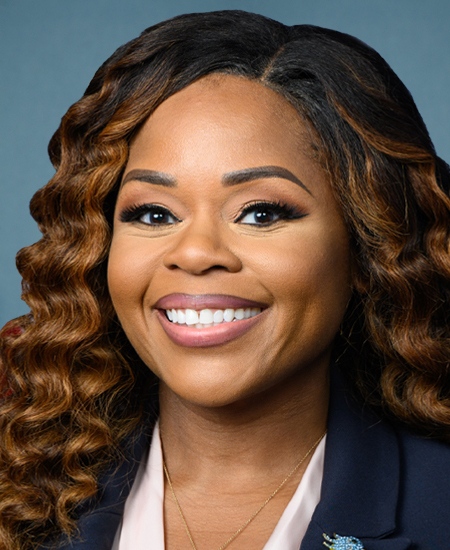
Rep. Sheila Cherfilus-McCormick
Sponsored bills
National Infrastructure Bank Act of 2021 This bill creates the National Infrastructure Bank to facilitate the long-term financing of infrastructure projects. Specifically, the bank must provide loans to public and private entities for financing, developing, or operating eligible infrastructure projects. An eligible project must have a public sponsor as well as local, regional, or national significance. The bill treats the bank as a government corporation exempt from tax and treats contributions to the bank as charitable contributions. The bill also provides for criteria and preferences for deciding whether to provide a loan, such as whether a project promotes job creation or provides environmental benefits. Projects that receive a loan must (1) pay all laborers and mechanics locally prevailing wages, and (2) use only certain U.S.-produced construction materials unless a waiver is secured from the bank. The bank shall issue stock and may also issue bonds and maintain a discount line of credit with the Federal Reserve System. The bank must apply for a national bank charter and, once chartered, accept deposits from individuals, corporations, and public entities and pay interest on those deposits. The bill imposes requirements related to the bank's operation, such as minimum reserve requirements and requirements for handling loan losses. In addition, the bank must facilitate the organization of at least seven regional economic accelerator planning groups to, among other activities, identify infrastructure needs and priorities. Within five years, the Government Accountability Office must report on the bank's activities.
Puppy Protection Act of 2021 This bill requires the Department of Agriculture to expand standards that govern the humane handling, care, treatment, and transportation of animals to include new requirements for commercial dog dealers. Specifically, the standards must require dog dealers to provide to dogs adequate housing, exercise, and veterinary care; appropriate and nutritious food; continuous access to potable water; and meaningful socialization with humans and compatible dogs for at least 30 minutes each day. The standards must also include requirements for breeders to use safe breeding practices and make all reasonable efforts to find humane placement for retired breeding dogs.
Shark Fin Sales Elimination Act of 20 21 This bill addresses the sale of shark fins and the inclusion of rays and skates in the Seafood Traceability Program. The Seafood Traceability Program has data reporting and recordkeeping requirements at the time of entry for imported fish or fish products entered into U.S. commerce. The bill makes it illegal to possess, buy, or sell shark fins or any product containing shark fins, except for certain dogfish fins. A person may possess a shark fin that was lawfully taken consistent with a license or permit under certain circumstances. Penalties are imposed for violations under the Magnuson-Stevens Fishery Conservation and Management Act. The Department of Commerce must revise its regulations to include rays and skates as species that are subject to the Seafood Traceability Program.
This bill designates the community-based outpatient clinic of the Department of Veterans Affairs in Middleburg, Florida, as the A.K. Baker VA Clinic.
Every Vote Counts Act This bill requires states to take certain actions to facilitate absentee voting for federal elections. First, the bill requires each state to establish an absentee ballot tracking program to track and confirm receipt of absentee ballots for federal elections. The Election Assistance Commission must make payments to states for establishing these programs. Next, the bill requires each state to provide in each county secured drop boxes at which individuals may drop off their completed absentee ballots for federal elections. These drop boxes must be (1) available beginning 45 days before the election; (2) accessible to individuals with disabilities and individuals with limited proficiency in the English language; (3) accessible by public transit; (4) available during all hours of the day; and (5) located in all communities within the county, including rural communities and on tribal lands. States must also post the requirements for absentee ballots to be counted and tabulated in the election. Further, the bill outlines additional requirements that a state must meet in determining the number and location of drop boxes. The bill also requires the National Institute of Standards and Technology to develop alternatives to signature matching for verifying the identity of an individual who is voting by absentee ballot.
Children Don't Belong on Tobacco Farms Act This bill prohibits as a form of oppressive child labor the employment of any employee under age 18 who has direct contact with tobacco plants or dried tobacco leaves.
Protecting our Students in Schools Act of 2021 This bill prohibits the use of corporal punishment in schools that receive federal funding. Specifically, the bill authorizes the Department of Education (ED) to take specified actions (e.g., withholding funds and issuing cease-and-desist orders) for schools that allow school personnel, law enforcement officers, or school security guards to subject students to corporal punishment. The bill also establishes enforcement provisions, including a private right of action for a student who has been subjected to corporal punishment. Each state educational agency (SEA) that receives federal funding must submit specified information to ED, including a school climate report that describes the SEA's policies and procedures related to exclusionary and aversive discipline practices in schools. Additionally, the bill authorizes ED to award three-year grants to SEAs and, through them, subgrants to local educational agencies to implement positive behavioral interventions and supports to address student behavior and reduce exclusionary and aversive discipline practices. ED must promulgate regulations as necessary to ensure compliance with the bill. The Department of Defense and the Department of the Interior must ensure that the schools they operate or fund also comply with these regulations.
Veteran Education Empowerment Act This bill reauthorizes through FY2029 and otherwise revises a Department of Education (ED) grant program for student veteran centers. Specifically, ED must make grants to institutions of higher education (IHEs) or consortia of IHEs to establish, maintain, improve, or operate a student veteran center. A student veteran center is a dedicated space on a campus that provides students who are veterans or members of the Armed Forces with (1) a lounge or meeting space for themselves, their spouses or partners, their children, and veterans in the community; and (2) a centralized office for student veteran services that serves as a single point of contact to coordinate comprehensive support services for student veterans.
John Lewis Every Child Deserves a Family Act This bill prohibits discrimination on the basis of sexual orientation, gender identity, marital status, or religion in the provision of child welfare programs and services by entities receiving federal funding. The Department of Health and Human Services (HHS) must provide technical assistance to help states follow this requirement, including (1) guidance for bringing state laws into compliance, (2) developing training to increase cultural competency related to social identity, and (3) training for judges and attorneys involved in child welfare cases, among other supports. Additionally, HHS must establish the National Resource Center on Safety, Well-Being, Placement Stability, and Permanency for LGBTQ Children and Youth Involved with Child Welfare Services to provide training, technical assistance, and guidance to applicable state and local agencies and service providers. Further, the Religious Freedom Restoration Act may not be the basis for challenging the application or enforcement of this bill. The Government Accountability Office must study and report on states' compliance with the requirements of the bill no later than three years after enactment.