

This resolution condemns the recent violence near Atlanta, Georgia, and expresses the sense of the House of Representatives that law enforcement must be supported.
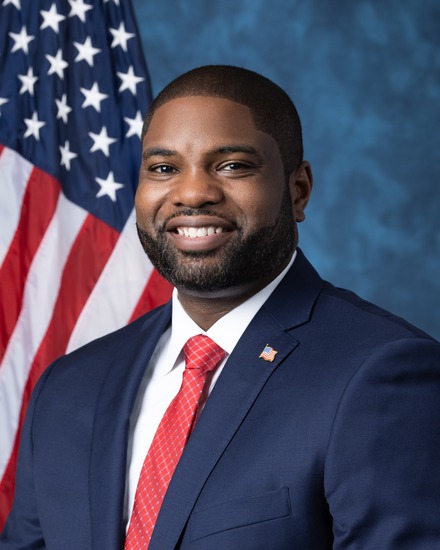
Rep. Byron Donalds
Sponsored bills
Stop Funding Our Adversaries Act of 2023 This bill prohibits federal agencies from conducting or supporting, either directly or indirectly, research that will be conducted by China's government, the Chinese Communist Party, or any agent, instrumentality, or entity belonging to or controlled by either entity.
Let Experienced Pilots Fly Act of 2023 This bill raises the mandatory retirement age for pilots engaged in commercial aviation operations from 65 to 67 years of age, unless the operation takes place in (1) the territorial airspace of a foreign county where such operations are prohibited by the foreign country, or (2) international airspace where such operations are not in compliance with the Annexes to the Convention on International Civil Aviation. The Federal Aviation Administration must also submit a report to Congress on further increasing the age limitation for pilots engaged in commercial aviation operations.
Maddy summaryHR 1623 amends the Homeland Security Act to exclude specific propane storage facilities from certain Department of Homeland Security chemical security standards. It directly affects facilities storing propane for residential use (as defined in the Fair Housing Act), agricultural production (per CFR), or small rural businesses (per the Small Business Act). The bill adds a new exclusion criterion for these facilities and requires the DHS Secretary to report to Congress and notify owners if a facility doesn't qualify for the exclusion. This changes the current security requirements for these specific propane storage locations without altering broader DHS chemical security rules.
Maddy summaryHCONRES 28 is a symbolic resolution expressing Congress's view that tax-exempt fraternal benefit societies - organizations providing life, health, and accident benefits to members - have long delivered critical community support. It states these societies, with about 7 million members nationwide, generate significant annual value through charitable work and volunteer activities (estimated at over $3.8 billion yearly). The resolution affirms that their tax-exempt status under Section 501(c)(8) of the tax code is essential for sustaining their volunteer-driven model and relieving pressure on government safety programs. As a non-binding expression of congressional sentiment, it does not alter existing laws or create new obligations.
Maddy summaryH.J. Res. 30 seeks to block a Department of Labor rule that would have required retirement plan managers (like those handling 401(k)s) to follow strict "prudence and loyalty" standards when selecting investments and voting on company matters. The rule, published in December 2022, aimed to protect retirement savings by ensuring fiduciaries prioritize participants' interests. This resolution, if passed, would prevent the rule from taking effect, avoiding new compliance requirements for retirement plan managers and sponsors. It directly affects retirement plan administrators and the millions of participants in these plans.
Maddy summaryHR 1748, the Quantum in Practice Act, amends the National Quantum Initiative Act to explicitly include "quantum molecular modeling or simulation" as a priority research area. This change directs federal funding and research efforts toward advancing quantum computing applications for molecular-level simulations. The bill directly affects scientists and researchers working under the National Quantum Initiative Act by expanding their program focus to include modeling chemical processes, materials, and reactions. Key provisions add this specific research category to existing funding priorities, aiming to accelerate breakthroughs in fields like sustainable fertilizers, drug development, and advanced materials. The policy change is purely procedural, redirecting existing program resources without creating new funding.
Maddy summaryThis bill requires the Consumer Financial Protection Bureau (CFPB) to explicitly consider the impact of proposed rules on small businesses during rulemaking. It amends the Dodd-Frank Act to mandate that the CFPB evaluate small business effects and adds a requirement for the agency to provide detailed justifications if it decides not to consider small business needs in a rule. These changes apply specifically to the CFPB's regulatory process and directly affect small businesses by requiring the agency to address their unique challenges in rule development. The bill focuses on procedural changes to existing regulatory flexibility analysis requirements under Title 5 of the U.S. Code.
Maddy summaryHR 1716, the Global Aircraft Maintenance Safety Improvement Act, requires U.S. airlines to annually report detailed information about heavy maintenance work performed outside the U.S. on their aircraft, including locations, work descriptions, and any safety issues identified after maintenance. It prohibits U.S. airlines from entering new contracts for such maintenance with repair stations in countries classified by the FAA as "Category 2" due to safety deficiencies. The bill also mandates that mechanics and supervisors at foreign repair stations performing heavy maintenance on U.S. aircraft must hold appropriate FAA certifications. Additionally, it establishes a working group with international aviation authorities to review and recommend improvements for overseeing foreign repair stations.
Maddy summaryHR 1141, the Natural Gas Tax Repeal Act, repeals a specific provision (Section 136) of the Clean Air Act that established an incentive program for reducing methane emissions and waste in natural gas systems. This bill directly affects natural gas producers and operators who previously participated in or were subject to the methane emissions reduction program. The key mechanism is the removal of this incentive program, eliminating federal requirements and financial incentives related to methane waste reduction for the natural gas industry. The bill also rescinds unobligated funds allocated for this program. This is a policy change removing a regulatory incentive, not a tax repeal.