

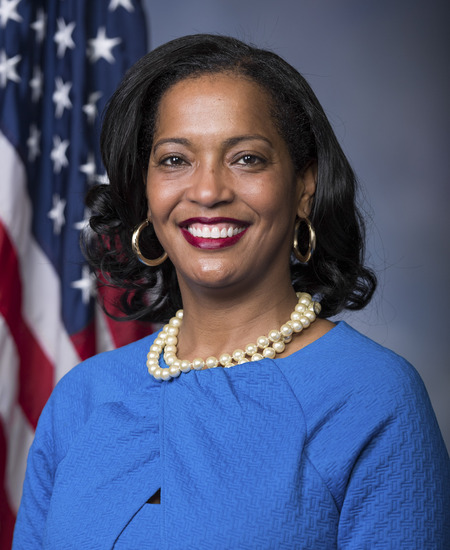
Photo of Jahana Hayes
D United States House · District 5 · Connecticut On the 2026 ballot

Rep. Jahana Hayes

Compare
Total votes
2,837
all sessions
Attendance
99%
24 missed
Near the chamber average
With party
97%
of cast votes
Near the chamber average
Bipartisan score
1%
crosses aisle rarely
Near the chamber average
Sponsored
2,286
bills & resolutions
Higher than 90% of chamber peers
Committees
6
assignments
2,286 bills and resolutions

Sponsored bills

Total
2,286
Primary
106
Co-sponsor
2,180
This page
2,286
matching current filters
Co-sponsor HR 240
Passed May 19, 2021 1 co-sponsor
Co-sponsor HR 210
Passed · United States House · Co-sponsor
Rural STEM Education Research Act

Rural STEM Education Research Act This bill specifies federal scientific research and development efforts towards STEM (science, technology, engineering, and mathematics, including computer science) workforce development and rural STEM education. (Sec. 3) The bill amends the objectives of the Manufacturing Extension Partnership program to include the provision to secondary schools of information about the job skills needed in manufacturing companies, and the promotion and expansion of certification systems offered through local high schools. The activities of a manufacturing extension center are expanded to include local high schools in the facilitation of collaborations and partnerships between manufacturing companies and schools to help those entities better understand the specific needs of manufacturers and to help manufacturers better understand the skill sets that students learn in school programs. The National Institute of Standards and Technology (NIST) must award prizes to stimulate research and development of creative technologies in order to deploy affordable and reliable broadband connectivity to underserved rural communities. NIST may award not more than a total of $5 million in prizes. (Sec. 4) The Office of Science and Technology Policy must establish a broadband research and development working group to address national research challenges and opportunities for improving broadband access and adoption across the United States. (Sec. 5) The National Science Foundation (NSF) shall enter into an agreement with the National Academy of Sciences under which the National Academy of Sciences agrees to evaluate aspects of STEM education and workforce development in rural areas. (Sec. 6) The Government Accountability Office shall conduct a study on the engagement of rural populations in federal STEM programs. (Sec. 7) Experimental Program to Stimulate Competitive Research (EPSCoR) programs shall consider modifications to award structures to increase the capacity of rural communities to provide quality STEM education and STEM workforce development programming to students and teachers. (Sec. 8) The NSF must award grants to institutions of higher education or nonprofit organizations for (1) research and development to advance innovative approaches to support and sustain high-quality STEM teaching in rural schools, (2) research and development of programming to identify the barriers rural students face in accessing high-quality STEM education, (3) development of innovative solutions to improve the participation and advancement of rural students in grades Pre-K through 12 in STEM studies, and (4) research on online STEM education courses for rural communities. The NSF may establish a pilot program of regional cohorts in rural areas to provide peer support, mentoring, and hands-on research experiences for rural STEM educators of students in grades Pre-K through 12 in order to build an ecosystem of cooperation among educators, researchers, academia, and local industry.

Passed May 19, 2021 1 co-sponsor
Co-sponsor HRES 405
In committee · United States House · Co-sponsor
Supporting the goals and ideals of the International Day Against Homophobia, Transphobia, and Biphobia.

This resolution supports the goals and ideals of an International Day Against Homophobia, Transphobia, and Biphobia. The resolution encourages (1) health care providers to offer culturally and clinically competent care to the lesbian, gay, bisexual, transgender, queer, or questioning (LGBTQ+) community; (2) schools to support the creation of gender and sexuality alliances; (3) individuals to learn about national resources for those who identify as LGBTQ+; and (4) funding organizations, aid efforts, and governments to prioritize the health and human rights of LGBTQ+ people.

In committee May 18, 2021 1 co-sponsor
Co-sponsor HRES 398
Passed · United States House · Co-sponsor
Recognizing the forthcoming centennial of the 1921 Tulsa Race Massacre.

This resolution expresses the sense of the House of Representatives that the United States can achieve a more perfect union by condemning the violence and destruction perpetrated against the African American community of Greenwood in Tulsa, Oklahoma. The resolution states that a more perfect union may be achieved through other means as well, including by promoting tolerance and unity, and it recognizes Congress's commitment to acknowledge and learn from the history of racism and racial violence in the United States in order to reverse the legacy of white supremacy and fight for racial justice.

Passed May 18, 2021 1 co-sponsor
Co-sponsor HRES 215
In committee · United States House · Co-sponsor
Recognizing the forthcoming centennial of the 1921 Tulsa Race Massacre.

This resolution recognizes the forthcoming centennial of the Tulsa Race Massacre of 1921. The resolution acknowledges the historical significance of this event as one of the largest single instances of state-sanctioned violence against Black people in American history; honors the lives and legacies of the estimated 300 Black individuals who were killed during the massacre and the nearly 9,000 who were left homeless and penniless; condemns efforts to cover up the truth and shield the white community, especially government officials, from accountability; condemns the continued legacy of racism and white supremacy against Black people in the United States, particularly in the form of police brutality; encourages education about the massacre, the history of white supremacy that fueled the massacre, and subsequent attempts to deny or cover up the massacre, in all elementary and secondary education settings and in institutions of higher education; and recognizes the commitment of Congress to acknowledge and learn from the history of racism and racial violence to reverse the legacy of white supremacy and fight for racial justice.

In committee May 18, 2021 1 co-sponsor
Co-sponsor HR 3321
In committee · United States House · Co-sponsor
Credit for Caring Act of 2021

Credit for Caring Act of 2021 This bill allows an eligible caregiver a tax credit of up to $5,000 for 30% of the cost of long-term care expenses that exceed $2,000 in a taxable year. The bill defines eligible caregiver as an individual who has earned income for the taxable year in excess of $7,500 and pays or incurs expenses for providing care to a spouse or other dependent relative with long-term care needs.

In committee May 18, 2021 1 co-sponsor
Co-sponsor HR 3294
In committee · United States House · Co-sponsor
IGNITE HBCU Excellence Act

Institutional Grants for New Infrastructure, Technology, and Education for HBCU Excellence Act or the IGNITE HBCU Excellence Act This bill establishes a grant program to support long-term improvements of historically Black colleges and universities (HBCUs) and graduate programs at HBCUs. Specifically, the bill requires the Department of Education (ED) to award grants to HBCUs to improve campus facilities. A recipient must use grant funds for certain activities, such as constructing or renovating facilities, carrying out major repairs, and strengthening the safety and security of a campus. Any new construction, modernization, or renovation projects must meet building code and energy and water conservation requirements. Further, HBCUs must seek to procure contracts from certain small businesses, including those owned and controlled by veterans and service-disabled veterans. The bill prohibits the use of grant funds for specified activities, including for the payment of routine and predictable maintenance costs, minor repairs, and utility bills. The Government Accountability Office must study the implementation of the grant program. The bill also requires ED to repay the outstanding balance of principal, interest, fees, and costs and any related reimbursements for certain capital financing loans.

In committee May 18, 2021 1 co-sponsor
Co-sponsor HR 3271
In committee · United States House · Co-sponsor
Climate Change Health Protection and Promotion Act of 2021

Climate Change Health Protection and Promotion Act of 2021 This bill requires the Department of Health and Human Services (HHS) to take a series of actions to address the potential impacts of climate change on public health. Specifically, HHS must develop a strategic action plan and a climate and health program to ensure the public health and health care systems in the United States and other nations are prepared for, and can respond to, the impacts of climate change on health. HHS must revise the plan periodically to reflect new scientific developments and information. Additionally, HHS must establish a permanent science advisory board to provide (1) scientific and technical recommendations on the impacts of climate change on public health, and (2) advice for purposes of issuing the plan and conducting the program.

In committee May 18, 2021 1 co-sponsor
Co-sponsor HR 1976
In committee · United States House · Co-sponsor
Medicare for All Act of 2021

Medicare for All Act of 2021 This bill establishes a national health insurance program that is administered by the Department of Health and Human Services (HHS). Among other requirements, the program must (1) cover all U.S. residents; (2) provide for automatic enrollment of individuals upon birth or residency in the United States; and (3) cover items and services that are medically necessary or appropriate to maintain health or to diagnose, treat, or rehabilitate a health condition, including hospital services, prescription drugs, mental health and substance abuse treatment, dental and vision services, and long-term care. The bill prohibits cost-sharing (e.g., deductibles, coinsurance, and copayments) and other charges for covered services. Additionally, private health insurers and employers may only offer coverage that is supplemental to, and not duplicative of, benefits provided under the program. Health insurance exchanges and specified federal health programs terminate upon program implementation. However, the program does not affect coverage provided through the Department of Veterans Affairs or the Indian Health Service. The bill also establishes a series of implementing provisions relating to (1) health care provider participation; (2) HHS administration; and (3) payments and costs, including the requirement that HHS negotiate prices for prescription drugs. Individuals who are age 18 or younger, age 55 or older, or already enrolled in Medicare may enroll in the program starting one year after enactment of this bill; other individuals may buy into the program at this time. The program must be fully implemented two years after enactment.

In committee May 18, 2021 1 co-sponsor
Showing 1,911 to 1,920 of 2,286 bills