Recognizing Military Service in PSLF Act This bill requires the Department of Education to count each month for which a borrower's federal student loan payment was in deferment or forbearance during a period of active duty, including certain National Guard duty, as a qualifying payment for the purpose of the Public Service Loan Forgiveness (PSLF) program. Under current law, a borrower who is a service member is eligible to receive student loan forgiveness under the PSLF program; however, if the borrower places their loan into deferment or forbearance while they are on active duty, that period of time does not count as a qualifying payment for the PSLF program.
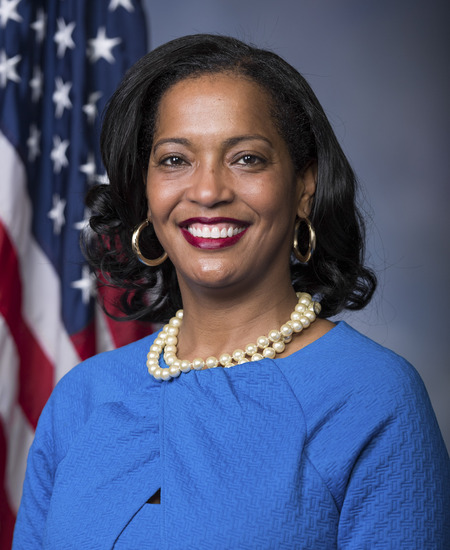
Rep. Jahana Hayes
Sponsored bills
HOPE for HOMES Act of 2021 This bill provides support for energy efficiency upgrades in homes. Specifically, the bill directs the Department of Energy (DOE) to establish a grant program that supports training on how to efficiently retrofit homes. In addition, DOE must establish a Home Energy Savings Retrofit Rebate Program to provide rebates for homeowners to invest in energy efficiency improvements.
Diversifying by Investing in Educators and Students to Improve Outcomes For Youth Act or the Diversify Act This bill revises the Teacher Education Assistance for College and Higher Education (TEACH) grant program. The TEACH program awards grants to undergraduate and graduate students who commit to teaching in a high-need field and in an elementary or secondary school that serves low-income students. First, the bill raises the maximum amount for TEACH grants. Second, the bill allows TEACH grants to cover the full cost of attendance. Currently, these grants may be used only for tuition, fees, and on-campus housing. The bill allows teaching in a high-need early childhood education program to count toward service requirements for the program. Next, the bill eliminates the process for converting a TEACH grant to a loan if a recipient does not complete the requirements of the program. Further, the bill prohibits the Department of Education (ED) from instituting or creating a monetary penalty for failure or refusal to complete the service requirement. In addition, the bill requires ED to send an electronic certificate to grant recipients who have completed their service requirement. The bill also exempts the TEACH program from sequestration, which is a process of automatic, usually across-the-board spending reductions under which budgetary resources are permanently cancelled to enforce specific budget policy goals.
Jobs, On-the-Job 'Earn-While-You-Learn' Training, and Apprenticeships for Young African Americans Act This bill makes changes to the national apprenticeship system aimed at promoting diversity. Specifically, the bill establishes the Diversity and Inclusion Administrator in the Office Apprenticeship within the Office of Employment and Training Administration at the Department of Labor, requires every apprenticeship program that registers or renews an apprenticeship with the Office of Apprenticeship to submit a plan to increase participation by individuals who are African American, and requires the Diversity and Inclusion Administrator to award grants to create or expand diversity in registered apprenticeship programs.
Civics Learning Act of 2021 This bill expands the use of American History and Civics Education—National Activities grants to prioritize innovative civics learning and teaching. Specifically, the bill expands the allowable uses of these grants to include before-, during-, and after-school activities and extracurricular activities; activities that include service learning and community service projects that are linked to school curriculum; activities that encourage and support student participation in school governance; and online and video game-based learning. Further, the Department of Education must ensure that specified percentages of grant funds are awarded on a diverse basis to eligible entities (e.g., institutions of higher education) that serve students and teachers at elementary schools, middle schools, and high schools.
Opportunity To Address College Hunger Act This bill requires institutions of higher education (IHEs) that receive grants to operate work-study programs to notify a student receiving work-study assistance that the student may be eligible for participation in the Supplemental Nutrition Assistance Program (SNAP). The Department of Education must provide guidance to states and IHEs on how to identify and communicate with students who are potentially eligible for SNAP.
This resolution condemns the acts of gun violence that led to the tragic loss of eight lives in Georgia on March 16, 2021.
Birth Access Benefiting Improved Essential Facility Services Act or the BABIES Act This bill requires the Centers for Medicare & Medicaid Services (CMS) to establish a Medicaid demonstration program to improve freestanding birth center services for women with low-risk pregnancies. Among other things, the CMS must (1) publish criteria for freestanding birth centers to participate in the program, including specified accreditation, licensure, and service requirements; (2) publish guidance for states to establish prospective payment systems under Medicaid for program participants; and (3) award planning grants for states to develop program proposals. The CMS may choose up to six states to participate in the program.
Real Education and Access for Healthy Youth Act of 2021 This bill requires the Department of Health and Human Services (HHS) to establish grants to support sex education and sexual health services for young people (ages 10 through 29) and repeals requirements that apply to certain federally funded sex education programs. HHS must award grants, in coordination with the Department of Education, to (1) provide sex education to young people through elementary and secondary schools, institutions of higher education, and youth-serving organizations; and (2) train education professionals to effectively teach, and otherwise support, sex education. Sex education refers to high quality teaching and learning that follows, to the maximum extent practicable, specified educational standards; covers a variety of topics concerning sex and sexuality; explores values and beliefs about those topics; and helps young people gain skills to navigate relationships and manage sexual health. Additionally, HHS must award grants for the provision of sexual health services to marginalized youth to youth-serving organizations and health care entities that are eligible to receive covered outpatient drugs at reduced prices through the 340B drug discount program. Recipients of any of these grants must comply with certain nondiscrimination requirements. In addition, they may not use funds for sex education programs or sexual health services that provide incomplete or inaccurate medical information or fail to address specified issues. The bill also eliminates prohibitions regarding the content of specified federally funded sexual health education and information programs and repeals the Abstinence Only Until Marriage program.

Ghost Army Congressional Gold Medal Act This bill directs the Speaker of the House of Representatives and the President pro tempore of the Senate to award a Congressional Gold Medal to the 23rd Headquarters Special Troops and the 3133d Signal Service Company, known as the Ghost Army , collectively, in recognition of its service during World War II.