

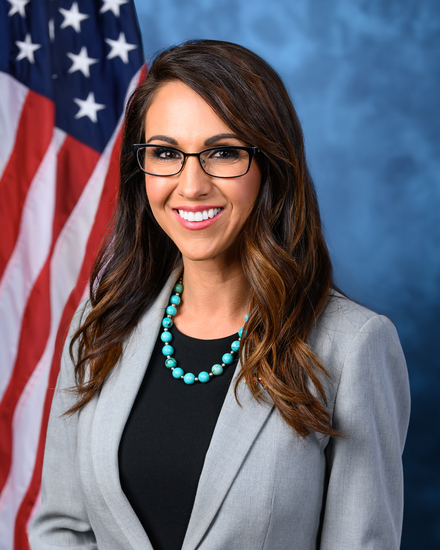
Photo of Lauren Boebert
R United States House · District 4 · Colorado On the 2026 ballot

Rep. Lauren Boebert

Compare
Total votes
2,837
all sessions
Attendance
96%
120 missed
Lower than 78% of chamber peers
With party
82%
of cast votes
Lower than 96% of chamber peers
Bipartisan score
9%
crosses aisle rarely
Higher than 94% of chamber peers
Sponsored
1,024
bills & resolutions
Near the chamber average
Committees
7
assignments
1,024 bills and resolutions

Sponsored bills

Total
1,024
Primary
88
Co-sponsor
936
This page
1,024
matching current filters
Co-sponsor HR 152
In committee · United States House · Co-sponsor
Hearing Protection Act

Maddy summaryHR 152, titled the "Hearing Protection Act," actually addresses firearm silencers (suppressors), not hearing protection. The bill removes federal registration requirements for silencers by directing the Attorney General to destroy all existing silencer records within 365 days. It also preempts state laws that tax, register, or impose recordkeeping requirements on silencers, making such state rules unenforceable. Additionally, the bill updates tax codes to include silencers as taxable items and clarifies their definition in firearm laws.

In committee Dec 17, 2024 1 co-sponsor
Co-sponsor HR 10414
In committee · United States House · Co-sponsor
To repeal the Impoundment Control Act of 1974.

Maddy summaryHR 10414 seeks to repeal the Impoundment Control Act of 1974 (2 U.S.C. 681 et seq.), a law that limited the President's authority to withhold funds Congress had appropriated. This bill would remove the legal restrictions requiring the President to seek Congressional approval before delaying or refusing to spend money already approved by Congress. The repeal would directly affect the executive branch's budget implementation powers, restoring the pre-1974 practice where the President could withhold funds without specific Congressional consent. This is a procedural change altering the legal framework governing federal spending, with no new provisions or direct impact on specific programs or citizens.

In committee Dec 16, 2024 1 co-sponsor
Co-sponsor HR 1586
In committee · United States House · Co-sponsor
Forest Protection and Wildland Firefighter Safety Act of 2023

Maddy summaryHR 1586, the Forest Protection and Wildland Firefighter Safety Act of 2023, exempts certain fire suppression activities from requiring permits under the Clean Water Act. It directly affects federal agencies like the Forest Service, National Park Service, and Bureau of Land Management, as well as state, local, and tribal governments conducting wildfire response. The bill's key provision removes the need for a Section 402 permit under the Clean Water Act when these covered entities discharge fire retardants, chemicals, or water for fire control or prevention. This change streamlines firefighting operations by eliminating a specific permitting step during active wildfire events.

In committee Dec 16, 2024 1 co-sponsor
Co-sponsor HR 10398
In committee · United States House · Co-sponsor
Safe Shelters Act of 2024

Maddy summaryHR 10398, the Safe Shelters Act of 2024, prohibits sex offenders required to register under federal law from using emergency shelters not specifically designated for them. Covered sex offenders must immediately notify shelter staff of their registration status if entering an undesignated shelter, and shelter operators must then provide information about designated shelters and the prohibition. The bill directs FEMA to designate specific federal buildings or prisons as emergency shelters exclusively for these offenders during disasters, with lists of available facilities to be provided by GSA and the Bureau of Prisons within 180 days. Violating the notification or shelter use rules carries penalties of fines, up to 5 years in prison, or both.

In committee Dec 12, 2024 1 co-sponsor
Primary HR 8753
Passed · United States House · Lead sponsor
To direct the United States Postal Service to designate single, unique ZIP Codes for certain communities, and for other purposes.

Maddy summaryHR 8753 requires the U.S. Postal Service to assign a single, unique ZIP Code to 31 specific communities across 10 states, including Eastvale, CA, and The Villages, FL, within 270 days of the bill's enactment. This change directly affects residents and businesses in these communities by standardizing mail delivery addresses. The key mechanism mandates the USPS to establish one distinct ZIP Code per listed community, replacing any existing multi-part or shared codes. This is a procedural adjustment to improve mail sorting efficiency, not a substantive policy change.

Passed Dec 12, 2024 0 co-sponsors
Co-sponsor HR 7779
In committee · United States House · Co-sponsor
Good Samaritan Remediation of Abandoned Hardrock Mines Act of 2024

Maddy summaryThe Good Samaritan Remediation of Abandoned Hardrock Mines Act of 2024 establishes a limited pilot program allowing non-responsible parties (called "Good Samaritans") to remediate pollution at abandoned hardrock mine sites. The bill creates a permit process requiring applicants to demonstrate they're not liable for the pollution, can safely complete the remediation, and will protect the environment. The Environmental Protection Agency would issue up to 15 permits for these projects, providing liability protection for permitted activities while requiring public notice and environmental review. The pilot program would expire after 7 years, with the EPA required to report on its effectiveness to Congress.

In committee Dec 11, 2024 1 co-sponsor
Primary HR 6547
In committee · United States House · Lead sponsor
Colorado Energy Prosperity Act of 2024

Maddy summaryThe Colorado Energy Prosperity Act of 2024 prohibits the U.S. Secretary of the Interior from finalizing, implementing, administering, or enforcing a specific draft resource management plan and environmental impact statement for federal lands in the Colorado River Valley and Grand Junction areas. This bill directly affects federal land management decisions by blocking the implementation of a plan published in the Federal Register (August 4, 2023) that was intended to guide resource use. The key provision is a clear, direct prohibition on the Secretary taking any action to advance this draft document. The bill does not create new regulations or alter existing laws but stops a specific federal environmental review process.

In committee Dec 10, 2024 0 co-sponsors
Co-sponsor HR 374
In committee · United States House · Co-sponsor
Abolish the ATF Act

Maddy summaryHR 374, titled the "Abolish the ATF Act," would eliminate the Bureau of Alcohol, Tobacco, Firearms and Explosives (ATF) as a federal agency. This bill directly affects the ATF itself, ending its existence and all its current operations. The key provision is a single, straightforward legislative action to abolish the bureau, without specifying alternative agencies or processes for handling the functions it currently performs. The bill does not detail how firearm regulations, tobacco enforcement, or other ATF responsibilities would be managed after abolition.

In committee Dec 5, 2024 1 co-sponsor
Co-sponsor HR 5528
Passed · United States House · Co-sponsor
Safe and Smart Federal Purchasing Act

Maddy summaryThe Safe and Smart Federal Purchasing Act (HR 5528) requires the Director of the Office of Management and Budget (OMB) to evaluate whether federal agencies' use of the "lowest price technically acceptable" procurement method creates national security risks. This review specifically examines agency practices under Federal Acquisition Regulation section 15.101-2. Within 180 days of enactment, OMB must submit a report to the House Oversight Committee and Senate Homeland Security Committee detailing its findings. The bill does not change procurement rules but mandates this assessment to inform future policy decisions.

Passed Dec 2, 2024 1 co-sponsor
Co-sponsor HR 10250
In committee · United States House · Co-sponsor
Mens Rea Reform Act of 2024

Maddy summaryThis bill clarifies the mental state requirements prosecutors must prove in federal criminal cases. It establishes that for most serious offenses (those punishable by imprisonment or fines over $2,500), the government must prove beyond a reasonable doubt that a defendant acted "knowingly" or with a specified mental state for each element of the crime, unless the law already specifies otherwise. Exceptions apply for jurisdictional elements, venue rules, or if Supreme Court precedent requires a different standard. The law applies retroactively to cases starting after its enactment, unless it would punish innocent conduct or deny existing defenses. It does not change which acts are criminal but standardizes how mental state must be proven.

In committee Nov 22, 2024 1 co-sponsor
Showing 321 to 330 of 1,024 bills
Previous 1 … 32 33 34 … 103 Next