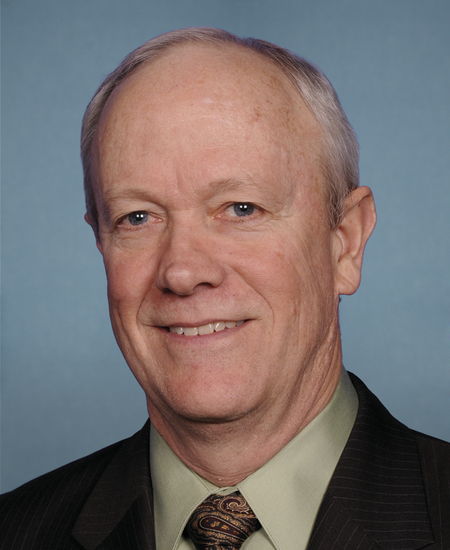
Photo of Jerry McNerney
D United States House · District 9 · California

Rep. Jerry McNerney

Compare
Total votes
958
all sessions
Attendance
99%
5 missed
Near the chamber average
With party
99%
of cast votes
Higher than 95% of chamber peers
Bipartisan score
0%
crosses aisle rarely
Lower than 96% of chamber peers
Sponsored
439
bills & resolutions
Near the chamber average
Committees
0
assignments
439 bills and resolutions

Sponsored bills

Total
439
Primary
22
Co-sponsor
417
This page
439
matching current filters
Primary HR 1841
In committee · United States House · Lead sponsor
Digital Equity Act of 2021

Digital Equity Act of 2021 This bill requires the National Telecommunications and Information Administration to establish grant programs for promoting digital equity, supporting digital inclusion activities, and building capacity for state-led efforts to increase adoption of broadband by their residents. Specifically, the bill establishes the State Digital Equity Capacity Grant Program to make distributions to states based on their populations, demographics, and availability and adoption of broadband. The bill also establishes the Digital Equity Competitive Grant Program for supporting efforts to achieve digital equity, promote digital inclusion, and stimulate adoption of broadband.

In committee Mar 12, 2021 0 co-sponsors
Co-sponsor HR 842
Passed · United States House · Co-sponsor
Protecting the Right to Organize Act of 2021

Protecting the Right to Organize Act of 20 21 This bill expands various labor protections related to employees' rights to organize and collectively bargain in the workplace. Among other things, it (1) revises the definitions of employee , supervisor , and employer to broaden the scope of individuals covered by the fair labor standards; (2) permits labor organizations to encourage participation of union members in strikes initiated by employees represented by a different labor organization (i.e., secondary strikes); and (3) prohibits employers from bringing claims against unions that conduct such secondary strikes. The bill also allows collective bargaining agreements to require all employees represented by the bargaining unit to contribute fees to the labor organization for the cost of such representation, notwithstanding a state law to the contrary; and expands unfair labor practices to include prohibitions against replacement of, or discrimination against, workers who participate in strikes. The bill makes it an unfair labor practice to require or coerce employees to attend employer meetings designed to discourage union membership and prohibits employers from entering into agreements with employees under which employees waive the right to pursue or a join collective or class-action litigation. The bill further prohibits employers from taking adverse actions against an employee, including employees with management responsibilities, in response to that employee participating in protected activities related to the enforcement of the prohibitions against unfair labor practices (i.e., whistleblower protections). Such protected activities include providing information about a potential violation to an enforcement agency, participating in an enforcement proceeding, initiating a proceeding concerning an alleged violation or assisting in such a proceeding, or refusing to participate in an activity the employee reasonably believes is a violation of labor laws. Finally, the bill addresses the procedures for union representation elections, provides employees with the ability to vote in such elections remotely by telephone or the internet, modifies the protections against unfair labor practices that result in serious economic harm, and establishes penalties and permits injunctive relief against entities that fail to comply with National Labor Relations Board orders.

Passed Mar 11, 2021 1 co-sponsor
Co-sponsor HR 1
Passed · United States House · Co-sponsor
For the People Act of 2021

For the People Act of 2021 This bill addresses voter access, election integrity and security, campaign finance, and ethics for the three branches of government. Specifically, the bill expands voter registration (e.g., automatic and same-day registration) and voting access (e.g., vote-by-mail and early voting). It also limits removing voters from voter rolls. The bill requires states to establish independent redistricting commissions to carry out congressional redistricting. Additionally, the bill sets forth provisions related to election security, including sharing intelligence information with state election officials, supporting states in securing their election systems, developing a national strategy to protect U.S. democratic institutions, establishing in the legislative branch the National Commission to Protect United States Democratic Institutions, and other provisions to improve the cybersecurity of election systems. Further, the bill addresses campaign finance, including by expanding the prohibition on campaign spending by foreign nationals, requiring additional disclosure of campaign-related fundraising and spending, requiring additional disclaimers regarding certain political advertising, and establishing an alternative campaign funding system for certain federal offices. The bill addresses ethics in all three branches of government, including by requiring a code of conduct for Supreme Court Justices, prohibiting Members of the House from serving on the board of a for-profit entity, and establishing additional conflict-of-interest and ethics provisions for federal employees and the White House. The bill requires the President, the Vice President, and certain candidates for those offices to disclose 10 years of tax returns.


Passed Mar 11, 2021 1 co-sponsor
Primary HR 1700
In committee · United States House · Lead sponsor
Broadband Infrastructure Finance and Innovation Act of 2021

Broadband Infrastructure Finance and Innovation Act of 2021 This bill requires the National Telecommunications and Information Administration to make financing available for the construction and deployment of broadband infrastructure through a broadband infrastructure finance and innovation program. Specifically, the bill provides a means for communities and public-private partnerships to apply for low-interest secured loans, lines of credit, or loan guarantees to finance broadband infrastructure investments. The bill requires biennial reports on the financial performance of projects carried out with program assistance.

In committee Mar 10, 2021 0 co-sponsors
Co-sponsor HR 1672
In committee · United States House · Co-sponsor
Connect America Act of 2021

Connect America Act of 2021 This bill requires the Federal Communications Commission to establish a funding program to expand broadband access for unserved areas, areas with low-tier or mid-tier service, and unserved anchor institutions (e.g., schools or libraries). The program shall consist of both national systems of competitive bidding and grants of specified amounts to states. An area with low-tier service is an area where at least 90% of the population has access to broadband service with speeds between 25-100 megabits per second (mbps). An area with mid-tier service is an area where at least 90% of the population has access to broadband service with speeds between 100 mbps and 1 gigabit per second. Priority must be given to projects that would expand access to broadband service in areas where at least 90% of the population has no access to broadband service or to service with speeds of at least 25 mbps.

In committee Mar 10, 2021 1 co-sponsor
Co-sponsor HR 1673
In committee Mar 10, 2021 1 co-sponsor
Co-sponsor HR 1670
In committee · United States House · Co-sponsor
Abortion is Health Care Everywhere Act of 2021

Abortion is Health Care Everywhere Act of 2021 This bill authorizes the use of certain foreign assistance funds to provide comprehensive reproductive health care services in developing countries, including abortion services, training, and equipment.

In committee Mar 9, 2021 1 co-sponsor
Showing 361 to 370 of 439 bills
Previous 1 … 36 37 38 … 44 Next