

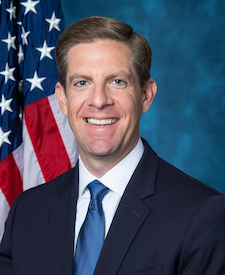
Photo of Mike Levin
D United States House · District 49 · California On the 2026 ballot

Rep. Mike Levin

Compare
Total votes
2,837
all sessions
Attendance
100%
5 missed
Higher than 82% of chamber peers
With party
97%
of cast votes
Near the chamber average
Bipartisan score
2%
crosses aisle rarely
Near the chamber average
Sponsored
1,568
bills & resolutions
Higher than 75% of chamber peers
Committees
3
assignments
1,568 bills and resolutions

Sponsored bills

Total
1,568
Primary
91
Co-sponsor
1,477
This page
1,568
matching current filters
Co-sponsor HR 3232
In committee · United States House · Co-sponsor
Respect for Grieving Military Families Act

Maddy summaryThis bill, HR 3232 (Respect for Grieving Military Families Act), requires the military to automatically forgive overpayments of retired pay sent to a joint account after a service member’s death but before the end of the month of death. It directly affects military retirees’ families who have joint accounts with designated beneficiaries, preventing them from having to repay these accidental payments. The bill also adjusts Survivor Benefit Plan payments: if forgiveness doesn’t occur, the first 12 monthly annuity payments to the beneficiary will each be reduced by one-twelfth of the overpayment amount. This ensures grieving families aren’t burdened with repaying funds they weren’t meant to receive.

In committee May 11, 2023 1 co-sponsor
Co-sponsor HR 3240
In committee · United States House · Co-sponsor
To amend title 36, United States Code, to grant a Federal charter to the Veterans Association of Real Estate Professionals.

Maddy summaryHR 3240 grants a federal charter to the Veterans Association of Real Estate Professionals (VAREP), a California-based nonprofit already recognized as a veterans service organization under IRS tax law. The bill establishes specific rules for VAREP, requiring it to maintain its tax-exempt status, submit annual reports to Congress, and follow restrictions like not issuing stock, making political contributions, or claiming government authority. VAREP must continue its existing mission of supporting veterans through financial literacy programs, housing assistance (including foreclosure prevention), workforce development, and suicide awareness initiatives. This charter does not create new government benefits but formally recognizes and regulates this specific organization's federal status.

In committee May 11, 2023 1 co-sponsor
Co-sponsor HR 3238
In committee · United States House · Co-sponsor
Affordable Housing Credit Improvement Act of 2023

Maddy summaryHR 3238, the Affordable Housing Credit Improvement Act of 2023, updates the Low-Income Housing Tax Credit (LIHTC) program to increase the availability of affordable housing across the United States. The bill makes several key changes including increasing state funding formulas, modifying tenant eligibility rules to better serve vulnerable populations (such as domestic violence victims and students), and expanding credit eligibility for projects in rural and Native American communities. Specific provisions raise the credit for properties serving extremely low-income households, clarify rules around tenant income increases, and require housing providers to protect victims of domestic violence. The bill also updates terminology from "low-income" to "affordable" throughout the tax code and enhances program transparency through data sharing requirements. These changes aim to make the LIHTC program more effective at creating and preserving affordable housing units for low-income households nationwide.

In committee May 11, 2023 1 co-sponsor
Co-sponsor HR 3184
In committee · United States House · Co-sponsor
Invest to Protect Act of 2023

Maddy summaryThe Invest to Protect Act of 2023 establishes a federal grant program for local law enforcement agencies with fewer than 200 officers (including counties, municipalities, and tribal governments) to fund training and support services. Grants cover de-escalation training, mental health resources, evidence-based safety training (such as handling domestic violence or mental health crises), and recruitment/retention incentives like signing bonuses, retention bonuses (up to 20% of salary), and stipends for graduate education in mental health or social work. The bill requires a streamlined grant application process (under two hours), public disclosure of bonus amounts, and annual audits to prevent misuse of funds.

In committee May 10, 2023 1 co-sponsor
Co-sponsor HR 3170
In committee · United States House · Co-sponsor
HELPER Act of 2023

Maddy summaryThe HELPER Act of 2023 creates a new FHA mortgage insurance program specifically for first responders and K-12 teachers. It allows eligible first-time homebuyers in these professions to secure mortgages with 100% financing (no down payment required) for purchasing or repairing a primary residence. To qualify, applicants must be employed as law enforcement, firefighters, paramedics, or K-12 teachers, have completed housing counseling, and meet specific employment history requirements (e.g., 4 years in the role or disability-related release). The program authorizes $660,000 for fiscal year 2024 and $160,000 annually through 2030, with authority expiring after 5 years.

In committee May 10, 2023 1 co-sponsor
Co-sponsor HR 3148
In committee · United States House · Co-sponsor
POWER Act

Maddy summaryHR 3148, the POWER Act, provides $20 million in federal grants to state, local, and Tribal law enforcement agencies to purchase chemical screening devices and train staff. The devices identify narcotics like fentanyl, methamphetamine, and synthetic opioids, helping officers quickly and safely analyze seized substances. Agencies must use funds to supplement, not replace, existing budgets and submit annual reports on device usage and effectiveness. The bill directly affects law enforcement agencies by enhancing their ability to investigate drug cases and share data with other agencies.

In committee May 9, 2023 1 co-sponsor
Co-sponsor HR 3092
In committee · United States House · Co-sponsor
Transit to Trails Act

Maddy summaryThe Transit to Trails Act establishes a federal grant program to fund transportation projects connecting critically underserved communities - defined as areas lacking adequate park access, low-income, communities of color, or environmental justice areas - to public lands and recreational spaces. Eligible entities, including states, local governments, tribal organizations, and park districts, can apply for grants to develop transportation connectors (like bus routes) and culturally appropriate education materials, with priority for projects using low-emission vehicles and offering discounted fares for low-income riders. Grants range from $25,000 to $500,000, with federal funding covering up to 80% of costs, and recipients must report on demographics served and project outcomes. The program is funded at $40 million annually in its fifth year, aiming to improve mobility to parks and recreation in communities historically excluded from such access.

In committee May 8, 2023 1 co-sponsor
Co-sponsor HR 2387
In committee · United States House · Co-sponsor
Rim of the Valley Corridor Preservation Act

Rim of the Valley Corridor Preservation Act This bill adjusts the boundary of the Santa Monica Mountains National Recreation Area in California as depicted on a specified map to include the Rim of the Valley Unit. The Rim of the Valley Unit, and any lands or interests acquired by the United States and located within its boundaries, shall be administered as part of the recreation area. The Department of the Interior may acquire only through exchange, donation, or purchase from a willing seller any nonfederal land within the boundaries of the Rim of the Valley Unit.

In committee May 8, 2023 1 co-sponsor
Co-sponsor HCONRES 37
In committee · United States House · Co-sponsor
Expressing the sense of Congress that there is a climate emergency which demands a massive-scale mobilization to halt, reverse, and address its consequences and causes.

Maddy summaryHCONRES 37 is a non-binding congressional resolution expressing that Congress views climate change as an emergency requiring a massive national mobilization. It states that human-caused climate change severely impacts U.S. economic well-being, health, safety, and national security, and urges the President to use existing authorities to accelerate climate action. The resolution does not create new laws or funding but emphasizes the need for urgent, equitable efforts to reduce emissions, address environmental injustice, and support vulnerable communities disproportionately affected by climate impacts. It cites rising global temperatures, extreme weather costs ($165 billion in U.S. disasters in 2022), and the Inflation Reduction Act as context, while clarifying it does not declare an actual national emergency.

In committee May 5, 2023 1 co-sponsor
Co-sponsor HR 3074
In committee · United States House · Co-sponsor
Due Process Continuity of Care Act

Maddy summaryThis bill removes a restriction that previously barred people in jail or prison while awaiting trial from receiving Medicaid health benefits. It directly affects individuals in custody pending legal proceedings by allowing states to provide Medicaid coverage for their medical care during this time. The bill also allocates $50 million in planning grants to help states develop systems to enroll these individuals, recruit healthcare providers who can serve them, and establish electronic billing for services provided in correctional facilities or through outpatient care. Key provisions require states to assess healthcare needs, eliminate policy barriers, and create plans to increase provider participation in Medicaid for this population.

In committee May 5, 2023 1 co-sponsor
Showing 811 to 820 of 1,568 bills
Previous 1 … 81 82 83 … 157 Next