

Maddy summaryThis bill requires private firearm transfers between individuals to go through a licensed dealer who must conduct a background check. It applies to most private sales but includes exceptions for transfers between family members (like parents and children), law enforcement, emergencies preventing harm, and temporary loans at shooting ranges or for hunting. Dealers must provide background check notices in both English and Spanish. The law aims to prevent prohibited individuals from obtaining firearms through private transactions while maintaining existing state authority on firearm laws.
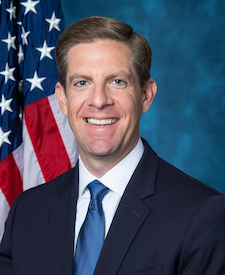
Rep. Mike Levin
Sponsored bills
Maddy summaryHR 1948 authorizes the International Boundary and Water Commission (IBWC) to accept funds from federal or non-federal entities - including grants or agreements - to study, design, construct, operate, or maintain wastewater treatment facilities, water conservation projects, and flood control works along the U.S.-Mexico border. The bill requires these funds to be deposited into a specific U.S. Treasury account and imposes a $5 million annual limit on reimbursing non-federal partners for project costs. It also prohibits accepting funds from entities tied to "foreign countries of concern" (as defined in other law) and mandates annual reports to Congress detailing how funds were used. This bill directly affects the IBWC’s funding mechanisms and entities providing financial support for border water infrastructure projects.
Maddy summaryThe VET PFAS Act (HR 3639) provides VA health care coverage for veterans and their family members exposed to PFAS chemicals at military bases, without requiring proof linking illness to exposure. Veterans who served at contaminated bases and family members who resided there (or were in utero while the veteran lived there) can now receive treatment for specific conditions like testicular cancer, kidney cancer, thyroid disease, and pregnancy-related hypertension. The law creates a presumption that these conditions are service-connected, streamlining access to VA benefits. Annual reports will track program usage, including the number of veterans and families receiving care and the conditions treated.
Maddy summaryHR 3755, the Safe Stay Act, requires owners of hotels, motels, and other places of public accommodation where people stay overnight to install compliant carbon monoxide alarms in all sleeping units. The bill defines "compliant" alarms as those meeting the International Fire Code or NFPA 72 standards. It also mandates that these businesses provide written notice to guests at check-in confirming alarm compliance, with violations treated as deceptive practices enforceable by the Federal Trade Commission. The law updates federal fire safety guidelines and requires states to update their compliance lists to reflect these changes.
Maddy summaryThe STOCK Act 2.0 requires Members of Congress, federal officials, Federal Reserve employees, Supreme Court justices, and their spouses and dependent children to report and divest certain financial interests, including investments in stocks, cryptocurrencies, commodities, and futures. It mandates that covered individuals report these financial interests within 120 days of taking office or upon the bill's enactment, and sell any existing investments that conflict with public duties. The bill establishes a fine of 10% of the value of unreported or undivested interests for noncompliance and requires electronic filing of financial disclosures with public online access to searchable reports. This legislation expands and strengthens the original STOCK Act by creating more comprehensive reporting requirements and improving public transparency about potential conflicts of interest. The provisions apply to a wide range of government officials and their families, with specific requirements for Federal Reserve officials added through this bill.
Maddy summaryThe bill's title ("Protect Vulnerable Immigrant Youth Act") does not align with its actual provisions. HR 3763 amends two sections of the Immigration and Nationality Act to adjust employment-based visa categories, specifically adding "or (J)" to existing numerical limitations and preference allocation rules. These changes would affect certain employment-based visa applicants (e.g., those in categories like "J" for religious workers or other specific employment groups) by removing numerical caps that previously applied to them. The bill contains no provisions related to youth protection, immigration status for minors, or direct safeguards for vulnerable immigrant youth.
Maddy summaryHRES 473 is a non-binding House resolution calling on the U.S. government to urgently use diplomatic efforts to ensure food and medical supplies reach civilians in Gaza. It directly addresses the needs of approximately 2.2 million Palestinians facing acute hunger, including 10,000 children identified with acute malnutrition, following a border blockade that blocked aid from March to May 2025. The resolution specifically urges the White House and State Department to secure "immediate and secure delivery and disbursement" of aid and a lasting end to the conflict, citing collapsed bakeries, exhausted food rations, and a near-total health system collapse.
Maddy summaryHRES 471, the "Restoring Integrity in Democracy Resolution," would amend House rules to prohibit current and future House members (including delegates and resident commissioners) from serving on the boards of for-profit companies. The key provision adds a new rule to the House's procedural rules, explicitly banning such board positions to address potential conflicts of interest. This change would directly affect all House members by restricting their outside business activities while in office. The resolution is a procedural rule change, not a law affecting the public, and aims to strengthen ethical standards within the House.
Maddy summaryThe Family Vaccine Protection Act makes the Advisory Committee on Immunization Practices (ACIP) an official part of federal law, requiring it to provide vaccine recommendations based on strong scientific evidence. It mandates that the CDC Director must adopt ACIP's recommendations unless they don't meet the evidence standard, and if not adopted, the CDC must explain its decision and notify Congress within 48 hours. The bill establishes procedures for ACIP to review new vaccines within 90 days of licensure and to consider breakthrough therapies or public health emergencies. This act aims to strengthen transparency and evidence-based decision-making in vaccine recommendations for the public health system. It affects the CDC, ACIP, and Congress through formalized processes for vaccine policy development.
Maddy summaryHR 3734, the Stop MUSK Act, amends federal ethics law to require high-level government officials to recuse themselves from decisions involving entities with which they had financial ties in the past four years. It directly affects executive branch leaders (including those in the Executive Schedule) and special government employees who previously worked for or had financial relationships with organizations like corporations, nonprofits, or consulting firms. The key provision expands the recusal requirement to cover any former employer or financial interest held during the preceding four years, including roles as an employee, contractor, consultant, or competitor. This aims to prevent conflicts of interest by mandating transparency when officials engage with entities tied to their prior careers.