

Maddy summaryThe Women’s Suffrage National Monument Location Act (HR 1318) authorizes the placement of a monument on the National Mall to honor the women’s suffrage movement and the 19th Amendment. The bill specifies that the monument must be located within a designated area on the National Mall known as the "Reserve," bypassing standard requirements for monument locations under existing law. This legislation sets the physical site for a monument already authorized by previous law (Public Law 116-217), without creating new policy or altering commemorative regulations beyond the location.
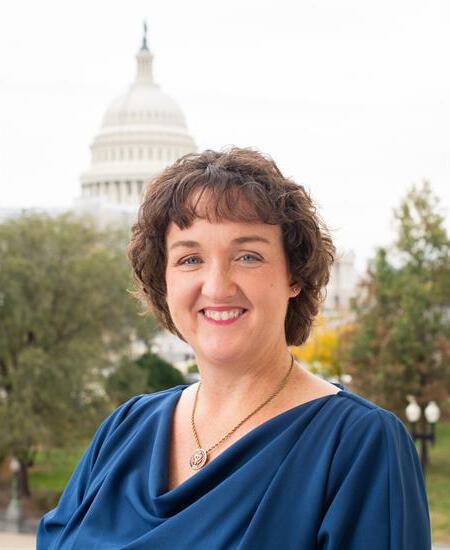
Rep. Katie Porter
Sponsored bills
Maddy summaryThis bill (HR 1555, Public Law 118-211) designates the U.S. Postal Service facility at 2300 Sylvan Avenue in Modesto, California, as the "Corporal Michael D. Anderson Jr. Post Office Building." It directly affects the postal facility and all official references to it, requiring future documents to use the new name. The bill has no policy provisions - its sole purpose is to honor Corporal Michael D. Anderson Jr. through this commemorative naming. It was passed by Congress and signed into law on January 2, 2025.
Maddy summaryThis resolution (HRES 1627) is a ceremonial measure honoring the late former President Jimmy Carter, Jr. It expresses the House's appreciation for his public service and deep sympathy to his family following his death on December 29, 2024. The resolution does not create new laws or policies; it simply directs the Clerk to transmit a copy to Carter's family. It commemorates his life, legacy, and work as a diplomat, Nobel Peace Prize winner, and advocate for human rights, without implementing any concrete policy changes.
Maddy summaryThe Treat and Reduce Obesity Act of 2023 expands Medicare coverage for obesity treatment by allowing a wider range of healthcare providers - including nurse practitioners, dietitians, psychologists, and community-based counseling programs - to deliver intensive behavioral therapy for obesity, provided they coordinate with primary care providers. It also adds Medicare Part D coverage for medications used to treat obesity or for weight loss management in overweight individuals with related health conditions like diabetes or high blood pressure. These changes directly affect Medicare beneficiaries, particularly older adults (65+), who face higher obesity rates and associated costs, including $50 billion annually in Medicare spending for obesity-related care. The bill requires annual reports to Congress on implementation to improve coordination of obesity care across federal health programs.
Maddy summaryThis bill creates a 4-year transitional coverage period for Medicare to automatically cover "breakthrough medical devices" - new FDA-prioritized devices approved after March 2021 - as "reasonable and necessary" for treatment. During this period, these devices qualify for additional payments under Medicare's hospital and outpatient payment systems without requiring separate approval. After the 4-year period, Medicare must develop regular coverage based on additional data, with automatic coverage for all approved uses if no action is taken within two years. The bill requires Medicare to assign unique codes for these devices within three months of FDA approval and to update payment systems regularly. It also includes special provisions for "specified breakthrough devices" that lack existing Medicare benefit categories, requiring reports on their impact and cost to Congress.
Maddy summaryThis bill, HR 1097 (Everett Alvarez, Jr. Congressional Gold Medal Act of 2023), authorizes the award of a Congressional Gold Medal to Everett Alvarez, Jr., in recognition of his service as a U.S. Navy pilot and Vietnam War prisoner of war. It directly honors Alvarez, who was the first U.S. pilot shot down in the Vietnam War, spent over 8.5 years in captivity, and later served in the Peace Corps and Veterans Administration. The bill’s key mechanism is directing the U.S. Mint to strike a gold medal bearing his name and image, with bronze duplicates available for sale to cover costs. It does not create new policies or affect any group beyond the honoree.
Maddy summaryHR 663, the Native American Child Protection Act, amends the Indian Child Protection and Family Violence Prevention Act to strengthen child protection systems for Native American children. It expands definitions of child abuse to include serious physical injuries (like fractures or burns) and sexual exploitation, and requires culturally appropriate services in grant programs. The bill creates a National Indian Child Resource and Family Services Center, mandates reports on grant usage, and allows tribes, urban Indian organizations, and intertribal consortia to partner in prevention and treatment. These changes directly affect tribal governments, child welfare agencies, and families in tribal communities by improving response systems for child abuse and neglect.
Maddy summaryThis bill requires the Secretary of Defense to submit annual reports to Congress on medical malpractice claims filed by uniformed service members against military healthcare providers. The reports must include the number of claims processed, average resolution time, how each claim was resolved, and the number of denials broken down by specific reason (like incomplete documentation). These reports are mandated annually until 2028 and aim to improve transparency in the military claims process. The bill directly affects military medical staff, service members filing claims, and congressional oversight committees.
Maddy summaryThis bill approves new agreements that amend the Compact of Free Association between the United States and the Federated States of Micronesia, the Republic of the Marshall Islands, and the Republic of Palau. It incorporates related agreements including fiscal procedures and trust fund agreements that govern how U.S. funding is managed and distributed to these nations. The bill provides funding for 2024-2043 to support programs like healthcare, education, veterans' services, and economic development in the Freely Associated States. It establishes reporting requirements and oversight mechanisms for federal agencies implementing these agreements. The bill directly affects U.S. federal agencies, the Freely Associated States, and U.S. funding mechanisms for these Pacific Island nations.
Maddy summaryThe Promoting Accessibility on Federal Lands Act of 2024 requires the Secretaries of Agriculture and the Interior to conduct a comprehensive assessment of accessibility for individuals with disabilities at federal trails, campsites, boat docks, and outdoor recreation facilities on National Forest System lands and public lands. Within 180 days of receiving funding, these assessments must be completed and made publicly available on the Department of Agriculture and Department of the Interior websites. Existing accessibility evaluations conducted before the bill's enactment may be incorporated into the required assessment. This legislation establishes a standardized process to document current accessibility conditions without mandating immediate facility modifications.