

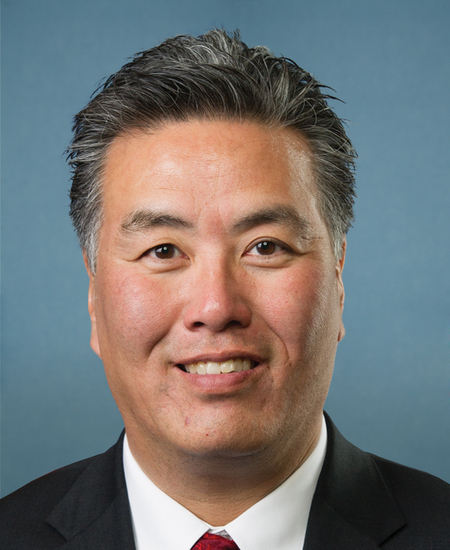
Photo of Mark Takano
D United States House · District 39 · California On the 2026 ballot

Rep. Mark Takano

Compare
Total votes
2,837
all sessions
Attendance
99%
27 missed
Higher than 78% of chamber peers
With party
97%
of cast votes
Higher than 76% of chamber peers
Bipartisan score
1%
crosses aisle rarely
Lower than 77% of chamber peers
Sponsored
1,619
bills & resolutions
Near the chamber average
Committees
5
assignments
1,619 bills and resolutions

Sponsored bills

Total
1,619
Primary
96
Co-sponsor
1,523
This page
1,619
matching current filters
Co-sponsor HR 3243
In committee · United States House · Co-sponsor
Therapeutic Fraud Prevention Act of 2025

Maddy summaryHR 3243, the Therapeutic Fraud Prevention Act of 2025, bans the provision of paid conversion therapy aimed at changing a person's sexual orientation or gender identity, and prohibits advertising such therapy as effective, safe, or without risk. It directly affects LGBTQ+ individuals and their families who might be targeted by these practices, as professionals have determined conversion therapy is ineffective and harmful. The law treats violations as deceptive acts under consumer protection laws, empowering the Federal Trade Commission and state attorneys general to enforce it through civil actions. It explicitly excludes legitimate gender transition support and non-discriminatory counseling from the ban.

In committee May 7, 2025 1 co-sponsor
Co-sponsor HR 3226
In committee · United States House · Co-sponsor
Law Enforcement Officers Equity Act

Maddy summaryThe Law Enforcement Officers Equity Act expands federal retirement benefits to include specific non-traditional law enforcement roles, such as IRS tax collection officers, U.S. Postal Inspection Service employees, Department of Veterans Affairs police, and certain U.S. Customs and Border Protection seized property specialists. It directly affects current and future federal workers in these positions who were previously excluded from law enforcement retirement benefits under the Federal Employees Retirement System and Civil Service Retirement System. The bill allows current employees (incumbents) to elect to count prior service toward retirement by paying a deposit covering the difference in retirement contributions, with government contributions made over 10 years. It also temporarily exempts law enforcement officers from mandatory separation for three years after enactment.

In committee May 7, 2025 1 co-sponsor
Co-sponsor HR 3184
In committee · United States House · Co-sponsor
PFAS Alternatives Act

Maddy summaryHR 3184, the PFAS Alternatives Act, funds research to develop turnout gear (firefighter safety clothing) without harmful PFAS chemicals, directly affecting firefighters who wear this gear. It authorizes $25 million annually (2025-2029) for grants to eligible organizations to research and test PFAS-free gear, requiring partnerships with firefighting groups to translate findings into practice. The bill also allocates $2 million yearly (2027-2031) for training programs on safe gear use and decontamination. Its goal is to reduce firefighters' exposure to chemicals linked to occupational illnesses during operations.

In committee May 6, 2025 1 co-sponsor
Co-sponsor HRES 380
In committee · United States House · Co-sponsor
Supporting the designation of the week of May 5 through May 9, 2025, as "Teacher Appreciation Week".

Maddy summaryHRES 380 is a symbolic resolution supporting the designation of May 5-9, 2025, as "Teacher Appreciation Week." It does not create new laws or funding but formally recognizes teachers' contributions to education. The resolution affirms teachers' role in shaping students' futures and calls for including teachers in education policymaking at all levels. It highlights teacher survey data showing broad support for policies like equitable school funding and culturally responsive teaching, though the resolution itself only expresses support for the week's designation. This is a non-binding gesture with no direct impact on affected individuals or policies.

In committee May 5, 2025 1 co-sponsor
Co-sponsor HR 3131
In committee · United States House · Co-sponsor
Community Services Block Grant Improvement Act of 2025

Community Services Block Grant Improvement Act of 2025 This bill reauthorizes the Community Services Block Grant (CSBG) program through FY2032 and makes certain changes to the program and associated eligibility requirements. The CSBG program supports various antipoverty activities, primarily through formula-based allotments to states, tribes, and territories, the majority of which must be made available in grants to eligible local entities.  Specifically, the bill permanently sets the measure of eligibility for services, assistance, or resources provided directly to individuals or families under the program at 200% of the poverty line. (Under current law, the eligibility measure is temporarily set at 200% of the poverty line, an increase from the previous measure of 125% of the poverty line.) The bill also makes certain changes to the permitted uses of funding, including by allowing CSBG funds to be used to facilitate low-income individuals’ and communities’ access to high-speed broadband, digital literacy training, technical support, and other services. States may also use certain funds allocated for training and technical assistance to assist eligible entities in responding to statewide and regional conditions that create economic insecurity, including emergency conditions.   The bill also expands requirements for the plans that states must submit to the Department of Health and Human Services in order to receive CSBG funds (e.g., transparency assurances), and sets deadlines by which states must make funds available to eligible entities. Finally, the bill repeals a provision that allowed states to use CSBG funds to offset revenue losses associated with state charity tax credits.

In committee May 1, 2025 1 co-sponsor
Co-sponsor HR 3140
In committee · United States House · Co-sponsor
Stop Subsidizing Multimillion Dollar Corporate Bonuses Act

Maddy summaryThis bill amends the tax code to limit corporate tax deductions for certain executive compensation. It expands the definition of "covered individual" to include former top executives (like former CEOs or CFOs) who received high pay before 2021, as well as current executives whose compensation was reported to shareholders. The key change prevents companies from deducting excessive pay packages - such as multimillion-dollar bonuses - from taxable income for these covered individuals. The policy applies to publicly traded corporations and takes effect for tax years starting in 2025.

In committee May 1, 2025 1 co-sponsor
Co-sponsor HRES 366
In committee · United States House · Co-sponsor
Recognizing the 50th anniversary of Black April and the Fall of Saigon on April 30, 1975.

Maddy summaryHRES 366 is a non-binding resolution recognizing the 50th anniversary of the Fall of Saigon on April 30, 1975, known as Black April in Vietnamese history. It honors the Vietnamese American community - now over 2.3 million strong - who resettled in the U.S. after 1975 and have contributed to American society through diverse fields like public service and business. The resolution commemorates the service of U.S. and South Vietnamese military personnel during the Vietnam War and reaffirms U.S. support for democracy and human rights in Vietnam. As a symbolic gesture, it does not create new laws but encourages public observance of this historical event and the community's resilience.

In committee Apr 30, 2025 1 co-sponsor
Co-sponsor HR 3112
In committee · United States House · Co-sponsor
Better CARE for Animals Act of 2025

Maddy summaryHR 3112, the Better CARE for Animals Act of 2025, strengthens enforcement of the federal Animal Welfare Act by requiring dealers and exhibitors to hold valid licenses for animal sales or transport (Section 4). It expands enforcement authority by allowing the Attorney General to sue violators for up to $10,000 per day, seize animals, and seek injunctions (Section 20), while clarifying that courts can address violations of related rules and regulations. The bill directly affects animal dealers, exhibitors, the USDA, and the Department of Justice, creating clearer pathways for holding violators accountable. Key provisions include updating definitions, broadening inspection powers to cover all regulations, and directing penalty funds toward temporary animal care costs during legal proceedings.

In committee Apr 30, 2025 1 co-sponsor
Co-sponsor HR 3115
In committee · United States House · Co-sponsor
Assault Weapons Ban of 2025

Assault Weapons Ban of 2025 This bill makes it a crime to knowingly import, sell, manufacture, transfer, or possess a semiautomatic assault weapon (SAW) or large capacity ammunition feeding device (LCAFD). The prohibition does not apply to a firearm that is (1) manually operated by bolt, pump, lever, or slide action, except for certain shotguns; (2) permanently inoperable; (3) an antique; (4) only capable of firing rimfire ammunition; or (5) a rifle or shotgun specifically identified by make and model. The bill also exempts from the prohibition the following, with respect to a SAW or LCAFD: importation, sale, manufacture, transfer, or possession related to certain law enforcement efforts, or authorized tests or experiments; importation, sale, transfer, or possession related to securing nuclear materials; and possession by a retired law enforcement officer. The bill permits continued possession, sale, or transfer of a grandfathered SAW, which must be securely stored. A licensed gun dealer must conduct a background check prior to the sale or transfer of a grandfathered SAW between private parties. The bill permits continued possession of, but prohibits sale or transfer of, a grandfathered LCAFD. Newly manufactured LCAFDs must display serial number identification. Newly manufactured SAWs and LCAFDs must display the date of manufacture. The bill also allows a state or local government to use Edward Byrne Memorial Justice Assistance Grant Program funds to compensate individuals who surrender a SAW or LCAFD under a buy-back program.

In committee Apr 30, 2025 1 co-sponsor
Co-sponsor HRES 237
In committee · United States House · Co-sponsor
Of inquiry requesting the President and directing the Secretary of Education to transmit, respectively, certain documents to the House of Representatives relating to the reduction in force and other downsizing measures at the Department of Education.

Maddy summaryThis resolution (HRES 237) is a procedural request, not a policy bill. It directs the President and Secretary of Education to hand over unredacted documents within 14 days about Department of Education downsizing, including staff reductions, closures, and actions related to the Secretary’s March 3, 2025, memo. The documents must cover compliance with key education laws like Title IX, IDEA, and the Family Educational Rights and Privacy Act. It does not change laws or affect the public but seeks transparency about executive branch decisions on the department’s structure.

In committee Apr 29, 2025 1 co-sponsor
Showing 271 to 280 of 1,619 bills
Previous 1 … 27 28 29 … 162 Next