

Maddy summaryHRES 1447 is a non-binding resolution expressing support for designating the week of September 22-28, 2024, as "Gold Star Families Remembrance Week." It directly honors families who lost loved ones while serving in the U.S. military (referred to as "Gold Star Families") and families of veterans. The resolution encourages Americans to observe the week by performing community service and celebrating the sacrifices of fallen service members, without creating new laws or obligations. It aligns with existing recognition of Gold Star Mother’s Day (the last Sunday in September) but expands the focus to all affected families.
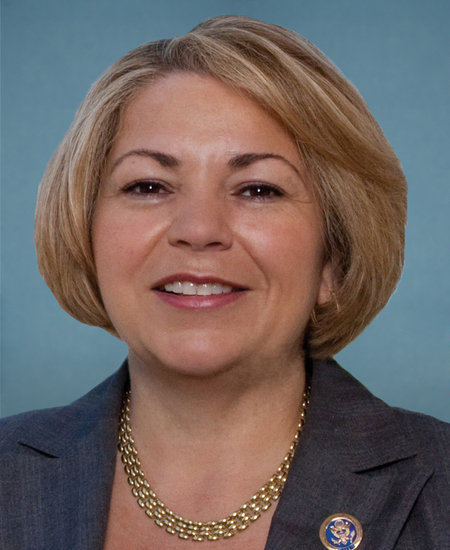
Rep. Linda T. Sánchez
Sponsored bills
Maddy summaryThis bill creates a federal grant program to fund supportive services for residents in affordable housing properties. It provides 5-year competitive grants to non-profit organizations or tribes managing properties assisted by programs like the low-income housing tax credit or Section 8 housing. Grantees must use at least 25% of funds for staff salaries/benefits and can cover services including health access, education, financial literacy, aging-in-place support, and disability services - though residents cannot be required to accept these services. The program targets residents of qualifying affordable housing properties, focusing on improving health, economic stability, and community integration.
Maddy summaryHRES 1437 is a ceremonial resolution designating the week beginning September 9, 2024, as "National Hispanic-Serving Institutions Week." It recognizes Hispanic-serving institutions (HSIs) - colleges and universities with at least 25% Hispanic enrollment - and their role in educating low-income students, advancing economic mobility, and serving 31.7% of all undergraduate students. The resolution calls for the public and organizations to observe this week with ceremonies and activities during Hispanic Heritage Month. It does not create new laws, allocate funding, or change existing policies - it is purely a symbolic gesture of recognition.
Maddy summaryThis bill designates the U.S. Postal Service facility at 130 South Patterson Avenue in Santa Barbara, California, as the "Brigadier General Frederick R. Lopez Post Office Building." It updates all official U.S. government references to the building to reflect this new name, with no policy changes or funding impacts.
Maddy summaryThe CREATE AI Act of 2023 establishes a National Artificial Intelligence Research Resource (NAIRR) to improve access to AI research tools, computational resources, data, and educational materials for researchers and students across the United States. The NAIRR will provide computational resources, curated datasets, educational tools, and access to AI testbeds, with special emphasis on supporting groups historically underrepresented in STEM fields. Governed by a Steering Subcommittee chaired by the Director of the Office of Science and Technology Policy and managed by a Program Management Office within the National Science Foundation, the NAIRR includes specific requirements for ethical AI development, privacy protections, and security measures. The resource will be accessible to researchers at U.S. institutions of higher education, nonprofits, government agencies, and certain businesses, with priority given to projects addressing privacy, ethics, civil rights, and AI safety.
Maddy summaryHRES 1436 is a symbolic resolution (not a law) introduced in the U.S. House of Representatives. It recognizes suicide as a preventable public health crisis by citing statistics from the CDC, VA, and SAMHSA showing rising suicide rates across age groups, including veterans and adolescents. The resolution formally supports designating September as "National Suicide Prevention Month" and September 10, 2024, as "World Suicide Prevention Day." It does not create new policies, allocate funding, or directly affect any individuals - its purpose is solely to express congressional support for suicide prevention awareness and efforts.
Maddy summaryThe Stand with Ukraine Act of 2024 establishes a framework for sustained U.S. security assistance to Ukraine in response to Russia's invasion. It endorses a 10-year bilateral security agreement and directs the U.S. government to provide military equipment, training, and security assistance to strengthen Ukraine's defense capabilities against Russian aggression. Key provisions include treating Ukraine as a major non-NATO ally for defense transfers, fast-tracking military sales through the Foreign Military Sales program, and creating mechanisms to prioritize defense article transfers. The bill also includes specific support for Ukraine's recovery, reconstruction, and demining efforts following the conflict. This legislation directly affects U.S. foreign policy implementation, military assistance programs, and Ukraine's ability to build a credible defense against Russian threats.
This resolution supports the designation of National FFA Week. It also (1) recognizes the important role of the National FFA Organization (Future Farmers of America) in developing the next generation of globally conscious leaders who will change the world; and (2) celebrates the 10th anniversary of the Give the Gift of Blue program, which has donated more than 17,000 FFA blue jackets to FFA members in need.
Maddy summaryThis bill authorizes a single Congressional Gold Medal to honor Peter McGuire, a key figure in the 19th-century labor movement known as the "Father of Labor Day" and co-founder of the American Federation of Labor. The medal, designed by the Treasury and Labor Departments, will be presented by congressional leaders and permanently displayed at the Smithsonian’s National Museum of American History. Bronze duplicates may be sold to cover production costs, with proceeds going to the U.S. Mint. The bill is purely ceremonial, recognizing McGuire’s historical contributions to workers’ rights, the 8-hour workday, and labor union organization. It does not create new policy or affect current legislation.
Maddy summaryThis bill establishes a federal grant program to fund school sports access for K-12 students. It provides grants to elementary and secondary schools that comply with Title IX, allowing them to expand athletic programs, cover costs like equipment/uniforms, or reduce participation barriers - especially for girls and women in underrepresented sports. Schools receiving funds must certify they won’t discriminate based on gender identity or sexual orientation. The legislation directly affects public schools seeking to improve equity in youth sports, building on existing Title IX protections for transgender and LGBTQ+ students.