

Maddy summaryHR 8533, the Safe Air on Airplanes Act, requires the Federal Aviation Administration to update aircraft safety regulations to address bleed air systems. It prohibits new jet and turboprop aircraft designs from using these systems, mandates filters to remove oil fumes in new aircraft within 7 years, and sets a 30-year phase-out schedule for existing aircraft designs (25% by year 10, 50% by year 20, 100% by year 30). The bill directly affects aircraft manufacturers and airlines by changing requirements for new aircraft production and fleet modifications. It focuses on technical air quality standards for cabin air, not health outcomes or costs.
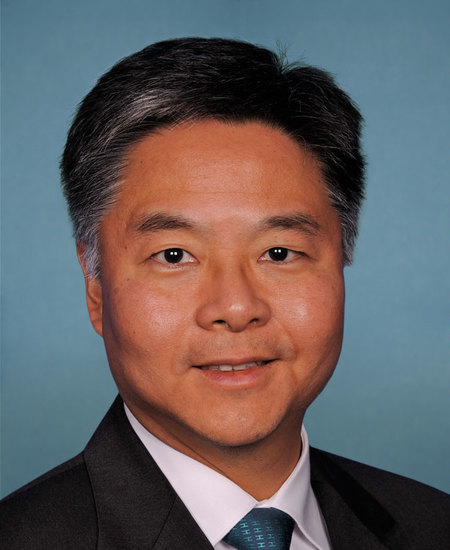
Rep. Ted Lieu
Sponsored bills
Maddy summaryHR 5754 renames the U.S. courthouse at 350 W. 1st Street, Los Angeles, California, as the "Felicitas and Gonzalo Mendez United States Courthouse." The bill updates all federal references - such as legal documents, maps, and records - to use the new name. This is a ceremonial designation with no policy changes or direct impact on citizens or laws. The bill solely affects the courthouse's official name and related federal paperwork.
Maddy summaryHR 8469, the Diverse Cybersecurity Workforce Act of 2024, requires the Cybersecurity and Infrastructure Security Agency (CISA) to establish a new program within its existing education initiative. The program targets underrepresented groups in cybersecurity, including racial and ethnic minorities, women, veterans, people with disabilities, older individuals (40+), those from low-income backgrounds, and people with nontraditional educational paths (like community colleges or HBCUs). CISA must tailor outreach to schools, unions, community colleges, and local workforce offices to promote cybersecurity careers in these communities. The bill authorizes $20 million annually (2025-2030) and mandates annual reports to Congress on the program's impact on workforce diversity.
Maddy summaryThis bill directs the U.S. Secretary of State to develop a strategy advocating for Taiwan’s full membership or observer status in Interpol, the international police organization. It requires the U.S. to actively seek support from Interpol member states and report to Congress on efforts to secure Taiwan’s participation. The bill aims to address Taiwan’s current lack of access to Interpol’s global crime-fighting communications system (I-24/7), which limits real-time sharing of criminal intelligence. This directly affects Taiwan’s ability to collaborate with international police on security threats and share information on criminal activities. The policy change focuses on U.S. diplomatic advocacy, not altering Taiwan’s legal status.
Maddy summary# Summary of Legislative Text This is a comprehensive legislative proposal focused on addressing substance use disorder through public health approaches, with significant funding and program requirements. Key elements include: 1. **Major Funding Programs:** - **Subtitle A (Local Grants):** $3.0 billion annually (2024-2033) for local entities to provide prevention, treatment, and recovery services - **Subtitle B (State/Regional Grants):** $4.6 billion annually (2024-2033) for state-level programs - **Subtitle C (Other Grants):** $1.0 billion annually (2024-2033) for specific entities and underserved populations - **Subtitle D (Innovation/Training):** $1.5 billion annually (2024-2033) for training, research, and capacity building 2. **Key Program Requirements:** - Mandates for evidence-based treatment services across multiple levels of care - Requirements for cultural competency, particularly for Native American communities - Specific focus on harm reduction, prevention, and recovery support - Provisions for naloxone distribution and overdose reversal programs 3. **Regulatory Changes:** - New certification requirements for covered manufacturers, distributors, and dispensers of Schedule II controlled substances - Penalties for failure to submit certifications or submitting false certifications - Creation of a "Comprehensive Addiction Resources Fund" for penalty revenues 4. **Focus Areas:** - Prevention services (including trauma-informed approaches) - Early intervention services - Recovery support services - Harm reduction programs - Workforce development for treatment providers - Special attention to underserved populations (rural communities, racial minorities, formerly incarcerated individuals) 5. **Funding Priorities:** - 10% of funds for Native American communities - Specific requirements for cultural competency and language access - Mandated data collection and reporting systems This legislation represents a significant shift toward public health approaches to substance use disorder, emphasizing prevention, treatment, and recovery support rather than punitive measures, with substantial funding commitments over a decade.
Maddy summaryHRES 1063 is a non-binding resolution passed by the U.S. House of Representatives to reaffirm America's commitment to NATO ahead of its 75th anniversary. It formally recognizes NATO's role in collective security, emphasizes Article 5's importance for mutual defense, and supports Finland and Sweden's membership. The resolution also calls on NATO allies to meet the 2% defense spending target, but does not create new laws or affect specific individuals or groups.
Maddy summaryHR 3246, the Sanction Russian Nuclear Safety Violators Act of 2023, imposes U.S. sanctions on Russian individuals or entities that endangered the Zaporizhzhia Nuclear Power Plant’s safety or Ukrainian operational control since Russia’s 2022 invasion of Ukraine. Key provisions require the President to block assets and deny visas to targeted foreign persons, with exceptions for humanitarian aid and efforts to restore Ukrainian control of the plant. The bill directly affects Russian officials and Rosatom personnel involved in the plant’s operations, aiming to address safety risks highlighted by the IAEA.
Maddy summaryThis bill requires Medicare to pay separately for certain high-cost diagnostic drugs used in nuclear imaging (like those for cancer detection) starting in 2024. It applies to drugs with a daily cost of $500 or more (adjusted annually), ensuring they are not bundled with other services. Payments will be based on either the drug's average sales price or wholesale cost, with adjustments to keep overall Medicare spending unchanged. This directly affects Medicare Part B providers (hospitals, clinics) and beneficiaries receiving these specific diagnostic treatments.
Maddy summaryThe READ Act Reauthorization Act of 2023 extends the authorization period for the Reinforcing Education Accountability in Development Act (commonly known as the READ Act) from five to ten fiscal years. This change allows U.S. international education programs, administered by agencies like USAID, to operate without annual reauthorization for a longer period. The bill directly affects programs providing educational support in developing countries, such as teacher training and literacy initiatives. The key mechanism is amending Section 4(a) of the existing law to adjust the funding duration, ensuring continued program stability.
Maddy summaryHRES 1228 is a ceremonial resolution passed by the U.S. House of Representatives to formally recognize May as Asian American, Native Hawaiian, and Pacific Islander (AANHPI) Heritage Month. It celebrates the historical contributions of AANHPI communities to the United States, citing their diverse cultural impact and key milestones like the completion of the transcontinental railroad. The resolution does not create new laws or policies but encourages the public to observe the month through educational programs and events. It directly affects all Americans by promoting awareness of AANHPI history and achievements, while acknowledging ongoing challenges like anti-Asian hate crimes.