

Clean Shipping Act of 2022 This bill directs the Environmental Protection Agency (EPA) to require vessels on certain commercial voyages to comply with standards for the carbon intensity of the vessel's fuel on a specified schedule, with vessels on such voyages utilizing 100% less than the carbon intensity baseline by 2040 and beyond. Additionally, the EPA must promulgate and continually revise standards to eliminate emissions of specified greenhouse gases and air pollutants associated with vessels at anchorage or at berth in the contiguous zone of the United States.
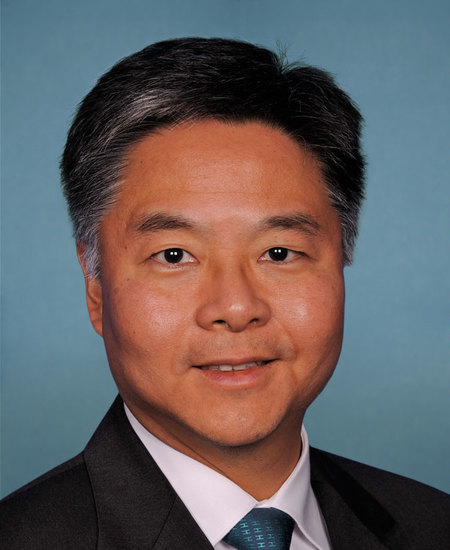
Rep. Ted Lieu
Sponsored bills
Upholding Human Rights Abroad Act This bill prohibits, with some exceptions, the Department of Defense (DOD) from providing certain support to forces (e.g., foreign forces or irregular forces) engaged in U.S. special operations if DOD has credible information that the force in question has committed a gross violation of human rights.
Reinforcing the Grid Against Extreme Weather Act This bill requires the Federal Energy Regulatory Commission to issue a rule to establish minimum transfer capabilities between transmission planning regions to help stabilize the electric grid.
Grid Resilience Act This bill requires the Department of Energy, the Federal Energy Regulatory Commission, and the Electric Reliability Organization to jointly study the feasibility of establishing or modifying a reliability standard (i.e., a requirement to provide for reliable operation of the electric grid) for thermoelectric power plants during droughts.
Break Free From Plastic Pollution Act of 2021 This bill sets forth requirements and incentives to reduce the production of a variety of products and materials, including plastics, and increase efforts to collect, recycle, or compost products and materials. The bill makes certain producers of products (e.g., packaging, paper, single-use products, beverage containers, or food service products) fiscally responsible for collecting, managing, and recycling or composting the products after consumer use. In addition, the bill establishes (1) minimum percentages of products that must be reused, recycled, or composted; and (2) an increasing percentage of recycled content that must be contained in beverage containers. Beginning on January 1, 2023, the bill phases out a variety of single-use products, such as plastic utensils. The bill also sets forth provisions to encourage the reduction of single-use products, including by establishing programs to refund consumers for returning beverage containers and by establishing a tax on carryout bags. The bill creates a temporary moratorium on new or expanded permits for certain facilities that manufacture plastics until regulations are updated to address pollution from the facilities. The Environmental Protection Agency (EPA) must publish guidelines for a national standardized labeling system for recycling and composting receptacles. Producers must include labels on their products that are easy to read and indicate whether the products are recyclable, compostable, or reusable. The EPA must also ensure that certain clothes washers have filtration units as required by this bill. Finally, the bill establishes limitations on the export of plastic waste to other countries.
Climate Leadership and Environmental Action for our Nation’s Future Act or the CLEAN Future Act This bill creates requirements and incentives to reduce emissions of greenhouse gases. The bill establishes an interim goal to reduce greenhouse gas emissions to at least 50% below 2005 levels by 2030 as well as a national goal to achieve net-zero greenhouse gas emissions by 2050. Each federal agency must develop a plan to achieve the goals. Beginning in 2023, retail electricity suppliers must provide an increasing percentage of electricity that is generated without the release of greenhouse gases into the atmosphere (zero-emission electricity). By 2035, the suppliers must provide 100% zero-emission electricity or demonstrate alternative means of compliance. For example, the suppliers may buy credits under a trading program that allows entities to buy, sell, and trade credits to demonstrate compliance. The bill also establishes a variety of requirements, programs, and incentives to reduce or eliminate greenhouse gas emissions by modernizing the electric grid and supporting clean energy microgrids; increasing the use of renewable energy and advanced nuclear power technologies; increasing energy efficiency in buildings, homes, and appliances; supporting clean transportation, including electric vehicles and related charging infrastructure; issuing greenhouse gas standards for certain vehicles, engines, and aircraft; promoting manufacturing and industrial decarbonization, including through buy-clean programs; supporting environmental justice efforts; and reducing methane, plastics, and super pollutants.
Health Equity and Accountability Act of 2022 This bill directs the Department of Health and Human Services (HHS) and others to undertake efforts to reduce health disparities. For example, the bill (1) requires more detailed reporting of demographic and health disparities data, including related to public health emergencies; (2) directs certain components of HHS to support health workforce diversity; and (3) increases access to culturally and linguistically appropriate health care. The bill also modifies eligibility and other requirements for Medicare, Medicaid, private health insurance, nutrition assistance, and other programs to reduce health disparities among vulnerable populations. The bill includes specific provisions with respect to noncitizens; maternal, infant, and child health; mental and behavioral health; specified conditions that disproportionately affect racial and ethnic minority groups, such as certain cancers, HIV/AIDS, kidney disease, and diabetes; investments in communities facing health and other inequities; and nondiscrimination in the provision of services in federally supported health programs. Additionally, the bill (1) revises health information technology programs to address health disparities, and (2) supports health impact assessments and other efforts pertaining to environmental justice and social determinants of health (i.e., nonmedical factors that influence health outcomes, such as income and educational attainment). The bill also requires various studies and reports on issues related to health care and health disparities, including a report by the Government Accountability Office on health workforce diversity.
This resolution affirms the leadership and commitment of the U.S. government in efforts to prevent conflict-related sexual violence and to support and protect survivors of such violence. The resolution calls on the United States to ensure mechanisms to hold perpetrators of sexual violence accountable are included in peacebuilding resolutions, and that women participate fully in such peace processes in accordance with the Women, Peace, and Security Act of 2017.
Telemental Health Parity Act of 2022 This bill requires private health insurance plans to apply benefits for mental health or substance use disorder services that are furnished via telehealth in the same manner as those services that are furnished in person. Under current mental health parity rules, insurance plans that provide benefits for mental health or substance use disorder services are generally required to make those benefits comparable to the benefits the plan provides for medical and surgical care.
This bill designates the facility of the United States Postal Service located at 502 East Cotati Avenue in Cotati, California, as the Arturo L. Ibleto Post Office Building.