

Maddy summaryHR 2918, the Fair Housing for Survivors Act of 2023, amends the Fair Housing Act to explicitly protect survivors of domestic violence, sexual assault, and sex trafficking from housing discrimination. It adds "survivor of domestic violence, sexual assault, or severe forms of trafficking" as a protected class under the law, prohibiting landlords and housing providers from refusing to rent, evicting, or charging more based on this status. The bill also clarifies that discrimination based on survivor status - including denial of housing due to protective orders, shelter stays, or prior incidents - is illegal. This directly affects survivors who face barriers like denied rentals, evictions, or higher costs when seeking safe housing, addressing documented discrimination reported by 67% of survivors in New York studies. The law preserves survivors' ability to pursue other discrimination claims under the Fair Housing Act.
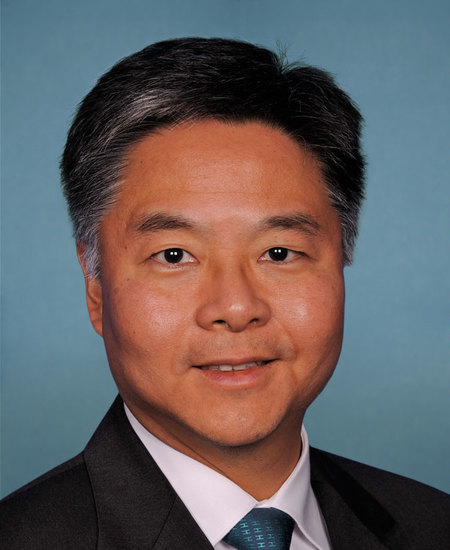
Rep. Ted Lieu
Sponsored bills
Raise the Age Act of 2023 This bill establishes new restrictions on the sale or transfer of certain semiautomatic firearms to individuals under 21 years of age. Specifically, this bill makes it unlawful for a licensed gun dealer, importer, manufacturer, or collector to sell or deliver a semiautomatic center-fire rifle or semiautomatic center-fire shotgun that has (or has the capacity to accept) an ammunition feeding device with a capacity of more than five rounds to an individual who the licensee knows or has reasonable cause to believe is under age 21. The prohibition does not apply if the individual under age 21 is a full-time law enforcement officer or active-duty member of the Armed Forces. The bill also requires the Federal Bureau of Investigation to report on the operation of its public access line, including a description of information sharing protocols and recommendations for improving such protocols.
Maddy summaryThis bill prohibits the use of federal funds to develop or deploy autonomous weapons systems that lack meaningful human control for nuclear weapon launches or target selection. It directly affects federal agencies, particularly the Department of Defense, by banning spending on such systems for nuclear purposes. The key provision requires human oversight over target selection and launch decisions, aligning with existing U.S. policy and international law requiring human control in nuclear command. The bill does not ban autonomous systems generally but specifically restricts their use in nuclear contexts where human judgment is mandated.
Maddy summaryHR 2899, the STOP Violence Act of 2023, adds $20 million in federal grants to help states, local governments, and nonprofits prepare public assembly facilities (like schools, malls, and event venues) for mass violence. The funds are specifically for providing compensation, training, and technical assistance to these facilities to enhance their safety measures against incidents such as active shooter attacks or targeted violence. The bill defines "mass violence" to include active shooter incidents (where someone uses a firearm to kill or attempt to kill in a crowded area) and targeted violence (where an assailant identifies a specific person, group, or institution before attacking). These grants aim to directly support facilities that host large gatherings of people, focusing on practical safety improvements.
Secure Background Checks Act of 2023 This bill extends federal restrictions on the receipt, possession, shipment, and transportation of firearms and ammunition to two new categories of persons: persons who fail to meet the minimum age requirements imposed by federal law and by the law of their resident state; and persons who are out-of-state residents and do not qualify for an exception, such as the temporary loan or rental of a firearm for lawful sporting purposes. Additionally, the bill imposes criminal penalties—a fine, a prison term of up to 10 years, or both—on an individual who ships, transports, or receives a firearm or ammunition while under indictment for a crime punishable by imprisonment for a term exceeding 1 year.
End Gun Violence Act of 2023 This bill extends federal restrictions on the sale or disposition of firearms and ammunition to a new category of persons: persons who have been convicted in any court of a violent misdemeanor within the preceding five years.
Maddy summaryThe Right to Read Act of 2023 defines an "effective school library" as one with certified librarians, adequate resources, and support for digital and information literacy. It requires states and school districts to ensure all students, particularly those in under-resourced schools, have access to such libraries through new reporting requirements and funding mechanisms. The bill provides $500 million annually for literacy programs and mandates biennial data collection on school library resources. It also protects staff from liability for following right-to-read policies and requires school libraries to uphold First Amendment rights by providing diverse reading materials without political bias.
Maddy summaryHR 2370, the Access to AEDs Act, authorizes $25 million in federal funding (2024-2028) to help public elementary and secondary schools improve access to automated external defibrillators (AEDs) and CPR training. The bill directs the Secretary of Health and Human Services to award grants to school districts and partners for developing AED programs, training staff and students, purchasing and maintaining AEDs, and creating cardiac emergency response plans. It specifically targets schools to address sudden cardiac arrest (SCA), which is a leading cause of death among student athletes and youth, with 90% of SCA victims dying without immediate CPR and defibrillation. The law requires grantees to report on their activities and establishes a clearinghouse to collect data on school AED access and costs.
Maddy summaryThe Child Labor Exploitation Accountability Act requires U.S. Department of Agriculture (USDA) contractors to annually disclose if they or their subcontractors faced serious labor violations - including child labor violations under the Fair Labor Standards Act - in the past three years. Contractors with such violations must report corrective steps, and those failing to address issues or repeating violations face a five-year ban from USDA contracts (including the year of listing and the next four years). The law mandates annual reports to Congress tracking the number of contractors on the ineligible list and the program's effectiveness. This policy directly affects agricultural businesses and suppliers contracting with the USDA, aiming to enforce labor compliance through financial consequences.
Maddy summaryHR 2823, the Filipino Veterans Family Reunification Act of 2023, exempts certain family members of eligible Filipino veterans from U.S. immigrant visa caps. It allows children or spouses of veterans to obtain visas without being counted against annual limits, directly affecting families seeking to reunite with veterans who served in the U.S. military during WWII or under specific naturalization provisions. The bill amends immigration law to include veterans naturalized under the 1990 Immigration Act (Section 405) or the 1940 Act (as amended in 1942). This creates a direct pathway for reunification by removing a key barrier to family immigration for these veterans' relatives.