

Justice is Beneficial Limitation on Investments and Necessary Disclosure Act of 2023 or the Justice is BLIND Act of 2023 This bill requires a federal judge, as well as any spouse or dependent child of a federal judge, to place specified investments into a qualified blind trust (i.e., an arrangement in which certain financial holdings are placed in someone else's control to avoid a possible conflict of interest) until 180 days after the end of their tenure as a federal judge.
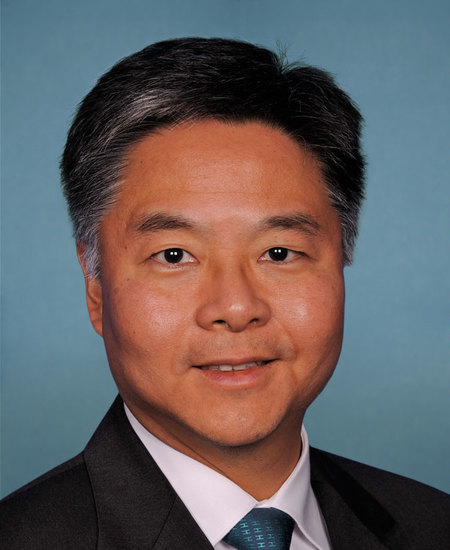
Rep. Ted Lieu
Sponsored bills
Maddy summaryHR 3537 authorizes the minting of commemorative coins to mark the 100th anniversary of the U.S. Foreign Service, established by the 1924 Rogers Act. The bill specifies three coin types ($5 gold, $1 silver, and half-dollar clad) with limited mintage (50,000 gold, 400,000 silver, 750,000 half-dollars) to be issued in 2025, featuring designs honoring diplomatic history. A surcharge on each coin sale ($35 for gold, $10 for silver, $5 for half-dollars) will fund the Association for Diplomatic Studies and Training (ADST) to support its oral history program and diplomatic preservation efforts. The coins will be legal tender, sold at cost-plus-surcharge, with all revenue directed to ADST per the bill's provisions.
Maddy summaryThis bill changes federal tax rules to allow employees to receive tax-free benefits for bike commuting expenses. It repeals a suspension of tax exclusions and expands coverage to include reimbursement for qualified bike/scooter purchases, repairs, or rentals (like bikeshare), as long as the vehicle meets safety specs (e.g., e-bikes under 20mph or 750W, scooters under 100lbs). The benefit is capped at 30% of the monthly amount allowed for commuting expenses. It directly affects employees who regularly bike to work and employers offering these tax-free commuting benefits, effective for 2023 tax years.
Cut Red Tape For Online Sales Act This bill modifies requirements for third party settlement organizations to eliminate their reporting requirement with respect to the transactions of their participating payees unless they have earned $5,000 or more. A third party settlement organization is the central organization that has the contractual obligation to make payments to participating payees (generally, a merchant or business) in a third party payment network. The bill also requires entities that report income to to issue a plain-language description of the taxability of income reported on Form 1099-K.
Maddy summaryHCONRES 44 is a non-binding congressional resolution urging the creation of a U.S. Commission on Truth, Racial Healing, and Transformation. It does not establish the commission itself but calls for its formation to acknowledge historical injustices against Black, Indigenous, and other people of color - including systemic discrimination in housing, Social Security, the GI Bill, and land policies - and to address ongoing racial inequities. The resolution emphasizes the need to dismantle the "belief in a hierarchy of human value" and promote racial healing as a national priority. It complements ongoing efforts like H.R. 40 (a bill to study reparations) but does not create new legal requirements or funding.
This resolution condemns the great replacement theory, which it describes as a white supremacist conspiracy theory that has been used to falsely justify racially motivated, violent acts of terrorism domestically and internationally.
Maddy summaryHR 3409, the Healthy Families Act, requires most employers to provide employees with paid sick leave. Employees earn 1 hour of paid sick time for every 30 hours worked, up to a maximum of 56 hours per year, which can be used for their own illness, caring for family members, or addressing domestic violence, sexual assault, or stalking situations. Smaller employers with fewer than 15 employees can provide unpaid sick leave instead of paid leave. The bill includes protections against retaliation for using sick leave and requires employers to inform employees about their rights under this law.
Maddy summaryHR 3422, the Judiciary Act of 2023, would amend the structure of the U.S. Supreme Court by increasing the number of associate justices from eight to twelve. It would also raise the required quorum for court proceedings from six to eight justices. This bill directly affects the Supreme Court's operational structure and composition. The change is purely procedural, altering the Court's size and voting requirements without impacting other legal processes or specific groups of people.
Maddy summaryThis bill creates incentives to build cybersecurity workforce capacity by: (1) offering employers a 50% tax credit (up to $5,000 per employee) for cybersecurity training costs; (2) providing up to $25,000 in student loan forgiveness for cybersecurity workers employed at least 60% of their time in economically distressed areas; and (3) increasing funding for cybersecurity education programs, including CyberCorps scholarships and Advanced Technology Education grants. It directly affects employers, cybersecurity professionals, and educational institutions through tax benefits, loan relief, and expanded training opportunities. The bill targets the shortage of cybersecurity talent in manufacturing and industrial sectors, aligning with industry-defined roles from the NIST cybersecurity framework. Key provisions require employers to claim the tax credit to qualify for a 5% scoring boost in federal government contracts over $5 million.
Maddy summaryHRES 81 is a non-binding resolution passed by the U.S. House of Representatives urging the President to support creating an international Special Tribunal to prosecute Russia’s leaders for the crime of aggression against Ukraine. It specifically references Russia’s 2022 full-scale invasion as a violation of UN Charter principles and General Assembly Resolution 3314, which defines aggression as unlawful military force against a sovereign state. The resolution calls for the President to take all available measures to advance this tribunal, emphasizing Ukraine’s sovereignty and the need to hold Russian officials accountable for war crimes. It does not create the tribunal itself but seeks U.S. diplomatic support for its establishment.