

Maddy summaryThe Improving Contractor Cybersecurity Act (HR 5310) requires federal information technology contractors to establish a public process for reporting security flaws. This process must allow anonymous submissions, prohibit lawsuits for accidental policy violations during reporting, and include clear timeframes for responding to reports. Contractors must also report certain vulnerabilities to the Cybersecurity and Infrastructure Security Agency (CISA), which will then share them with national security databases. The law applies to all new federal IT contracts entered into after its effective date.
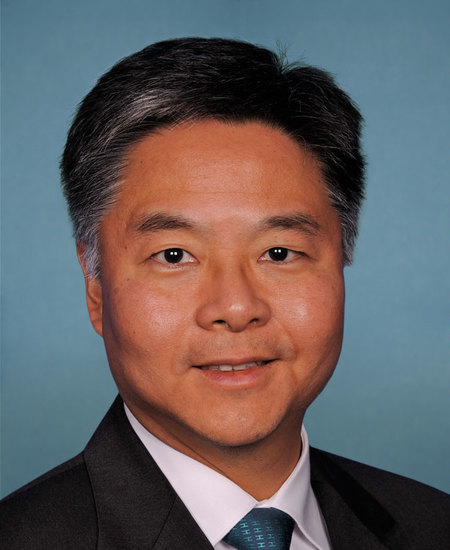
Rep. Ted Lieu
Sponsored bills
Maddy summaryThis bill creates a new process to speed up civil lawsuits where the President is a defendant. It applies specifically to cases involving the President's personal finances or allegations of sexual misconduct, provided the lawsuit meets legal standards. The law requires courts to prioritize these cases, allows parties to request a three-judge panel, and lets appeals go directly to the Supreme Court for fast handling. It does not change the legal standards for the cases themselves, only the procedural path through the courts. This affects plaintiffs bringing such specific claims against the President and the federal courts handling them.
Maddy summaryThis bill requires all public K-12 schools to implement mandatory training for staff on preventing sexual abuse, developing clear rules for appropriate staff-student and student-student relationships, and understanding reporting requirements under Title IX. It directs existing federal education funds to support these programs, with states needing to establish statewide policies by 2025 (two years after enactment). The training covers identifying abuse risks, legal obligations, and prevention strategies. The bill also mandates a federal report within one year of enactment to track abuse incidents and recommend further prevention measures.
Maddy summaryThis bill amends two sections of federal law to strengthen penalties for election interference by government officials. It expands the scope of criminal provisions to explicitly include the President, Vice President, and other executive branch employees (previously limited to lower-level staff), and increases the maximum prison sentence for violations from one year to three years. The changes specifically target actions like coercing political activity or interfering with elections through official authority. These amendments directly affect federal employees, particularly high-level officials in the executive branch, by making certain election-related misconduct criminal offenses with steeper penalties. The bill focuses on clarifying and broadening existing legal protections against election interference by government actors.
Maddy summaryThis bill requires the Bureau of Prisons to develop and implement a strategy for scanning all incoming mail at federal prisons to stop fentanyl and other synthetic drugs from entering facilities. It directs the Bureau to evaluate existing scanning technology within 180 days and submit a detailed plan to Congress within 90 days, including how to provide digital copies of mail to inmates within 24 hours and physical copies within 30 days (if safe). The strategy must achieve 100% mail scanning capacity at all federal prisons, prioritize high-security facilities, and include a budget proposal for fiscal years 2024-2026. This directly affects federal prisons, inmates, and Bureau employees by changing mail processing procedures to enhance safety and reduce staffing burdens from manual mail checks.
Maddy summaryThe Arms Sale Oversight Act (HR 5282) changes how the U.S. House of Representatives votes on arms sales by modifying procedural rules. It requires committees to report on such sales within 10 days or face a motion to discharge the committee (with debate limited to one hour). Once a committee acts, the House must vote with debate capped at 10 hours total, and amendments or reconsideration are prohibited. This bill directly affects the House's process for approving arms sales, setting specific time limits and procedural constraints.
Maddy summaryHR 5277, the Prevent Homelessness Act of 2023, establishes a $100 million annual Housing Stabilization Fund at HUD to provide short-term financial assistance to extremely low-income families (earning less than 30% of area median income) and very low-income families (earning less than 50% of area median income) facing housing crises. The fund provides grants to local homeless service networks to cover immediate housing needs like rent arrears, utility payments, repairs for unsafe living conditions, legal assistance for evictions, and other short-term costs that prevent homelessness. Assistance is limited to 8 months within any 12-month period and must align with local homeless prioritization systems, with funding allocated based on areas with the highest concentrations of low-income and homeless populations. The bill authorizes $100 million annually from fiscal years 2025 through 2029, focusing on stabilizing housing for vulnerable families facing urgent financial hardship.
Lead Endangers Animals Daily Act of 2023 or the LEAD Act of 2023 This bill directs the Department of the Interior to issue final regulations prohibiting the discharge of any firearm using ammunition other than nonlead ammunition on all lands and waters under the jurisdiction and control of the U.S. Fish and Wildlife Service. Interior must establish and annually update a list of nonlead ammunition. The prohibition does not apply to (1) a government official or agent who is carrying out a statutory duty unrelated to the management of wildlife; (2) a state, local, tribal, or federal law enforcement officer, or the agent of such an officer, who is carrying out a statutory duty; or (3) an active member of the U.S. military who is carrying out official duties. A person that knowingly violates the prohibition may be assessed a civil penalty by Interior of (1) no more than $500 for the first violation, and (2) no less than $1,000 or more than $5,000 for a second or subsequent violation.
Maddy summaryThis bill requires the Bureau of Prisons to submit annual reports after major disasters (like natural disasters or public health emergencies) affecting federal or contracted correctional facilities. The reports must detail impacts on inmates and staff, including access to medical care, food, water, and legal visitation; decisions about early release or home confinement; disability accommodations; and repair costs. It also mandates the Bureau to create a corrective action plan for improving emergency preparedness and include specific legislative recommendations. Additionally, the National Institute of Corrections must add new expertise to its board and hold public hearings on integrating disaster planning into facility operations. The bill directly affects federal prisons, contracted facilities, and the inmates/staff within them by standardizing post-disaster reporting and planning.
Maddy summaryThe Housing for All Act of 2023 allocates significant federal funding to address housing shortages and homelessness, with key provisions including $45 billion for the Housing Trust Fund, $40 billion for the HOME Investment Partnerships Program, and 500,000 new housing vouchers in 2024 that will increase to 1 million annually by 2027. The bill directly affects low-income families, people with disabilities, elderly individuals, communities of color, and those experiencing homelessness by expanding rental assistance, supporting permanent housing solutions, and creating new programs like Safe Parking Programs and Eviction Protection Grants. It establishes a Racial Equity Commission to examine structural racism in housing and requires coordination between housing and behavioral health services through new grant programs. The legislation also includes $500 million for converting hotels and commercial spaces into permanent housing and $800 million for legal assistance to prevent evictions. These provisions aim to increase housing stability, reduce homelessness, and address racial disparities in housing access across the United States.