

This resolution rejects the Supreme Court's decisions in the Insular Cases (a series of cases regarding the application of constitutional rights in U.S. territories) and recognizes that constitutional and democratic principles apply throughout the states and territories of the United States.
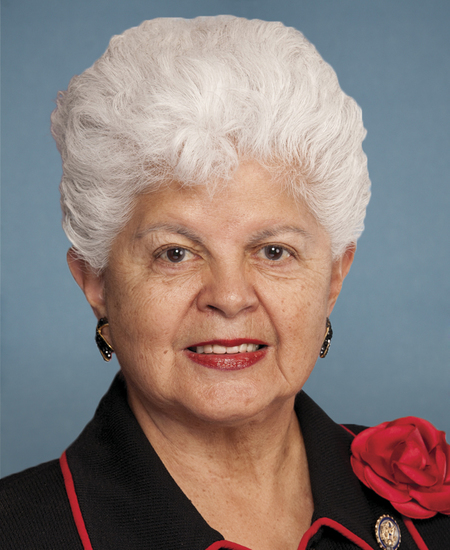
Rep. Grace F. Napolitano
Sponsored bills
Families Belong Together Act This bill provides various immigration benefits for eligible alien parents (or legal guardians) and minor children who were separated by the Department of Homeland Security (DHS) between January 20, 2017, and January 20, 2021. Generally, to be an eligible parent or minor child under this bill, the alien must not be inadmissible for certain crime- or security-related grounds, though DHS may waive certain grounds for humanitarian or public interest reasons. Furthermore, an eligible child who was separated as a minor remains eligible for the immigration benefits after reaching majority. DHS must grant humanitarian parole into the United States to an eligible alien who requests such parole, regardless of whether the alien is physically present in the United States. An eligible alien in the United States may apply for lawful permanent resident status. U.S. Citizenship and Immigration Services shall grant a qualifying alien's lawful permanent resident status within 30 days of receiving the alien's application. An alien who receives lawful permanent resident status under this bill shall be eligible for benefits and services that are available to an alien who is admitted as a refugee. Certain annual numerical limitations shall not apply to aliens who receive lawful permanent resident status under this bill. If an alien seeks judicial review of a denial of an application for lawful permanent resident status under this bill, the Department of Justice shall appoint counsel to represent that alien upon request.
Honduras Human Rights and Anti-Corruption Act of 2021 This bill temporarily imposes sanctions and other penalties on Honduran president Juan Orlando Hernandez and the government of Honduras for systemic corruption and human rights violations, with particular focus on the Honduran police and military. Specifically, the President must impose asset- and visa-blocking sanctions on Juan Orlando Hernandez due to his corrupt practices, including the use of the state apparatus to protect and facilitate drug trafficking. Additionally, the President must prohibit, within 30 days, the issuance of licenses to export defense articles and services and specified munitions to the Honduran police or military. The bill also (1) makes Honduras ineligible for security assistance to equip and train police and military, and (2) requires U.S. representatives at multilateral development banks to oppose any loans for Honduran police or military. Furthermore, the Department of the Treasury must instruct U.S. leadership of international financial institutions and the U.S. International Development Finance Corporation to promote human rights due diligence and risk management in any loan, grant, policy, or strategy related to Honduras. The sanctions and other penalties put in place under this bill terminate in five years but may be lifted earlier if specified conditions are met.
Green New Deals for Cities Act of 2021 This bill authorizes the Department of Housing and Urban Development to provide funding to states, local governments, or Native American nations to carry out Green New Deal projects, such as projects to clean up pollution, climate adaptation measures, or conservation projects on family farms. In order to receive such funding, a state, local government, or Native American nation must have a local Green New Deal program proposal and meet other requirements as specified by the bill. A proposal must contain certain commitments, including a commitment to zero greenhouse gas emissions by 2030 through a fair and just transition for all communities and workers.
Honoring Our Fallen TSA Officers Act This bill extends public safety officers' death benefits to Transportation Security Administration employees performing official duties related to protecting the nation's transportation systems.
Maddy summaryHR 2584, the Judiciary Act of 2021, would change the structure of the U.S. Supreme Court by increasing the number of associate justices from eight to twelve. This bill directly affects the Supreme Court's composition and operations, requiring a quorum of eight justices instead of six to conduct business. The key provision amends Title 28 of the U.S. Code to reflect these numerical changes to the Court's membership and quorum requirements. This is a procedural change to the Court's statutory structure, not a policy affecting the public.
Fair Housing for Domestic Violence and Sexual Assault Survivors Act of 2021 This bill prohibits discrimination against survivors of domestic violence, sexual assault, or sex trafficking in the sale or rental of housing and other related real estate activities.
Immigrants' Mental Health Act of 2021 This bill directs Customs and Border Protection (CBP) to take steps to address mental health issues among immigrants and CBP agents and officers. It also restricts the sharing of mental health information for use in certain immigration proceedings. CBP shall develop training to enable its agents and officers to (1) identify mental health issues and risk factors in immigrants and refugees, (2) provide crisis intervention using a trauma-informed approach, and (3) better manage work-related stress and psychological pressures. CBP shall assign at least one qualified mental or behavioral health expert to each Border Patrol station, port of entry, checkpoint, forward operating base, secondary inspection area, and short-term custody facility. The Department of Health and Human Services may not provide to the Department of Homeland Security information about the mental health of an alien that was obtained by a mental health professional while the alien was in federal government custody if the information will be used for (1) an asylum determination, (2) an immigration hearing, or (3) a deportation hearing.
Healthcare Workforce Resilience Act This bill makes previously unused immigrant visas available to nurses and physicians who petition for such a visa before the date that is 90 days after the end of the declared national emergency relating to the COVID-19 (i.e., coronavirus disease 2019) outbreak. The number of visas available shall be the total number of unused employment-based immigrant visas from FY1992-FY2020, up to 40,000. Of such visas, 25,000 shall be reserved for nurses and 15,000 for physicians. Certain family members may accompany the principal beneficiary of a visa provided under this bill, and visas for such family members shall (1) be made available from the unused visas from FY1992-FY2020, and (2) not be counted against the 40,000 cap. Visas provided under this bill shall be exempt from per-country limitations.
Dignity for Detained Immigrants Act of 2021 This bill directs the Department of Homeland Security (DHS) to establish standards for facilities holding aliens in its custody, phases out using non-DHS facilities for such purposes, and contains other related provisions. The standards shall comply with the American Bar Association's Civil Immigration Detention Standards. The DHS Office of Inspector General (OIG) shall conduct periodic unannounced inspections of each facility and shall take various actions against noncompliant facilities, including imposing fines, cancelling contracts, and closing facilities. DHS shall report to Congress any death of an alien in its custody within 24 hours and conduct an investigation within 30 days that identifies policy changes that could reduce the likelihood of such a death. DHS is prohibited from entering into contracts for third parties to operate detention facilities or alternatives to detention programs and shall terminate existing contracts within three years of the bill's enactment. The bill establishes that OIG facility inspection reports and contracts for an outside entity to operate a detention facility are records available to the public under the Freedom of Information Act. DHS shall maintain certain information relating to detained aliens, including the alien's location and whether the alien was separated from family. The bill provides for various requirements and procedures related to detaining aliens, including (1) prohibiting DHS from detaining children, (2) imposing a presumption that an alien should be released, and (3) establishing that aliens in custody shall be subject to the least restrictive conditions. The bill also abolishes mandatory detention for asylum seekers.