

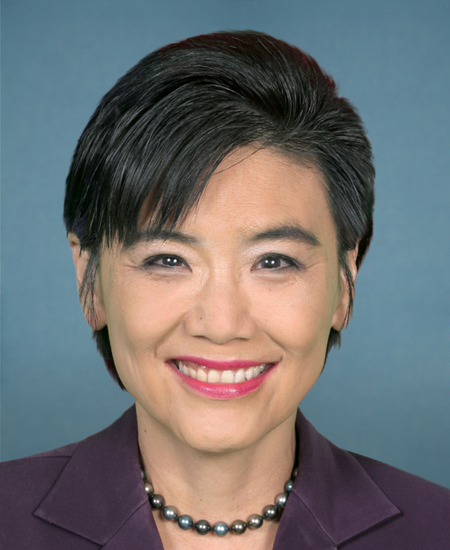
Photo of Judy Chu
D United States House · District 28 · California On the 2026 ballot

Rep. Judy Chu

Compare
Total votes
2,837
all sessions
Attendance
99%
30 missed
Higher than 89% of chamber peers
With party
98%
of cast votes
Higher than 80% of chamber peers
Bipartisan score
1%
crosses aisle rarely
Lower than 80% of chamber peers
Sponsored
2,360
bills & resolutions
Higher than 96% of chamber peers
Committees
5
assignments
2,360 bills and resolutions

Sponsored bills

Total
2,360
Primary
124
Co-sponsor
2,236
This page
2,360
matching current filters
Co-sponsor HR 694
In committee · United States House · Co-sponsor
Job Protection Act

Maddy summaryHR 694, the Job Protection Act, expands access to family and medical leave under the FMLA by reducing eligibility requirements. It lowers the required employment period from 12 months to 90 days for most workers and removes the 50-employee threshold, requiring all employers (including small businesses with one or more employees) to provide leave. Federal, presidential, and congressional employees also see their eligibility thresholds reduced to 90 days. The bill directly affects millions of private-sector workers and small businesses nationwide by making existing leave protections more widely available. It makes no changes to leave duration or pay, only to who qualifies and which employers must comply.

In committee Feb 1, 2023 1 co-sponsor
Co-sponsor HRES 77
In committee · United States House · Co-sponsor
Embracing the goals and provisions of the Treaty on the Prohibition of Nuclear Weapons.

Maddy summaryHRES 77 is a non-binding House resolution expressing support for the Treaty on the Prohibition of Nuclear Weapons. It calls on the President to make nuclear disarmament central to U.S. national security policy and urges specific actions: pursuing new arms control talks with Russia and China, renouncing first-use of nuclear weapons, ending the president’s sole authority to launch nukes, removing weapons from hair-trigger alert, and canceling plans to modernize the U.S. nuclear arsenal. The resolution directly addresses the President, Secretary of State, Secretary of Defense, and other federal leaders, urging them to lead global efforts to reduce nuclear risks. It does not create new laws or policies but formally endorses the treaty’s goals and outlines concrete steps for U.S. nuclear policy reform.

In committee Jan 31, 2023 1 co-sponsor
Co-sponsor HR 660
In committee · United States House · Co-sponsor
Ethan's Law

Maddy summaryHR 660, "Ethan's Law," requires gun owners in homes where minors (under 18) or individuals prohibited from owning firearms under federal/state law reside to store firearms securely. It makes unsecured storage unlawful if a minor or prohibited person could access the firearm, with fines of $500 per violation and enhanced penalties (up to 5 years in prison) if injury or death occurs. The bill also establishes a federal grant program to help states implement similar secure storage laws and provides funding incentives for states that already have such laws in place.

In committee Jan 31, 2023 1 co-sponsor
Co-sponsor HR 666
In committee · United States House · Co-sponsor
Access to Counsel Act

Maddy summaryHR 666, the Access to Counsel Act, requires U.S. immigration officers to provide certain travelers a meaningful opportunity to consult with legal counsel within one hour of starting secondary inspection at ports of entry. It directly affects travelers including U.S. citizens, lawful permanent residents returning from abroad, visa holders, refugees, and parolees seeking entry. Key provisions mandate phone access to counsel, allow advocates to present evidence to officers, and require in-person meetings when possible. Lawful permanent residents cannot abandon their status without first consulting a lawyer unless they waive this right in writing. The bill takes effect 180 days after enactment.

In committee Jan 31, 2023 1 co-sponsor
Co-sponsor HR 669
In committee · United States House · Co-sponsor
Restricting First Use of Nuclear Weapons Act of 2023

Maddy summaryThis bill requires Congress to declare war before the U.S. can conduct a first-use nuclear strike - meaning a nuclear attack launched without prior nuclear retaliation against the U.S., its territories, or allies. It prohibits using federal funds for such strikes unless explicitly authorized by a congressional declaration of war. The bill directly affects the President’s authority to order nuclear weapons use and the military’s execution of such orders, reinforcing constitutional war powers. It defines "first-use" strictly to prevent unilateral action absent congressional approval, aiming to create a clear legal check on nuclear decision-making.

In committee Jan 31, 2023 1 co-sponsor
Co-sponsor HR 582
Passed · United States House · Co-sponsor
Credit Union Board Modernization Act

Maddy summaryHR 582, the Credit Union Board Modernization Act, changes the required meeting frequency for boards of directors at federal credit unions. It replaces a simple "monthly" requirement with tiered schedules based on each credit union's performance rating under the Uniform Financial Institutions Rating System. Top-rated credit unions (ratings 1 or 2) must meet at least six times yearly, with one meeting per fiscal quarter. Lower-rated credit unions (ratings 3, 4, or 5) must meet monthly, and new credit unions must meet monthly for their first five years. This directly affects all federal credit unions by adjusting their board meeting obligations based on their regulatory rating.

Passed Jan 31, 2023 1 co-sponsor
Co-sponsor HRES 74
In committee · United States House · Co-sponsor
Recognizing the importance of establishing a national "Fred Korematsu Day of Civil Liberties and the Constitution".

Maddy summaryHRES 74 is a non-binding House resolution recognizing Fred Korematsu's lifelong fight for civil liberties, particularly his 1944 legal challenge to the WWII internment of Japanese Americans. It encourages the establishment of a national "Fred Korematsu Day of Civil Liberties and the Constitution" to be observed annually on January 30 (his birthday), promoting reflection on protecting rights during national security crises. The resolution highlights Korematsu's role in exposing government misconduct during the internment and his later warnings against post-9/11 civil liberties violations. It does not create new laws or affect specific groups but urges civic education on constitutional principles. (3 sentences)

In committee Jan 30, 2023 1 co-sponsor
Co-sponsor HR 639
In committee · United States House · Co-sponsor
Korematsu-Takai Civil Liberties Protection Act of 2023

Korematsu-Takai Civil Liberties Protection Act of 2023 This bill prohibits the detention or imprisonment of an individual based solely on an actual or perceived protected characteristic of the individual. The term protected characteristic includes each of the following: race, ethnicity, national origin, religion, sex, gender identity, sexual orientation, disability, and any additional characteristic that the Department of Justice determines to be a protected characteristic.

In committee Jan 30, 2023 1 co-sponsor
Co-sponsor HR 640
In committee · United States House · Co-sponsor
Fred Korematsu Congressional Gold Medal Act of 2023

Maddy summaryHR 640 authorizes the posthumous award of a Congressional Gold Medal to Fred Korematsu, a Japanese American civil rights advocate who challenged the World War II internment of Japanese Americans. The bill directs the Treasury Secretary to mint a gold medal bearing Korematsu's image and name, which will be displayed at the Smithsonian Institution. This commemorative measure recognizes Korematsu's lifelong advocacy against racial discrimination and his role in exposing the government's misleading actions during his 1944 Supreme Court case. The medal is a symbolic tribute, not a policy change, and does not affect any individuals or laws.

In committee Jan 30, 2023 1 co-sponsor
Co-sponsor HR 625
In committee · United States House · Co-sponsor
Keep Americans Safe Act

Maddy summaryThis bill prohibits the possession, sale, or transfer of most large-capacity ammunition magazines (holding more than 15 rounds) for the general public, while exempting law enforcement officers (including campus security officers), retired officers, and certain licensed entities like nuclear facility security. It requires new magazines manufactured after enactment to have serial numbers and manufacturing dates, and allows federal grant funds to support buy-back programs for these devices. Existing owners of such magazines lawfully possessed before the law's enactment are exempt from the prohibition. The law applies to devices not already covered under current exemptions for law enforcement, nuclear security, and retired officers.

In committee Jan 30, 2023 1 co-sponsor
Showing 1,471 to 1,480 of 2,360 bills