

Maddy summaryHR 251 renames the Department of Veterans Affairs outpatient clinic in Vallejo, California, as the "Delphine Metcalf-Foster VA Clinic." This bill updates all official U.S. government references - such as laws, maps, and documents - to reflect the new name. It directly affects the Vallejo clinic and its administrative records, with no policy changes or financial impact. The bill is purely procedural, honoring Delphine Metcalf-Foster through the clinic's designation.
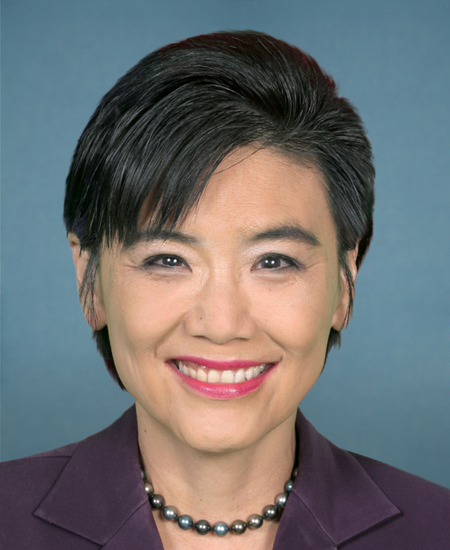
Rep. Judy Chu
Sponsored bills
This resolution condemns Iranian state-sponsored terrorist attacks against U.S. citizens and officials and Iranian dissidents. The resolution also expresses support for the people of Iran who are legitimately defending their rights for freedom against repression and condemns the killing of Iranian protesters by the Iranian regime.
Maddy summaryThe Better Care Better Jobs Act (HR 547) aims to improve access to home and community-based services (HCBS) for Medicaid beneficiaries by providing states with planning grants and enhanced federal funding. States that develop approved HCBS infrastructure improvement plans will receive a 10 percentage point increase in federal Medicaid funding for HCBS services, with additional incentives for self-directed care programs. The bill requires states to address barriers to access, expand workforce development, improve payment rates for direct care workers, and track demographic data on service utilization. It also establishes quality measurement requirements and mandates regular reporting on progress toward improving HCBS access and quality.
Maddy summaryHR 770, the ESP Family Leave Act, amends the Family and Medical Leave Act (FMLA) to create specific eligibility rules for education support professionals and school support staff in public schools and public higher education institutions. It changes the standard FMLA work-hour requirement (1,250 hours) to a new threshold: these workers qualify if they've worked at least 60% of their expected monthly hours for the previous school year. Employers must maintain records of each employee's expected monthly hours, and the bill defines "education support professionals" to include roles like paraeducators, secretaries, custodians, food service workers, security staff, and health support staff. The bill directly affects these support staff members, making it easier for them to qualify for FMLA leave under the revised hours calculation.
Maddy summaryHR 785 requires construction employers to provide each employee with at least one 15-minute paid rest break for every four hours worked. It directly affects construction workers performing general construction services (like building erection, remodeling, or demolition) by mandating these breaks and requiring employers to provide written notice in the employee's primary language about their rights. Employers must also display bilingual (English/Spanish) signs at worksites explaining break entitlements, prohibiting retaliation for taking breaks, and outlining complaint procedures. The bill does not override stricter state or local laws requiring longer breaks and explicitly defines "rest break" to exclude regular meal periods.
Maddy summaryHR 791, the American Music Fairness Act of 2023, requires terrestrial radio stations (AM/FM) to pay royalties for playing music, aligning their payment obligations with those of internet streaming services. It directly affects small local radio stations by establishing low annual fees: $10 for stations with under $100,000 annual revenue, $100 for public broadcasters with $100k-$1.5M revenue, and $500 for other stations in that revenue range. The bill ensures songwriters’ existing royalty rights remain unaffected (Section 6) and mandates that royalty rates for radio be set using economic data, including how radio promotion might impact music sales. This creates a new statutory royalty structure while protecting small broadcasters through tiered, low-cost payment tiers.
Maddy summaryHR 765, the African American History Act, authorizes $2 million annually for the National Museum of African American History and Culture to develop educational resources and programs about African American history. The bill directs the museum to create accessible teaching materials, support teacher professional development, and expand digital content for schools and the public, focusing on contributions, civil rights, and historical contexts. It requires annual reports to Congress and expires in 2028. The program directly supports educators, students, and families in learning about African American history through museums, schools, and online platforms.
This resolution states that the House of Representatives condemns the February 1, 2021, military coup in Burma (Myanmar) and denounces the Burmese military for human rights violations. The resolution calls on the Burmese military to end violence against prodemocracy activists and release political prisoners.
Maddy summaryHR 715, the Bipartisan Background Checks Act of 2023, requires background checks for all firearm transfers between private individuals, not just those through licensed dealers. It mandates that unlicensed sellers must involve a licensed dealer to conduct a background check before transferring a firearm, with exceptions for family transfers (like spouses or parents/children), law enforcement, temporary safety transfers, and certain hunting or range activities. The bill also requires licensed dealers to provide a notice and certification form in both English and Spanish to buyers. It explicitly states it won't create a national gun registry or override state laws on the same topic. The law would take effect 180 days after enactment.
Maddy summaryThis bill helps new car dealers affected by pandemic-era supply chain disruptions by changing tax rules for inventory sales. It allows dealers using LIFO accounting to treat certain sales of unsold vehicles (liquidations) between March 2020 and December 2021 as "qualified" for tax purposes. Dealers can defer recognizing income from these sales and have until 2026 to replace the sold vehicles before potential tax adjustments apply. The provision specifically targets dealers who couldn't replenish inventory during the supply chain crisis.