

Maddy summaryThis bill creates a federal grant program to fund supportive services for residents in affordable housing properties. It provides 5-year competitive grants to non-profit organizations or tribes managing properties assisted by programs like the low-income housing tax credit or Section 8 housing. Grantees must use at least 25% of funds for staff salaries/benefits and can cover services including health access, education, financial literacy, aging-in-place support, and disability services - though residents cannot be required to accept these services. The program targets residents of qualifying affordable housing properties, focusing on improving health, economic stability, and community integration.
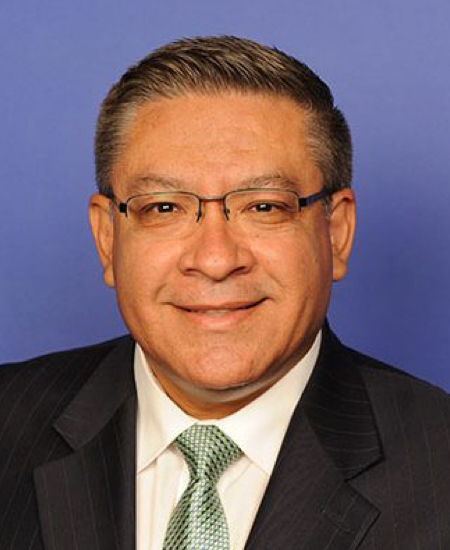
Rep. Salud O. Carbajal
Sponsored bills
Maddy summaryHRES 1437 is a ceremonial resolution designating the week beginning September 9, 2024, as "National Hispanic-Serving Institutions Week." It recognizes Hispanic-serving institutions (HSIs) - colleges and universities with at least 25% Hispanic enrollment - and their role in educating low-income students, advancing economic mobility, and serving 31.7% of all undergraduate students. The resolution calls for the public and organizations to observe this week with ceremonies and activities during Hispanic Heritage Month. It does not create new laws, allocate funding, or change existing policies - it is purely a symbolic gesture of recognition.
Maddy summaryThis bill designates the U.S. Postal Service facility at 130 South Patterson Avenue in Santa Barbara, California, as the "Brigadier General Frederick R. Lopez Post Office Building." It updates all official U.S. government references to the building to reflect this new name, with no policy changes or funding impacts.
Maddy summaryThis bill amends the Disabled Veterans' Outreach Program to expand eligibility for career services to include Gold Star spouses (spouses of service members who died while on active duty) and surviving spouses (spouses of veterans who died from service-connected causes). It updates existing program language to replace references to "veterans" with "veterans or eligible persons" and adds a new definition clarifying that "eligible person" includes these spouses. The change directly affects spouses who lost their partners in military service, allowing them to access the same career counseling and job placement services previously available only to veterans. The bill modifies existing program provisions without creating new services or funding.
Maddy summaryHRES 1432 designates September 10, 2024, as "National Firearm Suicide Prevention Day" to raise public awareness about firearm suicides and promote safe storage practices. The resolution encourages healthcare professionals to discuss safe firearm storage with patients and supports the day's goals of reducing firearm suicides through education. It directly affects the general public and healthcare providers by highlighting evidence that safe storage lowers suicide risk, referencing statistics like 54.6% of U.S. suicides in 2022 involving firearms. The bill is symbolic, with no new legal requirements, and aligns with existing awareness efforts like Firearm Suicide Prevention Day.
Maddy summaryThis bill (HR 9517) ensures that military service members and Department of Defense civilians who had student loans in deferment during active duty service have those months counted toward Public Service Loan Forgiveness (PSLF). It amends the Higher Education Act to automatically include months of deferment under active duty as qualifying payments for PSLF, without requiring additional action from borrowers. The bill also requires the Departments of Defense and Education to jointly identify eligible individuals through data matching and certify their service periods for PSLF eligibility. This directly affects active-duty service members and civilian personnel who served over 30 consecutive days on or after October 1, 2007.
Maddy summaryThe Stand with Ukraine Act of 2024 establishes a framework for sustained U.S. security assistance to Ukraine in response to Russia's invasion. It endorses a 10-year bilateral security agreement and directs the U.S. government to provide military equipment, training, and security assistance to strengthen Ukraine's defense capabilities against Russian aggression. Key provisions include treating Ukraine as a major non-NATO ally for defense transfers, fast-tracking military sales through the Foreign Military Sales program, and creating mechanisms to prioritize defense article transfers. The bill also includes specific support for Ukraine's recovery, reconstruction, and demining efforts following the conflict. This legislation directly affects U.S. foreign policy implementation, military assistance programs, and Ukraine's ability to build a credible defense against Russian threats.
Maddy summaryHR 8312, the Combat Veterans Pre-Enrollment Act of 2024, creates a 3-year pilot program allowing eligible combat veterans to pre-enroll in the VA healthcare system before separating from active duty. It directly affects service members who would qualify for VA healthcare upon separation and meet specific combat-related service criteria under existing law. The bill establishes a mechanism during the 180 days before separation, requiring coordination between VA, Defense, and Homeland Security to facilitate pre-enrollment. The program includes reporting requirements for participation rates, demographics, and a GAO evaluation of effectiveness after the pilot ends in 2027.
Maddy summaryThe School Hunger Elimination Act of 2024 automatically certifies children for free or reduced-price school meals if they are already receiving Medicaid benefits (with household income at or below 133% of the federal poverty line for free meals) or Supplemental Security Income (SSI). It requires states to establish data-sharing agreements with Medicaid agencies by the 2025 school year, eliminating the need for families to submit separate applications for meal eligibility. This change directly affects children in low-income households already enrolled in Medicaid or SSI, streamlining access to school meals without additional paperwork.
Maddy summaryHR 8447, the American Agricultural Security Act of 2024, establishes new agricultural research centers of excellence to address key security threats. These centers, hosted by eligible institutions like land-grant universities and Hispanic-serving colleges, focus on four areas: biosecurity/cybersecurity for the food supply, agricultural engineering, digital agriculture (including AI), and foreign animal diseases. The bill requires geographic diversity in center locations, mandates partnerships with federal agencies and industry to avoid duplication, and allocates $10 million annually for fiscal years 2025-2029. It also creates a separate grant program to fund research on protecting the food system from threats, with annual reporting requirements to Congress.